How to Know When It’s Time for a Residential Treatment Program

How to Know When It’s Time for a Residential Treatment Program

You didn’t think you’d ever have to Google this.
You’re the parent who shows up. You’ve sat through therapy sessions. You’ve read every article. You’ve called every hotline. You’ve listened when your child didn’t want to talk and spoken gently when they needed boundaries. And still—things are getting worse.

Maybe your young adult is spiraling—substance use, mental health crashes, aggressive outbursts, withdrawal from life. Maybe it’s been building quietly over time. Or maybe you’re coming off another terrifying night and wondering if this is finally the line.

And now, with your heart in your throat, you’re asking: Is it time for residential treatment?

At Greylock Recovery in Williamstown, Massachusetts, we meet parents at this exact point every day—tired, heartbroken, but still fighting for their kids. This blog will help you know what to watch for, what this kind of care actually means, and why it’s not giving up—it’s stepping in.

When Love Isn’t Enough—and Home Isn’t Safe

You’ve done everything you know how to do. And if you’re reading this, it’s probably because your child’s situation has passed the point of “normal struggle.”

Maybe their mood swings have become violent. Maybe you’ve found drugs, or they’ve admitted to using. Maybe they’ve stopped showing up to class, work, meals, or even leaving their room. Or maybe their mental health has deteriorated to the point where they say things that make your stomach drop.

You know your child. You know when something is just a phase—and when something is spiraling.

Residential care becomes a need when:

  • The crisis keeps repeating itself
  • Your home feels more like a pressure cooker than a refuge
  • Safety—physical or emotional—is no longer guaranteed

This isn’t about not loving them enough. It’s about loving them enough to act.
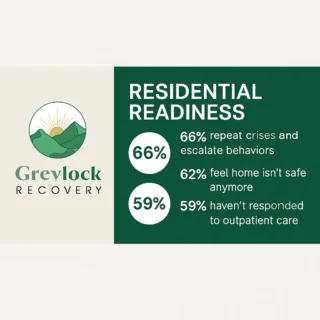
Residential Readiness Stats

Red Flags That Outpatient Just Isn’t Cutting It

Most families start with outpatient therapy. And for many, it works.

But if your child…

  • Won’t go to sessions (or lies about it),
  • Leaves therapy angry or numb,
  • Gets worse between visits,
  • Or seems totally disconnected from any effort to get better…

…it may be time to level up care.

Outpatient therapy is not designed for crisis containment. It’s a long-term support strategy. But when your child’s condition is acute—meaning it’s escalating fast, risking safety, or deeply impairing daily life—residential treatment offers the intensity and containment outpatient care can’t.

What Residential Treatment Actually Offers

This isn’t boot camp. It’s not a warehouse. And it’s not about locking your child away.

A high-quality residential treatment program provides:

  • 24/7 emotional and clinical support
  • Medication monitoring (if needed)
  • Structured daily routines
  • A break from peer, tech, or environmental triggers
  • Intensive therapy in group and individual formats
  • Support for co-occurring issues (anxiety, depression, trauma, ADHD, substance use)

At Greylock Recovery, we treat each young adult with the respect they haven’t felt in a while. Because many kids who act out are hurting more deeply than they’ll ever admit—and they’ve stopped believing anyone can help.

We start by earning trust. We build routine around chaos. And then, slowly, we help them re-engage with themselves.

When You’re the One Falling Apart

This isn’t just hard on them—it’s brutal on you.

You’re walking around with your phone always charged, always near. You’re sleeping light. You’re rehearsing conversations. You’re waiting for the next crisis and praying it’s not the one.

And sometimes, you’re mourning the version of your child that used to laugh, engage, try, dream.

You may be:

  • Doing damage control at school, with family, or with other siblings
  • Grieving milestones that are slipping away
  • Losing your sense of confidence as a parent
  • Scared to even ask for help because you fear being judged

We see you.

Residential care isn’t just about your child—it’s about giving you room to breathe. To recover your strength. To stop feeling like you’re one meltdown away from collapse.

What “Readiness” Actually Looks Like

Parents often wait for a moment of clarity. A rock bottom. A breakdown that’s “bad enough.”

But readiness for residential care doesn’t always come in big, dramatic forms.

Sometimes it looks like:

  • Another hospital visit that ends in discharge with no plan
  • A therapist saying, “I don’t know if I can help them anymore”
  • Your gut telling you, This can’t go on like this
  • Your child saying, “I don’t care if I wake up tomorrow”—or not saying anything at all

You don’t need to wait for a catastrophe to act. You just need to trust what you already know: your child needs more than what’s available right now.

Success Is Slow—But It’s Real

This isn’t a quick fix.

Most young adults don’t enter residential care with open arms. They push back. They resist. They say nothing will help. That’s normal.

But we’ve seen what happens when the noise clears and the survival brain quiets.

We’ve watched:

  • A 19-year-old who hadn’t been to class in a year start sketching again and applying to local colleges
  • A 17-year-old who tried to run away on day one stay for 60 days, then hug their parent at discharge
  • A 21-year-old finally say out loud, “I want to stay alive—but I don’t know how”

These aren’t magic turnarounds. They’re hard-earned, step-by-step openings to change.

FAQs: Residential Care for Crisis-Stage Families

How do I know for sure that my child needs residential care?
If your child is in danger, refusing care, or declining even with outpatient support, residential care is worth considering. We can help you assess the situation, not pressure you.

What if my child refuses to go?
That’s common. We can help you set boundaries, explore legal or clinical options, and provide strategies for motivating participation without escalating conflict.

Is this a punishment?
No. This is about safety and healing. We treat every client with respect, autonomy, and clinical support. This is not about blame—it’s about giving them what home can’t right now.

How long will my child be in care?
Programs vary, but most clients stay between 30–90 days. Some transition into outpatient care after, while others may need extended support. We create individualized plans.

What’s my role during the process?
You’ll be involved. Most programs include family therapy, communication coaching, and re-entry planning. You are not being pushed out—you are being supported, too.

This Is Still Your Child—and There’s Still Time

It might feel like they’ve disappeared. Like the version of your child you loved is gone.

But we promise you: they’re still in there. Scared. Angry. Shut down. But reachable.

And you don’t have to wait for one more worst-case scenario to act.

You’re allowed to say, We need help. You’re allowed to say, We can’t do this alone anymore. And you’re allowed to believe that healing is still possible—even if today feels like the end of the rope.

You don’t have to hold this alone anymore.
Call us at (413) 848-6013 or visit Greylock Recovery’s residential treatment program in Williamstown, Massachusetts to learn how we help families find stability, hope, and real change—together.
Call to Connect

You don’t have to be ready for everything. You just have to be ready for one step.

Call Our Free

24 Hour Helpline
Get The Help You Need
Counselors are standing by

Jody Kocsis is a dependable team member dedicated to maintaining a safe, clean, and efficient facility environment. With a strong attention to detail and a commitment to quality, Jody supports daily operations and ensures a positive experience for all.

Eric Simmons is the Director of Case Management at Greylock Recovery, bringing more than 15 years of experience in behavioral health, substance use disorder treatment, residential programming, admissions, and case management. He has led program operations, patient advocacy initiatives, staff development, and outcome improvement efforts across residential and human service settings.

Prior to Greylock Recovery, Eric served as Director of Residential and Admissions Services for a local Berkshire county recovery facility, overseeing residential operations, admissions, referral development, and regulatory compliance. His expertise includes case management, discharge planning, community resource development, compliance, and staff training.

Eric earned a Bachelor of Arts in Sociology from Westfield State University, graduating Magna Cum Laude. He is committed to helping individuals overcome barriers to recovery and achieve lasting stability, while also serving his community as a youth football coach and mentor.

Jennifer Parsons is a seasoned human resources executive with more than 15 years of experience leading strategic HR initiatives, talent management, employee relations, and organizational development. Most recently, she served as Senior Vice President of Human Resources at Pittsfield Cooperative Bank, where she played a key role in fostering a positive workplace culture and supporting the organization’s growth and success.

Jennifer holds the Senior Professional in Human Resources (SPHR) certification from the Human Resource Certification Institute (HRCI), demonstrating her expertise and commitment to excellence in the HR profession. She also earned an associate’s degree in both Business Administration and Hospitality Administration, providing a strong foundation in leadership, operations, and customer service.

A Berkshire County native, Jennifer is deeply committed to her community and currently resides in the region with her family. In addition to her professional accomplishments, she serves on the Board of Directors for the Gladys Allen Brigham Center in Pittsfield, supporting the organization’s mission to empower women and strengthen the Community.

Jennifer Walker has been caring for others since 1989, starting out as a nurse’s aide and working her way through roles as a medical assistant, LPN, and RN. Along the way, she earned an associate’s degree in business administration and gathered an impressive range of experience—from primary care and long-term care to neurosurgery, neurology, colorectal surgery, orthopedics, and hospital-based surgical services. She’s also spent seven years helping individuals overcome substance use disorders, including time as a Director of Nursing, and has worked in hospice and with patients with disabilities.

But Jennifer’s dedication to people goes far beyond the workplace. A former foster parent and active supporter of local charities, she pours her heart into her community. When she’s not in scrubs, you can find her cheering at a sports game, tending to her garden, or enjoying laughter-filled moments with her family. Her blend of skill, heart, and positivity makes her not just a caregiver, but a true bright light for everyone she meets.

Elizabeth Azzariti, LICSW,

Elizabeth Azzariti, LICSW, is a seasoned clinical leader with over 10 years of experience in treating behavioral and addiction issues. After a successful 25-year career in the insurance industry, where she advanced to VP of Finance and Administration, she returned to school, earned her Master of Social Work from Wheelock College, and launched a new career dedicated to behavioral health. In her new role as Clinical Director at Greylock Recovery, she brings deep expertise in clinical operations, program development, and multidisciplinary team leadership. Most recently, as Executive Director at Nulife Behavioral Health, she served as both Clinical and Executive Director, leading the launch of PHP, IOP, TMS, Alumni, and Family programs while overseeing clinical staff hiring, supervision, and operations. She designed and implemented a 16-week evidence-based curriculum for co-occurring disorders that boosted attendance, retention, and patient outcomes. Her prior leadership roles include Clinical Supervisor at Blue Hills Recovery—directing multidisciplinary teams across PHP, IOP, and 24/7 residential programs—and at New England Recovery Center. EMDR-trained and specializing in trauma-informed care and integrated treatment, Elizabeth is passionate about delivering high-quality clinical care that supports lasting recovery for individuals and families.

Flora Sadri-Azarbayejani’s journey in the field of healthcare began at Boston University, where she earned her undergraduate degree in biomedical engineering.

Dr. Sadri-Azarbayejani pursued dual master’s degrees at Boston University, specializing in epidemiology and biostatistics, and medical science. She then attained her doctorate in medicine from the University of New England College of Osteopathic Medicine. Dr. Sadri-Azarbayejani’s professional career commenced as an epidemiologist in infectious disease at the Massachusetts Department of Public Health.

Eventually appointed as the Chief Medical Officer.She became board certified in addiction medicine and worked in the addiction space since 2014. She has worked both inpatient and outpatient addiction medicine. Opening programs in both arenas.

Currently serves as the medical director for substance use services at Lowell Community Health Center and for an inpatient addiction treatment center. Dr. Sadri-Azarbayejani is an active and engaged member of various medical societies, including the Massachusetts Medical Society, the American Academy of Family Physicians (AAFP), and the American Society of Addiction Medicine (ASAM).

Involved with development of CARF guidelines for outpatient addiction treatment programs. She also hopes to make an impact on passing legislation of supervised consumption sites in the near future.

Lauren Temple is a Licensed Clinical Social Worker (LICSW) bringing over 15 years of dedicated leadership in the behavioral health sector, with extensive expertise spanning inpatient, outpatient, and substance use disorder programming. She obtained her Master of Science in Social Administration from Case Western Reserve University and holds dual licensure as an LICSW in Massachusetts and an LISW-S in Ohio. Serving as the Executive Director for Greylock Recovery, Lauren manages clinical operations, regulatory adherence, and strategic growth to uphold the highest standards of patient-centric treatment.

Her professional background includes directing diverse clinical teams, broadening service accessibility, and overseeing quality improvement efforts while navigating complex accreditation and state regulatory cycles. Lauren remains deeply invested in cultivating elite clinical staff, improving recovery metrics, and championing evidence-based advancements in behavioral health care.