


If you’ve been taking Klonopin regularly, it’s natural to wonder how long it stays in your body and what that means if you’re thinking about stopping. Many people ask this question because they’re concerned about side effects, drug tests, or the safest way to discontinue the medication.
If you’ve searched how long does Klonopin stay in your system, you’re not alone. Understanding how clonazepam is processed can help explain why healthcare providers recommend a slow, supervised taper rather than stopping suddenly. If you’re exploring benzodiazepine addiction treatment, learning how Klonopin works is an important first step. Greylock Recovery also offers comprehensive addiction treatment in western Massachusetts for individuals seeking safe, evidence-based care.
What Is Klonopin?
Klonopin is the brand name for clonazepam, a prescription medication that belongs to a class of drugs called benzodiazepines.
It is commonly prescribed to treat:
- Panic disorder
- Certain anxiety disorders
- Seizure disorders
- Some movement disorders
Klonopin works by increasing the activity of gamma-aminobutyric acid (GABA), a neurotransmitter that helps calm excessive activity in the brain.
For many people, it is an effective medication when taken exactly as prescribed. However, because the brain adapts to its effects over time, regular use can lead to physical dependence, making it important to stop only under medical supervision.
How Long Does Klonopin Stay in Your System?
Klonopin remains in the body longer than many other benzodiazepines.
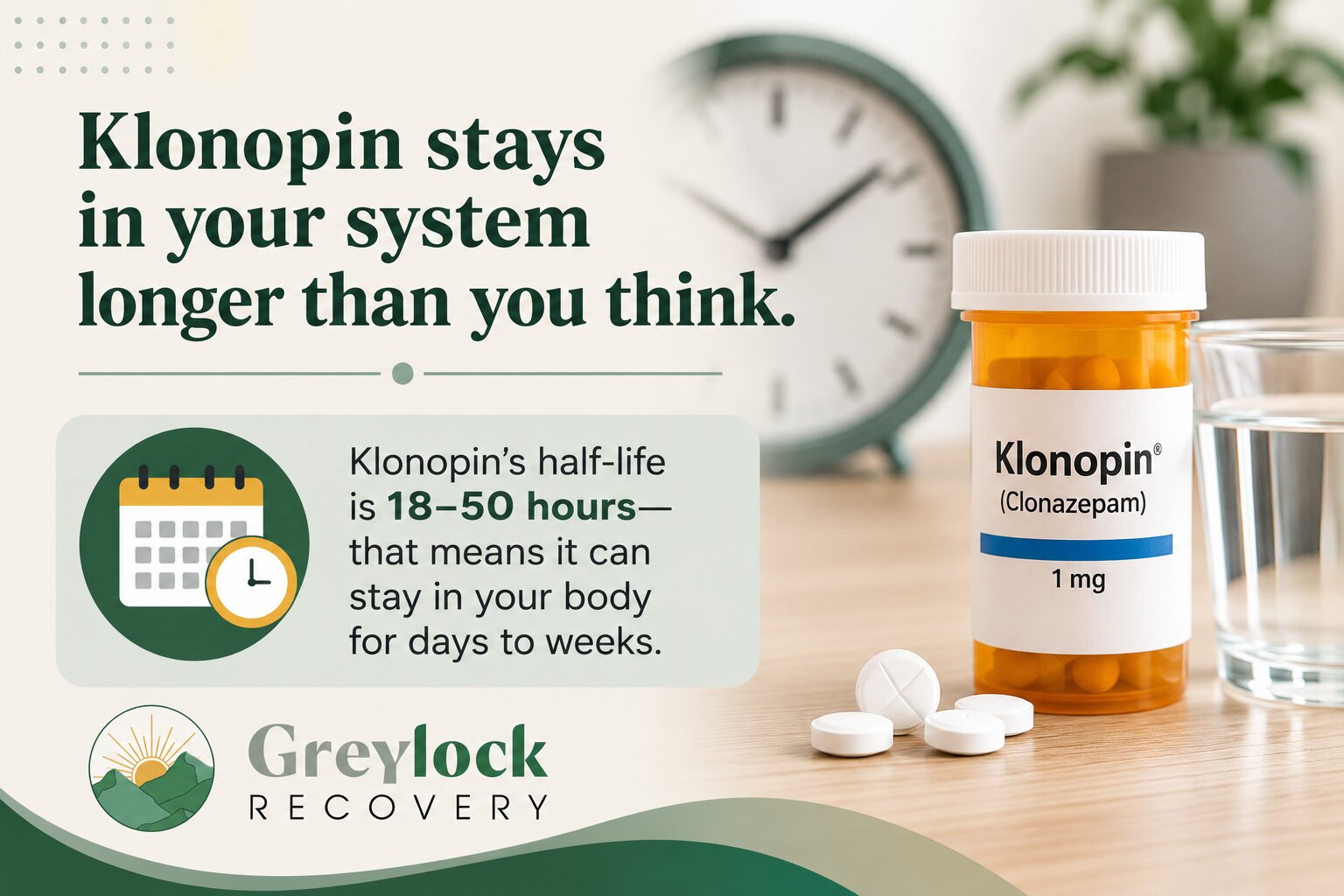
Its average half-life ranges from approximately 18 to 50 hours, making it one of the longest-acting medications in its class.
A drug’s half-life is the amount of time it takes for half of the medication to be eliminated from the bloodstream.
Since several half-lives are needed before most of the medication leaves the body, Klonopin may remain present for several days after the last dose, even though its noticeable effects may wear off sooner.
This long half-life is one reason healthcare providers often prescribe it for conditions that require consistent symptom control.
Klonopin Detection Windows
Many people are also curious about how long clonazepam can be detected on drug tests.
Detection times vary depending on the testing method, the person’s metabolism, and how long the medication has been used.
Urine
Urine testing is the most common method.
Klonopin may be detectable for:
- Approximately 5 to 7 days after occasional use
- Up to four weeks after prolonged or heavy use
Blood
Blood tests generally detect Klonopin for approximately 2 to 3 days after the last dose.
Saliva
Saliva testing typically detects clonazepam for 1 to 5 days, although testing methods vary.
Hair
Hair testing can identify previous Klonopin use for up to 90 days.
It’s important to remember that detection windows indicate only whether medication may still be present. They do not show whether someone is impaired or whether they are taking the medication appropriately under medical supervision.
What Affects How Quickly Klonopin Leaves the Body?
No two people eliminate medications at exactly the same rate.
Several factors influence how quickly clonazepam is cleared.
Dose
Higher doses generally require more time for the body to eliminate.
Frequency of Use
Someone taking Klonopin daily for months will usually clear it more slowly than someone who has taken only a few doses.
Length of Treatment
Long-term use allows the body to adapt to the medication, which can influence both clearance and withdrawal timing.
Metabolism
Individual differences in liver enzyme activity affect how quickly clonazepam is broken down.
Age
Older adults often metabolize medications more slowly than younger individuals.
Liver Function
Because Klonopin is processed primarily by the liver, reduced liver function may prolong how long it remains in the body.
Why the Long Half-Life Matters for Tapering
One of the most important reasons people ask about how long does Klonopin stay in your system is because they’re considering stopping the medication.
This is where the long half-life becomes especially important.
Unlike short-acting benzodiazepines, Klonopin withdrawal often does not begin immediately after the last dose.
For many people, withdrawal symptoms may not appear for several days because significant amounts of the medication are still circulating in the body.
This delayed onset sometimes causes people to believe they can stop safely on their own—only to experience worsening symptoms days later.
Healthcare providers account for this pattern when developing taper schedules.
Rather than stopping abruptly, they gradually reduce the dose over weeks or months so the brain has time to adjust safely.
Why Stopping Klonopin Suddenly Can Be Dangerous
Benzodiazepines affect brain chemistry in ways that require careful medical management during discontinuation.
Stopping Klonopin abruptly after regular use can increase the risk of withdrawal symptoms such as:
- Severe anxiety
- Panic attacks
- Tremors
- Insomnia
- Sweating
- Muscle stiffness
- Irritability
- Sensitivity to light and sound
In more serious cases, abrupt discontinuation may lead to:
- Hallucinations
- Seizures
- Delirium
Because withdrawal severity cannot always be predicted, medical supervision is strongly recommended whenever someone who has been taking Klonopin regularly plans to stop.
What a Supervised Taper Looks Like
A supervised taper is designed to reduce withdrawal symptoms while allowing the body to adapt gradually.
Although every taper is individualized, healthcare providers typically consider:
- Current daily dose
- Length of time taking Klonopin
- Other medications
- Medical history
- Mental health conditions
- Previous withdrawal experiences
Some tapers occur over several weeks, while others may take several months depending on individual circumstances.
The goal is not simply to stop the medication quickly—it is to stop it safely.
If alcohol or other sedatives are also involved, treatment providers may recommend additional medical monitoring. Individuals who need support for multiple substances may also benefit from alcohol addiction treatment near Pittsfield MA as part of a comprehensive recovery plan.
Understanding the Timeline Can Reduce Anxiety
Learning that Klonopin stays in the body longer than many medications can feel surprising at first.
In reality, its long half-life explains many aspects of treatment, including why withdrawal often starts later than expected and why healthcare providers emphasize gradual tapering.
Knowing what to expect can help reduce uncertainty and encourage safer decisions. If you’re considering stopping Klonopin, the most important step is speaking with a healthcare professional before making changes on your own.
Final Thoughts
Many people who take Klonopin eventually wonder whether it’s time to reduce or stop the medication. Understanding its long half-life and the way withdrawal develops can help explain why medical supervision is so important.
If you or someone you love has been taking Klonopin regularly and wants to stop safely, a supervised taper is essential. Our benzodiazepine addiction treatment in Berkshire County team can guide you through it safely. Call (413) 269-8387 learn more about treatment to take the next step toward lasting recovery.
Frequently Asked Questions
How long does Klonopin usually stay in your system?
Because Klonopin has a half-life of about 18 to 50 hours, it may remain in the body for several days after the last dose. Detection times vary depending on the type of drug test and individual factors.
Why does Klonopin withdrawal sometimes begin days later?
Klonopin leaves the body slowly. Withdrawal symptoms often do not appear immediately because the medication is still present in the bloodstream for an extended period after the last dose.
Is it safe to stop taking Klonopin without tapering?
No. Stopping Klonopin abruptly after regular use can lead to severe withdrawal symptoms, including seizures. A supervised taper provides the safest way to reduce the medication while minimizing risks.