I used to think the holidays would pull me out of it.
All the lights. The familiar songs. The warm gatherings. The traditions I’d memorized since childhood. Part of me hoped they’d shake something loose inside me—maybe spark a feeling I could hold onto, even if it was small.
But that year… nothing came.
I remember sitting on the couch with the tree lights glowing softly across the room, and everything inside me felt dark and quiet. Not the peaceful kind of quiet. More like the “I can’t keep doing this” kind of quiet. The kind where waking up feels heavier than staying asleep.
And the scariest part wasn’t wanting to die—it was not caring either way. It was the flatness. The nothingness. The thought that maybe disappearing would just make everything… stop.
But I didn’t want to die. I just didn’t know how to keep living like that.
What I didn’t expect was that reaching out to a detox program—something I’d always pictured as a desperate, last-resort move—would become the lifeline I didn’t even know I was allowed to grab.
When the Holidays Make Your Pain Feel Bigger
People always talk about the pressure of the holidays like it’s some funny annoyance—too much family, too much spending, too many events. But when you’re slipping into emotional darkness, that pressure isn’t funny. It’s suffocating.
The world feels louder.
People feel happier.
You feel further away from all of it.
You watch everyone around you laughing, baking, shopping, planning… and you’re there, quietly holding yourself together, wondering why the things that bring them joy feel so far out of reach.
There’s something uniquely painful about feeling empty during a season built on joy.
It doesn’t make you ungrateful.
It doesn’t make you dramatic.
It makes you human.
And it makes your pain impossible to ignore.
“I Don’t Want to Die… I Just Don’t Know How to Live Like This”
That sentence lived in my mind for months before I ever said it out loud.
I didn’t fit the picture of someone who was in danger. I wasn’t curled up on the floor or writing goodbye notes. I wasn’t making plans to hurt myself.
I was doing the dishes.
Going to work.
Running errands.
Smiling when people expected me to.
And then collapsing inside once I was alone.
That’s the thing no one tells you:
Suicidal ideation doesn’t always look dramatic.
Sometimes it looks like going through the motions.
Sometimes it looks like numbness swallowing every part of you.
Sometimes it looks like using substances because they’re the only thing that makes the silence tolerable.
I didn’t want to die.
I wanted the pain to stop.
I wanted the fog to lift.
I wanted to feel something again.
But I didn’t know how.
The Night Everything Quietly Shifted
It wasn’t a crisis moment. It wasn’t an overdose or a dramatic scene. It wasn’t a loved one begging me to get help.
It was a moment so ordinary it almost feels strange that it changed my life.
It was 1 a.m. I was sitting in the kitchen in the dark, holding a drink I didn’t even want. I’d taken something earlier in the night to calm the shaking in my hands, but my heart still felt like it was running a marathon.
I kept thinking, I don’t want to die. I just want this to stop.
And for the first time… the thought of getting help didn’t feel embarrassing. It felt like a small, flickering possibility.
I opened my phone and typed something I never thought I’d type:
“Detox program near me.”
Not a therapist.
Not a crisis hotline.
Not a rehab center.
Just detox.
A pause.
A reset.
A place where my body could stop fighting itself long enough for my mind to breathe.
And that search led me right to Greylock Recovery.
Detox Wasn’t What I Thought It Was
I always pictured detox as a clinical, cold, fluorescent-lit place for people who were “really bad off.”
But the detox program at Greylock didn’t feel like that at all.
It felt… gentle.
It felt like someone finally whispering, “You’re allowed to rest now.”
There were real beds.
Soft lighting.
People who spoke quietly and calmly.
Staff who didn’t rush me to explain anything.
Nurses who didn’t judge what substances I’d been using or why.
Nobody looked shocked.
Nobody made me feel dramatic.
Nobody made me feel like I had to be “worse” to deserve help.
I wasn’t a crisis to them.
I was a person who’d been hurting too long.
And honestly? That alone felt like healing.
When Numbness Becomes a Warning Sign
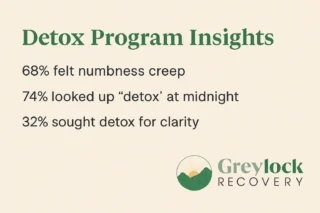
Most people imagine suicidal thoughts as loud—panicked, overwhelming, frantic.
But mine weren’t loud.
They were quiet.
Muted.
Like everything inside me had gone gray.
I didn’t feel hopeless.
I felt… absent.
Detox was the first place someone explained to me that numbness is its own danger. Not explosive. Not dramatic. But heavy enough to drown you slowly.
And unlike friends or family who panicked when I tried to describe it, the staff understood that numbness isn’t a sign of weakness—it’s a sign of exhaustion.
They didn’t try to “fix” me.
They didn’t offer inspirational quotes.
They didn’t turn it into a crisis.
They just sat with me in it.
Calmly.
Steadily.
Without fear or pressure.
Sometimes the most life-saving thing is having someone who isn’t scared of your truth.
A Detox Program Didn’t Solve Everything—But It Made the Next Step Possible
People often imagine detox as the end goal.
But for me, it was a beginning.
Not of recovery in the dramatic, movie sense.
But of clarity.
Of steadiness.
Of a little more breathing room inside my chest.
During detox, I finally slept without numbing myself to get there.
I finally ate real meals.
I finally talked about the thoughts that scared me.
I finally realized how long I’d been white-knuckling my own life.
And detox didn’t force me into decisions I wasn’t ready for.
It simply gave me the stability to consider them.
Sometimes, stabilizing your body is the first step toward stabilizing your mind.
You Don’t Need a Crisis to Need a Lifeline
If you’re reading this right now, maybe you’re wondering if you’re “bad enough” to need detox.
Let me say this as clearly and gently as I can:
If you’ve reached a point where you’re thinking about not being here—even passively—you are hurting enough to deserve help.
Detox isn’t about punishment.
It isn’t about labels.
It isn’t about being “sick enough.”
It’s about giving yourself a safe place to land before the pain becomes a crisis.
You’re allowed to need support before everything falls apart.
You’re allowed to rest.
You’re allowed to breathe.
You’re allowed to live.
Even if it doesn’t feel possible right now.
FAQs About Entering a Detox Program While Struggling with Suicidal Thoughts
Do I have to be actively suicidal to come to detox?
No. Many people enter detox because they feel overwhelmed, numb, or afraid of where their substance use or emotional state is heading.
Will I lose control over my decisions if I admit I feel hopeless?
No. Detox is not a hospital hold. You retain agency. Staff will support you, not overpower you.
What if my suicidal thoughts are passive or confusing?
That’s more common than people realize. You don’t need clarity to deserve support. You only need honesty—and you can share at your own pace.
What if I don’t want to stop using forever?
Detox is not a contract. It’s a beginning. A stabilizing step. You don’t need a long-term plan before you start.
Will staff judge me if I’ve been hiding how bad things are?
No. They’ve heard every version of this story. You won’t shock them. You won’t disappoint them. They’re here to support—not shame.
Is detox quiet? Will I have space to process?
Yes. Detox is intentionally calm. You get time to rest, reflect, and feel safe in your own body again.
If the world feels heavy, you don’t have to carry it alone.
Call (413) 8486013 to learn more about our Detox Program services in Williamstown, Massachusetts.
You’re not too far gone. You’re not beyond help. You’re allowed to stay.