


Some parents sit across from me and whisper the same sentence.
“I love my child. So why does helping them feel like I’m hurting them?”
If your 20-year-old son or daughter is drinking again, you may be standing in a place that feels both heartbreaking and confusing. You raised them, protected them, and tried to give them every chance. And yet somehow, the person you love is slipping back into patterns that are painful to watch.
Many parents begin looking into options like help for a young adult struggling with alcohol during this exact moment—when love is still strong, but the old ways of helping no longer seem to work.
The truth is that addiction changes family dynamics. It blurs lines. It turns kindness into enabling, and protection into exhaustion.
And for many parents, the hardest lesson is this: sometimes love starts to look like boundaries.
The Moment Parents Realize Love Isn’t Enough
Most parents don’t arrive at this realization quickly.
It usually happens slowly—through a series of moments that start to feel familiar.
Maybe it’s the third time your child promised they were cutting back.
Maybe it’s the call from a landlord, an employer, or a friend who sounds worried.
Maybe it’s the quiet realization that you’ve started monitoring their tone, their messages, even the time they come home.
Parents often describe it like living on emotional alert.
You want to believe things are improving.
But something inside you keeps whispering that they aren’t.
One mother once told me:
“Every time he said he was doing better, I wanted to believe him. I needed to believe him. But deep down, I knew something wasn’t right.”
This moment—the point where hope and reality collide—is often when families begin searching for deeper support.
Why Boundaries Feel So Unnatural for Parents
Setting boundaries with your own child can feel almost impossible.
From the moment they were born, your instinct has been to protect them. You solved problems before they became disasters. You stayed up late when they were sick. You stood beside them when life got hard.
Parenthood is built on showing up.
So when addiction enters the picture, the instinct to fix things gets stronger—not weaker.
You might pay off debts.
You might explain away missed responsibilities.
You might offer one more chance, hoping this will be the moment things change.
But addiction has a way of absorbing every safety net placed underneath it.
And eventually, many parents reach a painful realization:
What once helped your child grow may now be helping the addiction continue.
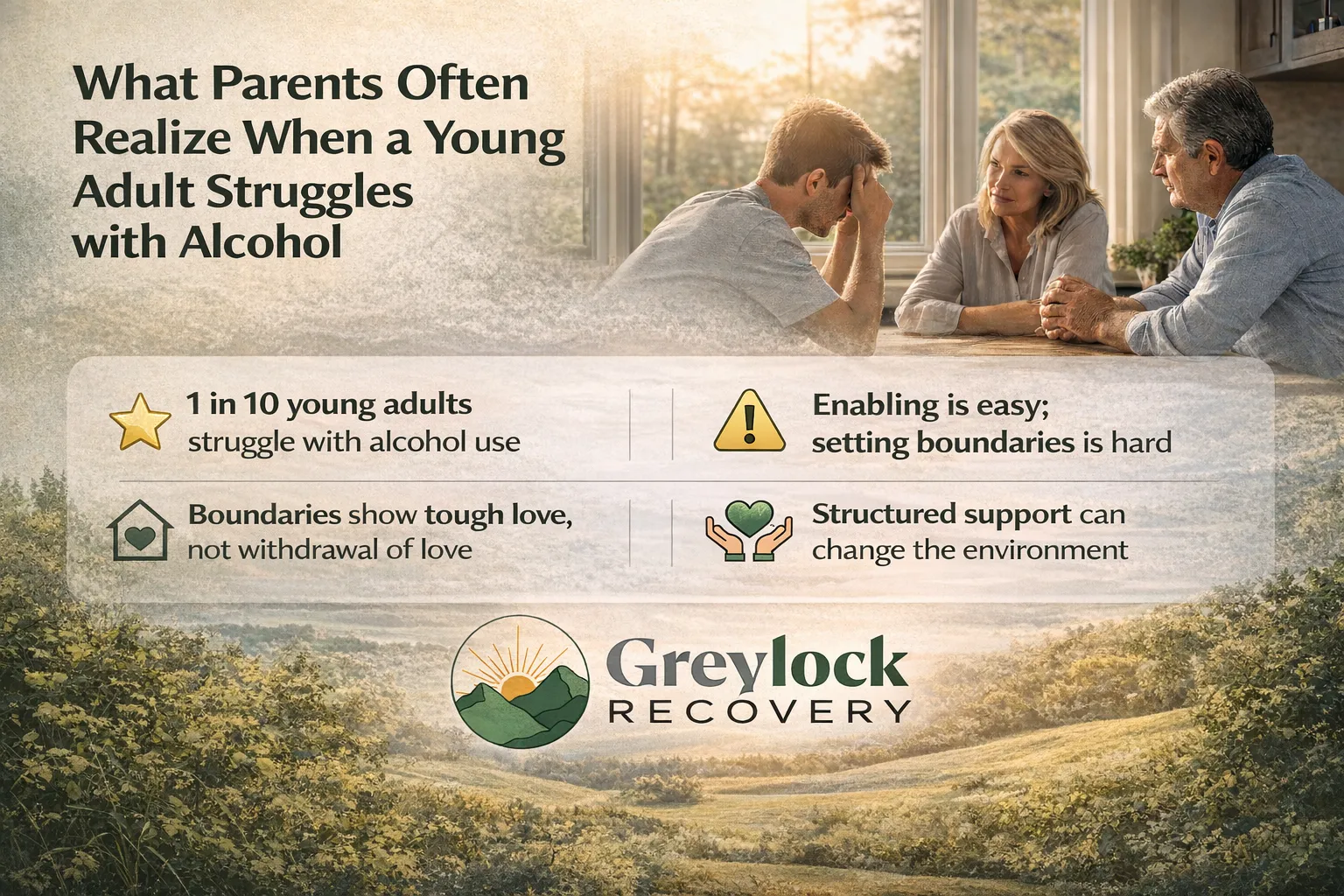
Boundaries don’t come naturally to parents because they feel like withdrawal of love. But in reality, they are often the clearest expression of love left.
The Invisible Weight Parents Carry
One of the hardest parts of supporting a child with addiction is the quiet guilt parents often carry.
It shows up in questions that rarely get spoken out loud.
Did we miss something earlier?
Was there a moment we should have stepped in differently?
Did we push too hard—or not hard enough?
These questions are normal. Almost every parent asks them at some point.
But addiction rarely grows from a single moment or parenting decision. It develops through a complicated mix of biology, emotional coping patterns, life experiences, and environmental influences.
What matters now is not rewriting the past.
What matters is deciding what support looks like moving forward.
Parents often need to hear something simple but powerful:
Your love did not cause this.
And your love is still one of the most important forces in your child’s recovery.
When Helping Turns Into Protecting the Problem
Families often begin by trying to soften the consequences of addiction.
You might call an employer when your child misses work.
You might cover rent when finances collapse.
You might offer money hoping it helps them stabilize.
These actions come from love.
But addiction thrives in environments where consequences disappear.
When the external world becomes too comfortable, there is often little pressure for change.
This is where boundaries begin to matter.
A boundary might look like saying:
“I love you, but I can’t give you money right now.”
Or:
“You’re welcome to stay here if you’re working toward recovery.”
These conversations can feel terrifying. Parents often worry that boundaries will push their child further away.
But boundaries don’t reject a person. They draw a line around the behavior that’s causing harm.
And sometimes, that clarity is the first step toward real change.
What Turning Points Often Look Like
Popular culture sometimes portrays recovery as a dramatic moment—a speech, a rock bottom, a sudden decision to change.
Real life is usually quieter than that.
Turning points often look like subtle shifts in circumstances.
A young adult loses a job and realizes the pattern is repeating.
A relationship begins to fracture.
A parent finally stops absorbing the impact of the addiction.
These moments create friction.
And friction, uncomfortable as it is, can create awareness.
I’ve seen many young adults begin to reconsider their choices only after the environment around them changes.
When the patterns that supported the addiction begin to shift, new possibilities can start to emerge.
Stories That Give Parents Hope
Parents often feel isolated during this process, as though their family is the only one experiencing this kind of heartbreak.
But the reality is that many families have walked this road—and many have found their way through it.
One father shared with me:
“The hardest thing I ever did was tell my daughter she couldn’t move back home unless she was willing to get help. I thought she’d disappear from our lives. Instead, two weeks later she called and asked where she could start.”
Another mother described the moment she stopped trying to manage everything for her son.
“For years I thought if I just worked harder, loved harder, worried harder, I could fix it. When I finally stepped back, it was terrifying. But it also gave him space to face his own choices.”
These stories aren’t about perfect endings.
They’re about families learning new ways to support their loved ones—ways that protect both the parent and the child.
Why Young Adults Sometimes Struggle the Most
Parents are often surprised that their child’s drinking becomes more intense in their late teens or early twenties.
But this period of life can be uniquely vulnerable.
Young adults are navigating independence, identity, relationships, and responsibility all at once. Alcohol often becomes a coping tool for stress, social pressure, or emotional uncertainty.
When drinking becomes a regular escape, it can slowly take over decision-making, motivation, and emotional regulation.
What begins as social drinking can evolve into something far more complicated.
And because young adults are still developing emotionally and neurologically, patterns formed during this stage can become deeply ingrained if left unaddressed.
This is why early support can make such a powerful difference.
What Families Often Need Support With
When families begin seeking help, they’re rarely just looking for solutions for their child.
They’re also searching for guidance for themselves.
Parents often need help learning how to:
- Set boundaries without abandoning their child
- Communicate without escalating arguments
- Protect their own emotional health
- Recognize enabling patterns
- Stay supportive while allowing accountability
This kind of support helps families shift from crisis mode into a more stable, sustainable approach to recovery.
And in many cases, families themselves begin healing during this process.
How Structured Support Can Change the Environment
When drinking has become deeply embedded in someone’s daily life, changing that pattern often requires a new environment.
This is where Alcohol Addiction Treatment can play a critical role.
Instead of trying to rebuild stability alone, young adults enter a structured space where they can step away from familiar triggers, develop coping skills, and receive consistent support.
Families often notice something surprising during this process.
Their child begins to reconnect with parts of themselves that seemed lost—motivation, honesty, emotional awareness.
Recovery doesn’t erase the past.
But it can rebuild a future that once felt out of reach.
Love Doesn’t Disappear When Boundaries Begin
One of the biggest fears parents carry is that setting boundaries will break the relationship.
But boundaries don’t end love.
They refine it.
They shift love away from rescuing and toward something steadier—support that encourages growth rather than protecting the addiction.
For many families, this shift becomes the beginning of a new relationship with their child.
One built on honesty instead of fear.
Clarity instead of confusion.
Hope instead of exhaustion.
And sometimes, that quiet shift becomes the place where recovery begins.
Frequently Asked Questions
How do I know if my child’s drinking is serious?
Patterns matter more than individual incidents. If drinking is interfering with work, school, relationships, or emotional stability, it may signal a deeper problem. Repeated broken promises, financial instability, and secrecy are also common warning signs.
Should I confront my child about their drinking?
Conversations can help, but timing and tone matter. Try to speak during calm moments rather than during arguments. Focus on expressing concern and specific observations rather than accusations.
Is setting boundaries the same as giving up on my child?
No. Boundaries are a way of protecting both you and your child. They help prevent the addiction from continuing unchecked while still leaving space for support and connection.
What if my child refuses help?
This is a common and painful situation. While you cannot force someone to change, you can change the environment around them. Boundaries, consistency, and access to resources can sometimes encourage reconsideration over time.
Can recovery really happen for young adults?
Yes. Many young adults recover and go on to rebuild relationships, careers, and personal goals. Early intervention and supportive environments often improve long-term outcomes.
How can parents take care of themselves during this process?
Supporting a child with addiction can be emotionally exhausting. Many parents benefit from counseling, family support groups, or guidance from addiction professionals. Caring for yourself is not selfish—it allows you to remain steady during a difficult time.
If you’re worried about a son or daughter whose drinking has begun to take control, you don’t have to navigate it alone. Call (413) 8486013 to learn more about our Alcohol Addiction Treatment in Williamstown, Massachusetts.