
How to Manage Cravings While Exploring Opioid Addiction Treatment

How to Manage Cravings While Exploring Opioid Addiction Treatment

You don’t have to be ready—you just have to be curious.
If you’re reading this, chances are you’ve had at least one moment of wondering: Is this still working for me? Opioids may have helped you cope with something big, or maybe they just crept into your life slowly. Either way, something inside you is starting to whisper, I want something else.

But cravings don’t always wait for clarity. Even when you’re exploring opioid addiction treatment, cravings can hit hard—and unexpectedly. That’s not a sign you’re not serious about change. It’s just part of how the brain reacts to uncertainty and stress.

At Greylock Recovery in Williamstown, Massachusetts, we help people explore recovery without pressure or judgment. Here’s how you can begin to manage cravings while you’re still figuring out what help looks like.

Cravings Are Not a Moral Failing

First, let’s take shame off the table.

Cravings are your brain trying to protect you. That might sound strange, but when you’ve used opioids to cope—whether with anxiety, pain, trauma, or just emotional overload—your brain learns that they bring relief. So when stress, boredom, or even quiet moments hit, it may send out a signal: Go get relief.

This doesn’t mean you’re weak. It doesn’t mean you don’t want to change.

It just means your brain is doing what it was trained to do.

And guess what? It can be retrained.

Try the “Name and Pause” Method

When a craving hits, your first instinct might be to act—or distract.

Instead, try this two-step approach:

  1. Name it: Say to yourself (out loud or in your head), “This is a craving.” Naming it helps pull it out of your body and into your awareness.
  2. Pause it: Give yourself a 10-minute window before deciding what to do next. Not forever. Just 10 minutes.

During that pause, you can:

  • Take five deep, slow breaths
  • Drink a glass of water
  • Walk around the block or even just stand outside
  • Text a friend or write a note to yourself

Often, the craving will pass—or at least lose intensity. And even if it doesn’t? You’ve already proven to yourself that you can create space. That matters.
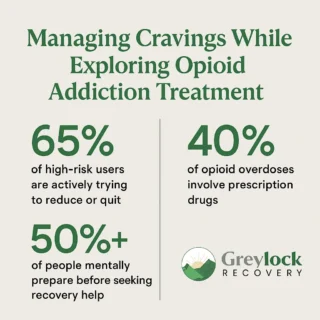
Opioid Craving Stats

Build a Craving Toolkit That Works for You

Not every craving strategy works for everyone. That’s okay. The key is finding tools that feel realistic, not perfect.

Here are a few ideas to build your own craving toolkit:

  • Anchor objects: A rock in your pocket, a bracelet, or anything that helps you ground yourself when the urge hits.
  • Soothing input: Music, white noise, or even a short video that shifts your mental state.
  • Movement: A short walk, yoga, dancing to one song.
  • Touchpoints: A text thread with a friend who knows what you’re working on—or a journal where you let the craving speak before you do.

The goal isn’t to stop craving. It’s to respond differently when it shows up.

Redefine What “Success” Looks Like

If you’re sober-curious, you might be in that space where you’ve tried cutting back—or stopping—but keep finding yourself returning to old patterns. That doesn’t mean you’re not serious. It means you’re learning.

Here’s what success might look like before full sobriety:

  • Saying no one time you would’ve said yes
  • Being honest with a friend about where you’re at
  • Making it through a stressful day without using
  • Calling a treatment center just to ask questions

Small victories matter. You’re not behind. You’re exactly where you need to be to move forward.

Start Talking About Treatment—Without Pressure

Exploring opioid addiction treatment doesn’t mean you’re signing your life away. It doesn’t mean you have to quit tomorrow or explain yourself to everyone you know.

It just means you’re open to hearing what help could look like.

That might mean:

  • Reading personal stories from people in recovery
  • Calling a treatment center to ask what outpatient options exist
  • Attending a free info session or peer group
  • Asking a friend in recovery what helped them most

At Greylock Recovery, we offer space for these early conversations. No expectations. No pressure. Just real answers from people who care.

Consider Outpatient Opioid Addiction Treatment

If you’re functioning well in daily life but still struggling privately, outpatient treatment can be a powerful, flexible option.

Outpatient care allows you to:

  • Keep your job or school schedule
  • Get support without upending your life
  • Start with therapy or group support before committing to more
  • Choose whether medication-assisted treatment (MAT) is right for you

Some people use outpatient care as a first step. Others combine it with therapy, family support, or medical care. There’s no wrong way to begin.

It’s not about labeling yourself—it’s about supporting yourself.

Cravings Are an Invitation, Not a Test

It may sound strange, but cravings can be useful.

They tell you when something in your life feels too big to hold alone. They signal when stress, grief, or even boredom is pushing your system toward escape. And they offer a moment—a gap—where something new could happen.

Managing cravings while exploring treatment isn’t about being perfect. It’s about being present. And being present—especially with your pain—is one of the bravest things a person can do.

FAQs: Cravings + Exploring Treatment

What if I still use sometimes? Can I still talk to a treatment center?
Yes. You don’t have to be sober to ask for help. Many people begin treatment while still using or uncertain. We’ll meet you where you are—no shame, no pressure.

Do I have to be “addicted” to consider opioid addiction treatment?
No label required. If opioids are interfering with your life—even a little—it’s okay to explore your options. Treatment is for anyone who wants change, not just those in crisis.

How can I explain my cravings to someone who doesn’t get it?
You don’t have to convince anyone. But it can help to say, “This isn’t about willpower. It’s about patterns I’m learning to change.” Cravings are a brain-body signal, not a failure.

Will treatment make cravings go away?
Treatment won’t erase cravings instantly—but it helps you understand and manage them. Over time, many people notice cravings lessen or become more manageable.

What if I’m not ready to stop using completely?
You don’t have to commit to full abstinence today. Talking to someone about your options is a good start. Some people use MAT or harm-reduction strategies while preparing for more change.

You Don’t Have to Figure This Out Alone

There’s a version of you that doesn’t have to fight cravings in silence. That doesn’t live in fear of the next wave of urge. That version of you isn’t perfect—but they are possible.

You don’t have to be sure. You just have to be open.

And if you’re ready to talk—we’re ready to listen.

Want to take the next step?
Call us at (413) 848-6013 or visit Greylock Recovery’s opioid addiction treatment in Williamstown, Massachusetts to learn more. You don’t have to commit. You just have to connect.
Call to Connect

You don’t have to be ready for everything. You just have to be ready for one step.

Call Our Free

24 Hour Helpline
Get The Help You Need
Counselors are standing by

Jody Kocsis is a dependable team member dedicated to maintaining a safe, clean, and efficient facility environment. With a strong attention to detail and a commitment to quality, Jody supports daily operations and ensures a positive experience for all.

Eric Simmons is the Director of Case Management at Greylock Recovery, bringing more than 15 years of experience in behavioral health, substance use disorder treatment, residential programming, admissions, and case management. He has led program operations, patient advocacy initiatives, staff development, and outcome improvement efforts across residential and human service settings.

Prior to Greylock Recovery, Eric served as Director of Residential and Admissions Services for a local Berkshire county recovery facility, overseeing residential operations, admissions, referral development, and regulatory compliance. His expertise includes case management, discharge planning, community resource development, compliance, and staff training.

Eric earned a Bachelor of Arts in Sociology from Westfield State University, graduating Magna Cum Laude. He is committed to helping individuals overcome barriers to recovery and achieve lasting stability, while also serving his community as a youth football coach and mentor.

Jennifer Parsons is a seasoned human resources executive with more than 15 years of experience leading strategic HR initiatives, talent management, employee relations, and organizational development. Most recently, she served as Senior Vice President of Human Resources at Pittsfield Cooperative Bank, where she played a key role in fostering a positive workplace culture and supporting the organization’s growth and success.

Jennifer holds the Senior Professional in Human Resources (SPHR) certification from the Human Resource Certification Institute (HRCI), demonstrating her expertise and commitment to excellence in the HR profession. She also earned an associate’s degree in both Business Administration and Hospitality Administration, providing a strong foundation in leadership, operations, and customer service.

A Berkshire County native, Jennifer is deeply committed to her community and currently resides in the region with her family. In addition to her professional accomplishments, she serves on the Board of Directors for the Gladys Allen Brigham Center in Pittsfield, supporting the organization’s mission to empower women and strengthen the Community.

Jennifer Walker has been caring for others since 1989, starting out as a nurse’s aide and working her way through roles as a medical assistant, LPN, and RN. Along the way, she earned an associate’s degree in business administration and gathered an impressive range of experience—from primary care and long-term care to neurosurgery, neurology, colorectal surgery, orthopedics, and hospital-based surgical services. She’s also spent seven years helping individuals overcome substance use disorders, including time as a Director of Nursing, and has worked in hospice and with patients with disabilities.

But Jennifer’s dedication to people goes far beyond the workplace. A former foster parent and active supporter of local charities, she pours her heart into her community. When she’s not in scrubs, you can find her cheering at a sports game, tending to her garden, or enjoying laughter-filled moments with her family. Her blend of skill, heart, and positivity makes her not just a caregiver, but a true bright light for everyone she meets.

Elizabeth Azzariti, LICSW,

Elizabeth Azzariti, LICSW, is a seasoned clinical leader with over 10 years of experience in treating behavioral and addiction issues. After a successful 25-year career in the insurance industry, where she advanced to VP of Finance and Administration, she returned to school, earned her Master of Social Work from Wheelock College, and launched a new career dedicated to behavioral health. In her new role as Clinical Director at Greylock Recovery, she brings deep expertise in clinical operations, program development, and multidisciplinary team leadership. Most recently, as Executive Director at Nulife Behavioral Health, she served as both Clinical and Executive Director, leading the launch of PHP, IOP, TMS, Alumni, and Family programs while overseeing clinical staff hiring, supervision, and operations. She designed and implemented a 16-week evidence-based curriculum for co-occurring disorders that boosted attendance, retention, and patient outcomes. Her prior leadership roles include Clinical Supervisor at Blue Hills Recovery—directing multidisciplinary teams across PHP, IOP, and 24/7 residential programs—and at New England Recovery Center. EMDR-trained and specializing in trauma-informed care and integrated treatment, Elizabeth is passionate about delivering high-quality clinical care that supports lasting recovery for individuals and families.

Flora Sadri-Azarbayejani’s journey in the field of healthcare began at Boston University, where she earned her undergraduate degree in biomedical engineering.

Dr. Sadri-Azarbayejani pursued dual master’s degrees at Boston University, specializing in epidemiology and biostatistics, and medical science. She then attained her doctorate in medicine from the University of New England College of Osteopathic Medicine. Dr. Sadri-Azarbayejani’s professional career commenced as an epidemiologist in infectious disease at the Massachusetts Department of Public Health.

Eventually appointed as the Chief Medical Officer.She became board certified in addiction medicine and worked in the addiction space since 2014. She has worked both inpatient and outpatient addiction medicine. Opening programs in both arenas.

Currently serves as the medical director for substance use services at Lowell Community Health Center and for an inpatient addiction treatment center. Dr. Sadri-Azarbayejani is an active and engaged member of various medical societies, including the Massachusetts Medical Society, the American Academy of Family Physicians (AAFP), and the American Society of Addiction Medicine (ASAM).

Involved with development of CARF guidelines for outpatient addiction treatment programs. She also hopes to make an impact on passing legislation of supervised consumption sites in the near future.

Lauren Temple is a Licensed Clinical Social Worker (LICSW) bringing over 15 years of dedicated leadership in the behavioral health sector, with extensive expertise spanning inpatient, outpatient, and substance use disorder programming. She obtained her Master of Science in Social Administration from Case Western Reserve University and holds dual licensure as an LICSW in Massachusetts and an LISW-S in Ohio. Serving as the Executive Director for Greylock Recovery, Lauren manages clinical operations, regulatory adherence, and strategic growth to uphold the highest standards of patient-centric treatment.

Her professional background includes directing diverse clinical teams, broadening service accessibility, and overseeing quality improvement efforts while navigating complex accreditation and state regulatory cycles. Lauren remains deeply invested in cultivating elite clinical staff, improving recovery metrics, and championing evidence-based advancements in behavioral health care.