

There’s a moment people don’t talk about enough—the one where you sit with the thought: If I stop… who do I become?
Not in a dramatic way. Not all at once.
Just a quiet, unsettling question that lingers in the background.
Because maybe the pills didn’t just take the edge off pain. Maybe they helped you feel more open, more expressive, more able to move through your day. Maybe they became part of how you cope, how you connect, how you create.
So the idea of stopping doesn’t feel like relief.
It feels like risk.
At Greylock Recovery, we meet people in that exact space every day—people who aren’t just afraid of withdrawal… but afraid of losing something that feels like them. And often, that’s the moment they begin exploring options like medication-assisted recovery options. Not because they’re ready to give everything up—but because they’re starting to wonder if there’s a way to feel better without losing themselves.
The Version of You That Feels “Alive” Might Also Be Carrying Too Much
It’s confusing when the thing that’s hurting you is also the thing that seems to help you function.
You might feel more social.
More expressive.
More able to get through the day without everything feeling so heavy.
And without it? Things can feel dull, tense, or even unbearable.
That doesn’t mean the substance is giving you something you don’t have.
It often means it’s temporarily changing how you access what’s already there.
The depth, the personality, the way you think and feel—that’s yours.
But when your body becomes dependent, it starts to blur the line between who you are and what you need just to feel okay.
The Fear of Withdrawal Is Real—and It Keeps People Stuck
Let’s talk about something practical for a second.
A lot of people aren’t continuing because they want to.
They’re continuing because stopping feels physically impossible.
If you’ve ever tried to stop taking pain pills and felt sick, shaky, restless, or overwhelmed—you already know how quickly your body can push you back.
That fear is real. And it deserves to be taken seriously.
It’s also one of the reasons people begin searching for real opioid withdrawal help—not because they’re weak, but because their body has adapted.
This isn’t about willpower.
It’s about physiology.
And when your body is supported through that process safely, something shifts:
You’re no longer fighting your own system just to get through the day.
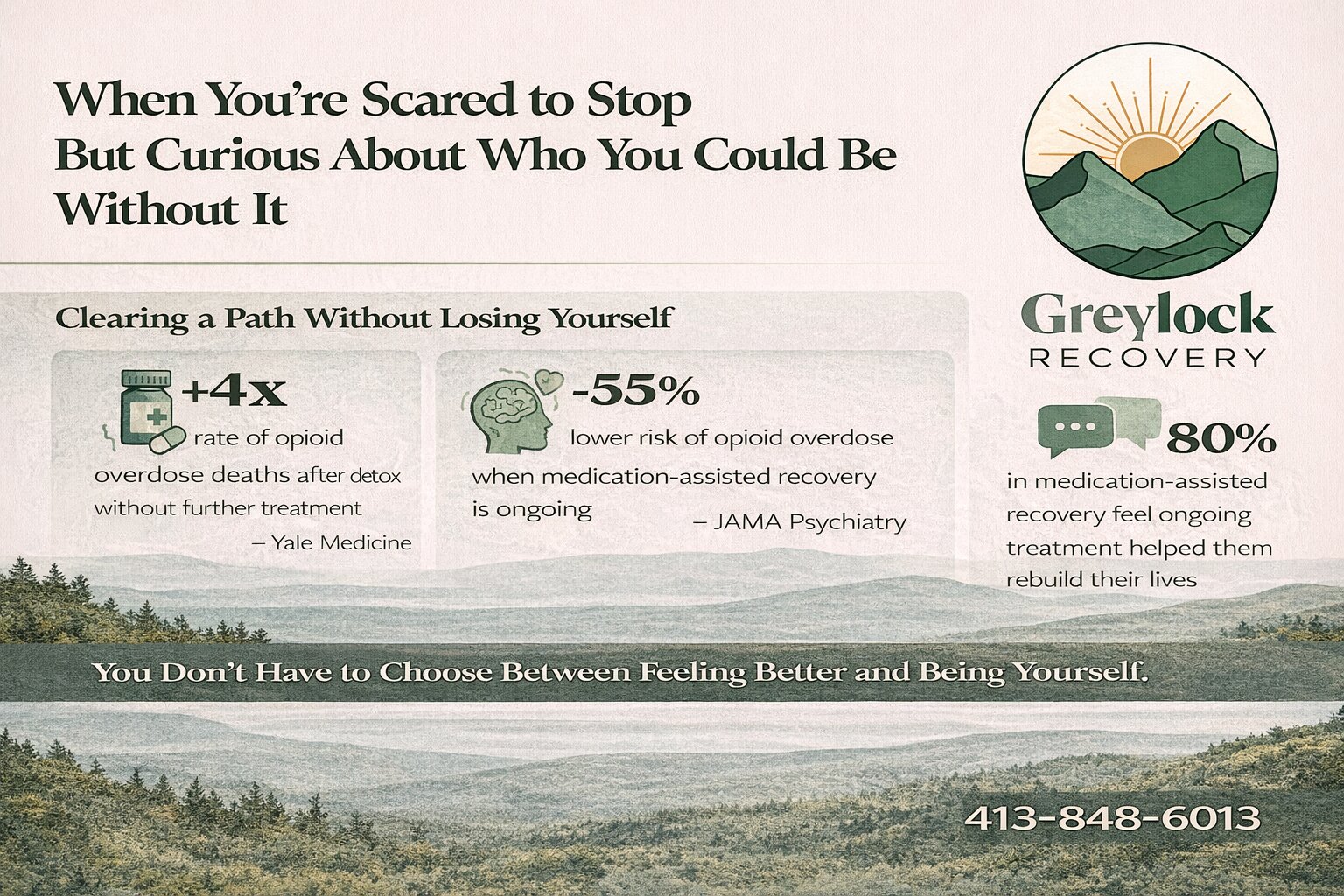
“I Don’t Want to Be a Different Person” Isn’t Resistance—It’s Honesty
There’s a quiet kind of courage in admitting this:
I’m not sure I want what recovery will turn me into.
That’s not denial. That’s awareness.
Because for many people, substances didn’t just numb pain—they shaped experiences. Social moments. Creativity. Even identity.
So of course there’s hesitation.
We don’t dismiss that here.
Instead, we ask a different question:
What if recovery doesn’t change who you are…
but changes how much pain you have to carry just to be that person?
Treatment Should Support You—Not Replace You
There’s a misconception that getting help means handing over control.
That you’ll be told who to be. How to act. What version of yourself is acceptable.
That’s not what effective care looks like.
At its best, treatment is collaborative. It adapts to you. It respects your pace, your personality, your concerns.
Medication-supported care, in particular, is often misunderstood.
It’s not about replacing one thing with another.
It’s about stabilizing the physical side of dependence so you can focus on the emotional and mental side—without constant disruption.
For many people, it’s the difference between surviving each day… and actually being able to engage with it.
You Don’t Have to Prove Anything by Suffering
There’s an idea out there that recovery only “counts” if it’s hard enough.
That you have to push through pain to earn it.
But suffering isn’t a requirement for healing.
You don’t have to white-knuckle your way through withdrawal.
You don’t have to lose yourself just to prove you’re serious.
There are ways to move through this with support, with structure, and with care that actually considers what you’re going through—physically and emotionally.
The Adjustment Period Is Real—But It’s Not Permanent
Let’s be honest about something:
The early phase of change can feel unfamiliar.
You might feel quieter. Slower. Less reactive.
And that can be uncomfortable—especially if you’re used to intensity.
But unfamiliar doesn’t mean wrong.
It often means your system is recalibrating.
Over time, what many people notice isn’t a loss of identity—but a return of clarity.
Emotions become more consistent. Thoughts feel less chaotic. Reactions feel more like choices instead of impulses.
And slowly, something important happens:
You start recognizing yourself again—but without the constant strain.
What You Gain Isn’t Loud—But It’s Real
Recovery doesn’t always come with a dramatic moment.
Sometimes it shows up quietly.
You wake up and realize your first thought isn’t about how to get through the day.
You sit with a feeling—and it passes without overwhelming you.
You have a conversation that feels genuine, not forced.
These moments aren’t flashy.
But they’re steady.
And over time, they build something that feels more sustainable than anything that came before.
FAQ: What People Quietly Wonder About Before Getting Help
Will medication make me feel numb or unlike myself?
Not when it’s used appropriately and monitored closely. The goal isn’t to numb you—it’s to stabilize your body so you can feel like yourself without the constant highs and lows.
What if I’ve tried to stop before and couldn’t?
That’s more common than you think. It doesn’t mean you failed—it means your body needed more support than it had at the time.
Do I have to commit to this forever?
No. Treatment is flexible. The goal is to support you where you are right now—not lock you into something long-term without your input.
What if I’m still unsure?
You’re allowed to be. You don’t have to feel 100% ready to ask questions or learn more. Curiosity is enough to start.
Will I lose my creativity or personality?
This is one of the most common fears—and one of the biggest misconceptions. What people often lose is the chaos, not the creativity. What stays is the part of you that can actually sustain it.
You’re Allowed to Be Both Scared and Curious
You don’t have to rush this.
You don’t have to label yourself.
And you don’t have to choose between staying the same and losing who you are.
There’s a middle space—where you can feel better and still be yourself.
If you’re even a little curious about what that might look like, that’s enough.
Call 413-848-6013 or visit our treatment services page to learn more about our treatment services, medication assisted services in Williamstown, Massachusetts.
You’re not disappearing.
You’re just starting to separate yourself from what was hurting you.