

There’s a moment I hear often in session.
It usually comes quietly, like someone admitting something they’re not sure they’re allowed to say:
“I don’t want to lose who I am.”
Not the surface-level version. The real one.
The part that feels alive, expressive, connected—even if it’s tangled up in something that’s also hurting you.
Early on, when people begin exploring options like medication support as part of recovery, this fear doesn’t fade.
It sharpens.
Because it starts to feel like a trade:
Stability… in exchange for yourself.
Let’s slow that down. Because that’s not actually what’s happening.
The Version of You That “Works” Came From Somewhere Real
It’s important to acknowledge something most conversations skip over:
What you’ve been doing… makes sense.
There’s usually a reason substances became part of your life in the first place:
- They helped you feel more open
- They softened anxiety or self-consciousness
- They amplified creativity or emotional access
- They made connection feel easier, faster, more natural
So when someone suggests changing that, it can feel like they’re asking you to give up your edge. Your spark.
But here’s the question I often ask gently:
Was it really giving you those things… or helping you access them temporarily while taking something else in return?
Because over time, most people notice the shift:
- What once helped starts to interfere
- What once opened you up starts to close things down
- What once felt like freedom starts to feel like pressure
That doesn’t erase what it gave you.
But it does mean you deserve something more sustainable.
Stability Isn’t the Opposite of Personality
There’s a common fear that things will become flat.
Predictable.
Muted.
Safe in a way that feels like… less.
But stability isn’t the opposite of personality.
It’s the foundation that lets your personality actually stay.
Right now, if your system is constantly swinging—up, down, wired, exhausted—you’re not experiencing yourself consistently.
You’re catching flashes of yourself.
Moments of clarity. Bursts of creativity. Pockets of connection.
Then losing them.
What stabilization does is different:
- It reduces the extremes so you can access yourself more often
- It allows emotions to move without overwhelming you
- It gives your brain and body a chance to operate without constant disruption
And from there, something surprising happens:
You don’t feel less.
You feel more like yourself, more often.
The Fear of Becoming “Boring” Is Usually About Losing Access
No one says it directly at first.
But it comes out eventually:
“What if I get boring?”
What people usually mean is:
- What if I can’t connect the same way?
- What if I lose my humor, my energy, my spark?
- What if people don’t like me as much?
These are real fears. And they deserve real answers.
What I’ve seen is this:
You don’t lose your spark.
You lose the unpredictability around it.
Instead of needing something external to unlock confidence or creativity, you begin to build access to it internally.
It may feel quieter at first.
Less dramatic.
But it’s also not followed by the same crash, shame, or disconnection.
And over time, that consistency becomes something people trust—both in you and within themselves.
You May Not Recognize Yourself at First — And That’s Okay
There can be a phase where things feel unfamiliar.
Not wrong. Just… different.
You might notice:
- Your reactions aren’t as intense
- Your thoughts feel slower, more spaced out
- You have moments of calm that feel almost unfamiliar
That can be disorienting.
Especially if you’ve spent years identifying with intensity.
But unfamiliar doesn’t mean inauthentic.
It often means your system is finally experiencing something it hasn’t had access to before: regulation.
And regulation can feel strange before it feels safe.
Regulated Isn’t the Same as Numb
This is one of the biggest misunderstandings.
People often worry that support will make them feel:
- Emotionally flat
- Disconnected
- Less creative or expressive
But that’s not regulation.
That’s numbness—and it’s not the goal.
Regulation feels different:
- You can feel sadness without spiraling
- You can feel joy without it tipping into chaos
- You can stay present in conversations instead of drifting or performing
It’s not less emotion.
It’s emotion you can stay inside of.
There’s a Quiet Grief That Deserves Space
Even if something isn’t sustainable… it still mattered.
The version of you that existed within that lifestyle:
- Found ways to cope
- Created meaning out of difficult moments
- Built connections, even if imperfectly
Letting go of that as your primary way of functioning can feel like losing a part of yourself.
And that deserves acknowledgment.
You’re not just choosing something new.
You’re also saying goodbye to something familiar.
Grief doesn’t mean you’re making the wrong decision.
It means you’re honoring what got you here.
What Starts to Grow in Its Place
Over time—and this part is important, because it’s not instant—something steadier begins to take shape.
People often describe:
- Creativity that’s more consistent, even if less chaotic
- Relationships that feel more genuine and less performative
- A sense of self that doesn’t disappear between highs and lows
It’s not as loud.
But it’s more reliable.
And eventually, that reliability becomes its own kind of freedom.
Because you’re no longer chasing access to yourself.
You have it.
This Isn’t About Changing Who You Are
It’s about removing the things that keep interrupting you from being who you are.
If you’ve been considering medication assisted support, it doesn’t mean you’re choosing to become someone else.
It means you’re choosing to meet yourself without constant interference.
That’s a very different decision.
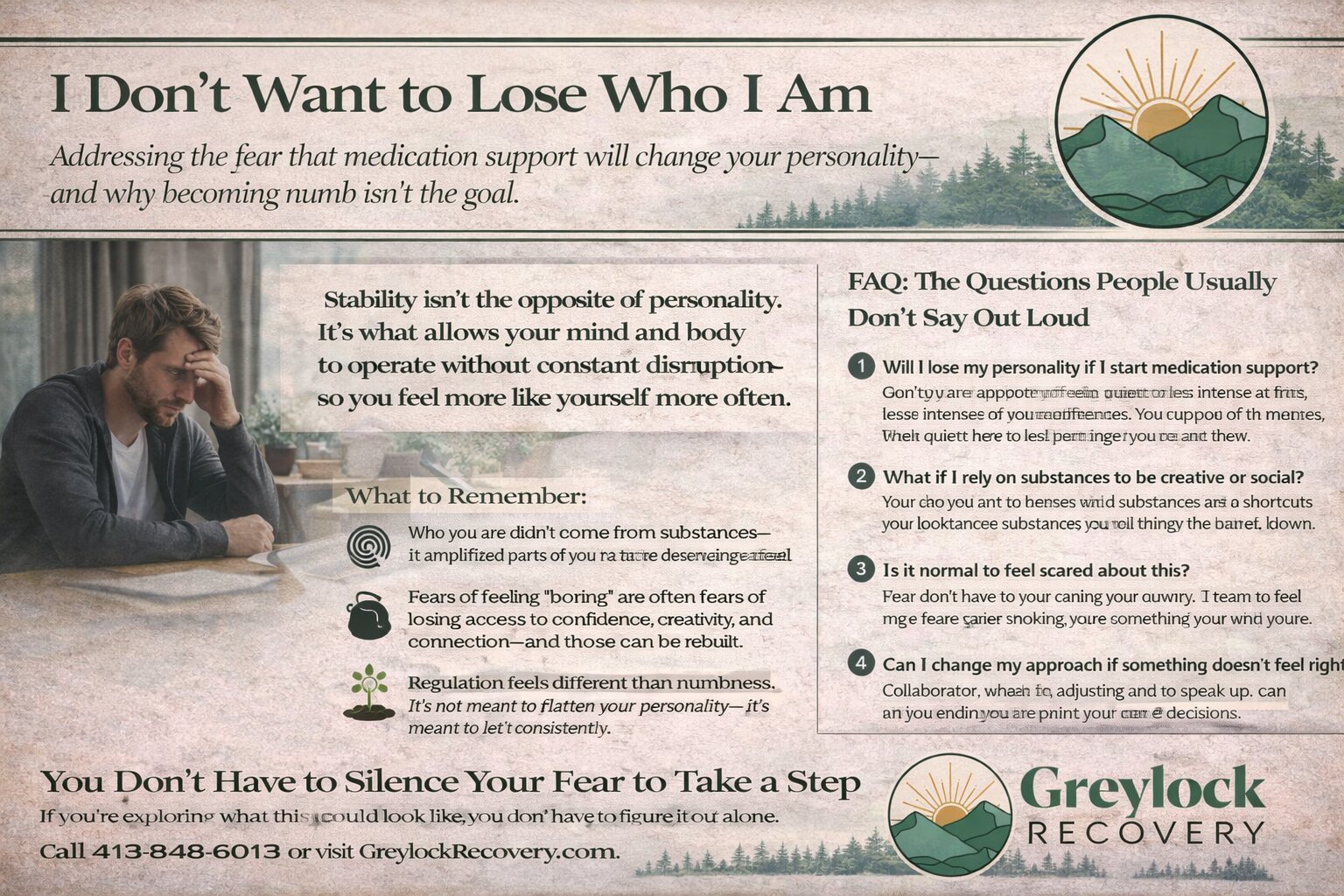
FAQ: The Questions People Usually Don’t Say Out Loud
Will I lose my personality if I start medication support?
No—but you might experience your personality differently at first. Many people notice things feel quieter or less intense early on, which can feel unfamiliar. Over time, most describe feeling more consistent, not less themselves.
What if I rely on substances to be creative or social?
This is more common than people admit. Substances can act like a shortcut to access certain states. The work becomes learning how to access those parts of yourself without needing something external to unlock them.
Is it normal to feel scared about this?
Yes. Especially if your identity has been tied to how you feel, express, or connect while using. Fear doesn’t mean you’re not ready—it means you care about who you are.
Will I feel numb?
The goal is not numbness. If something makes you feel emotionally flat or disconnected, that’s important to talk about. The aim is steadiness—not shutting you down.
How long does it take to feel like “yourself” again?
It varies. Some people notice shifts quickly, while for others it takes time to adjust. What’s consistent is that the “new” feeling often becomes more natural as your system stabilizes.
Can I change my approach if something doesn’t feel right?
Yes. Support should be collaborative. You should feel able to speak up, adjust, and be part of decisions about your care.
You Don’t Have to Silence Your Fear to Take a Step
You can be curious and scared at the same time.
You can want change and still feel attached to what’s familiar.
Both can exist.
If you’re exploring what this could look like, you don’t have to figure it out alone.
Call 413-848-6013 or visit our treatment services, medication assisted services to learn more about our treatment services, medication assisted services in .
And just to say this one more time—because it matters:
You are not too much.
You’re not something that needs to be flattened.
You’re someone who deserves to feel steady enough to actually experience yourself.