

You show up. You handle your responsibilities. You’re good at hiding things—especially from yourself.
On paper, there’s no crisis. So why does the thought of skipping your next dose make your chest tighten?
This isn’t about whether you’re an “addict.” It’s about whether your body—and mind—have crossed into a territory where stopping cold could be dangerous.
A medical detox program exists for one simple reason: to help people safely get off substances their bodies have come to depend on. And yes, that includes people like you—the high-functioning, the responsible, the ones no one would ever suspect.
You’re Still Showing Up. That Doesn’t Mean You’re Okay.
Addiction has a public face and a private one.
The public version stumbles, spirals, disappears.
But the private version? It keeps going to work. Picks the kids up. Makes small talk at the gym. Sends emails at midnight. All while numbing just enough to stay upright.
If you’re nodding right now, then you already know: functioning isn’t the same as health.
In fact, being high-functioning often delays people from getting help, because they think they haven’t “earned” it. That things aren’t “bad enough.” That they’re not sick—they’re just tired.
But you are tired. Deeply. And hiding a dependency doesn’t make it less dangerous. It just makes it lonelier.
You Can Be Stable on the Outside—and Still in Medical Risk
Let’s talk facts.
When your body becomes physically dependent on a substance—alcohol, opioids, benzos, stimulants—it doesn’t care whether you’re managing your career or just got promoted.
If you stop using suddenly, you risk more than discomfort. You risk seizures. Cardiac distress. Delirium tremens. Hallucinations. Complications that can land you in the ER—or worse.
A medical detox program ensures that when you stop, you do it safely. Under medical supervision. With access to medications that reduce the danger and discomfort. With professionals watching for complications that most people don’t see coming.
You don’t need to hit a dramatic “bottom.” You just need to stop gambling with your body’s tolerance.
Medical Detox Isn’t a Failure—It’s a Wise First Step
We need to rewrite the story we tell ourselves.
Needing medical detox isn’t a personal weakness. It’s an informed decision based on what your nervous system needs.
You wouldn’t pull your own tooth or stitch up your own wound. So why would you handle withdrawal on your own—especially when the risks are high?
Medical detox is not rehab. It’s the doorway. It’s the pause button. It gives your body a safe reset so you can actually think clearly about what comes next.
At Greylock Recovery, we treat detox like the beginning of healing—not the punishment for needing help.
“But I Don’t Drink That Much…” — What Functional Addiction Hides
The scariest thing about being high-functioning is how easy it is to rationalize your use.
- You’re not blacking out, so it’s fine.
- You’re not using in the mornings (except weekends).
- You could stop if you wanted to—you just don’t want to feel like hell.
Except… you do want to stop. You just don’t know how to do it without consequences. Without pain. Without someone finding out.
That fear of withdrawal is often your body’s way of signaling something’s shifted from habit to dependence. And that shift is exactly when medical detox becomes relevant.
Signs You Might Need a Medical Detox Program (Even If You’re High-Functioning)
- You’ve tried to quit or cut back but got physically sick
- You need more of the substance to get the same effect
- You’re using “just to feel normal” instead of to get high or drunk
- You experience tremors, nausea, sweating, or anxiety when you go too long without it
- You’ve looked up how to taper or detox on your own
- You’re terrified of withdrawal symptoms—and afraid to tell anyone
These aren’t moral failings. They’re signs your body is adapting in ways that make it unsafe to stop without help.
What Happens During Medical Detox at Greylock Recovery?
At Greylock, detox is designed to be safe, private, and respectful.
You’re not locked up or shamed. You’re monitored by clinical staff who understand both the science and the psychology of withdrawal.
What it usually includes:
- Medical evaluation to assess your risk level
- Medication-assisted treatment to reduce symptoms and complications
- 24/7 monitoring to make sure you stay safe and stable
- Emotional support and case management to plan next steps
- Optional transition into residential or outpatient care when you’re ready
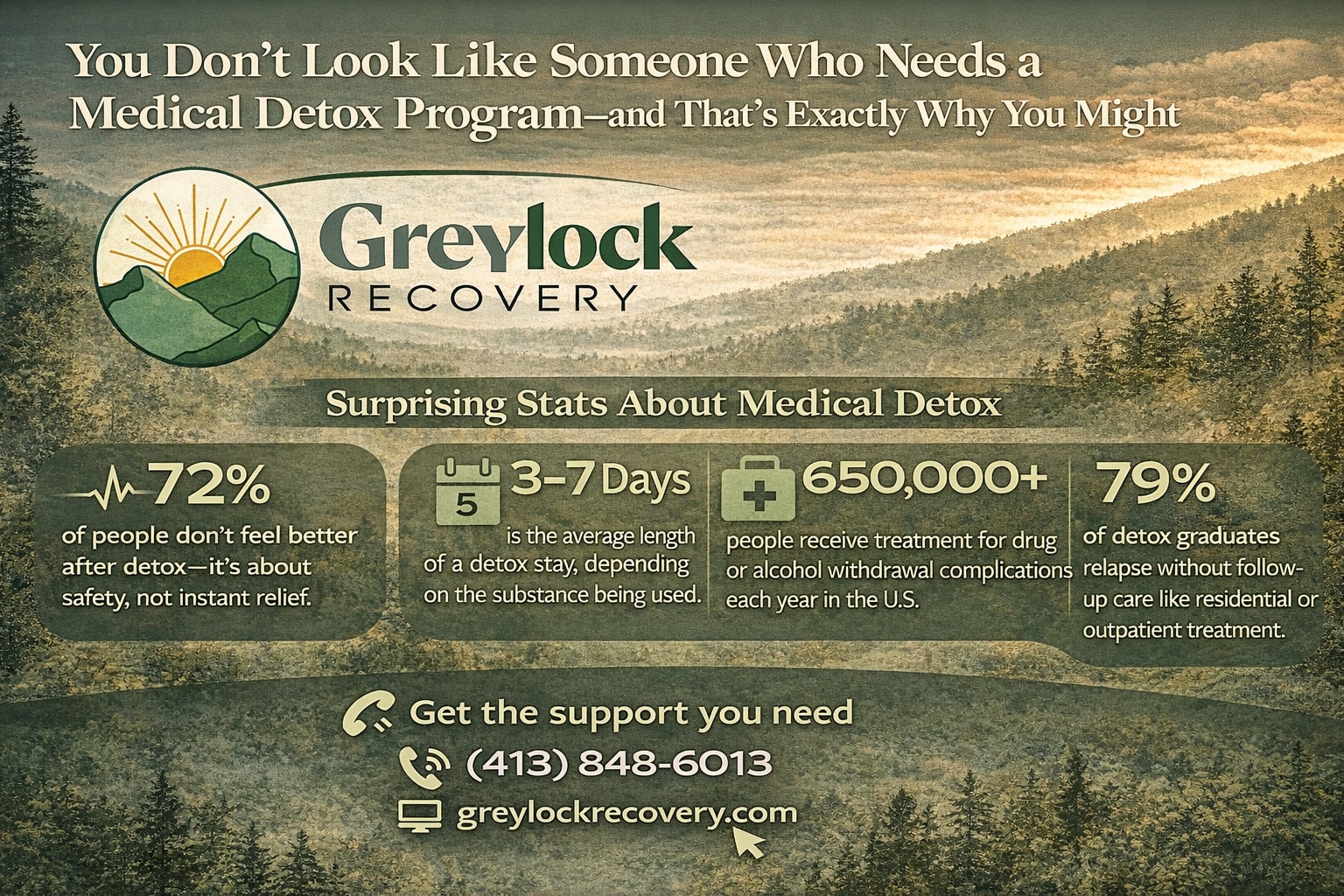
We don’t expect you to know what you need next. Detox is just the first 3–7 days. But they’re the most critical ones to do right.
You Don’t Need to Wait for a Crisis to Get Help
Let’s be blunt: waiting until you’re in the ER doesn’t make you braver.
If you’re reading this, some part of you already knows it’s time to stop. Not just slow down. Stop.
If your brain is shouting back, “But what about work? What will people think?”—we get it. That’s the fear talking.
But what happens if you don’t?
What happens if your body gives out before you give yourself permission to ask for help?
FAQ: Medical Detox for High-Functioning Individuals
Is detox only for “serious addicts”?
No. Detox is for anyone who may experience dangerous or uncomfortable withdrawal symptoms when stopping a substance. That includes high-functioning individuals who’ve built up physical dependence, even if they’re still managing life well on the outside.
What substances require medical detox?
Alcohol, benzodiazepines (like Xanax or Ativan), opioids (like oxycodone, heroin, or fentanyl), and certain stimulants may require detox—especially if used heavily or over a long period of time.
What’s the difference between medical detox and going “cold turkey” at home?
Medical detox involves supervision by trained professionals, medication to reduce withdrawal risks, and emergency support if complications arise. Going cold turkey at home can be dangerous, especially with alcohol or benzos, and is never recommended without medical clearance.
Will I have to stay in treatment after detox?
Not unless you choose to. Detox is often the first step, but many people move into outpatient care, therapy, or support groups afterward. At Greylock, we help you plan what feels right for you—not pressure you into something you’re not ready for.
How private is the detox process?
Extremely. Our facility is discreet, and your care is protected under strict confidentiality laws. You don’t have to tell your boss, your family, or anyone else unless you choose to.
Find Medical Detox Support in Massachusetts
You don’t have to fall apart for your pain to be valid.
If you’re high-functioning and afraid of what might happen when you stop using, that fear is reason enough to reach out. A medical detox program isn’t the end of your independence—it’s the beginning of real freedom.
Call (413) 848-6013 or visit to learn more about our medical detox program services in Massachusetts.