
I remember sitting in my car with my bag in the passenger seat.
I had just left treatment early. Not “graduated.” Not “completed.” Left.
And before I even hit the highway, I had already rewritten the story in my head:
See? It doesn’t work for you. You’re not built for this.
If you’ve walked away from a program—especially something like Opioid Addiction Treatment—and quietly labeled yourself a failure, I want to talk to you like someone who’s been there.
Not as a brochure. Not as a lecture.
Just as a person who once said, “I tried. It didn’t work.”
The Story We Tell Ourselves After We Leave
When you leave early, the outside world doesn’t always see it.
But you do.
You replay the groups you skipped. The conversations you avoided. The way you felt restless, irritated, disconnected. You compare yourself to the people who “seemed to get it.”
And slowly, the narrative hardens:
- I’m not serious enough.
- I don’t want it badly enough.
- I’ll never change.
That story feels true because it’s loud.
But loud doesn’t mean accurate.
Sometimes It Wasn’t the Right Fit
Not every program is the right environment for every person.
Some people shut down in large groups. Others feel overwhelmed in highly structured settings. Some need more medical support. Others need more trauma work. Some need more time before they can even hear what’s being said.
You can genuinely want to stop using and still feel like the room you’re in isn’t reaching you.
That doesn’t make you resistant.
It means the fit might have been off.
Treatment isn’t one-size-fits-all. And if your nervous system felt constantly on edge, misunderstood, or unseen, leaving may have been your body trying to protect itself.
You Might Have Left Because It Was Getting Too Real
Here’s something most people don’t admit:
Sometimes treatment starts working—and that’s what scares you.
When the substances quiet down, other things get louder. Grief you never processed. Shame you’ve carried for years. Trauma you buried. The realization of what you’ve lost.
That kind of clarity can feel unbearable at first.
So you leave.
Not because you don’t care.
But because feeling everything at once is terrifying.
I’ve seen people say “this isn’t helping,” when what they really meant was, “This is hitting something I don’t know how to survive.”
“It Didn’t Work” Often Means “I Wasn’t Ready Yet”
Timing matters more than we like to admit.
Maybe you went because your family pushed you.
Maybe it was court-ordered.
Maybe you were exhausted and just wanted the chaos to stop.
Those are real reasons to walk through the door. But they don’t always translate into internal readiness.
Readiness isn’t about being perfectly motivated. It’s about being willing to sit in discomfort long enough to change. And sometimes, that willingness grows slowly.
Leaving once doesn’t mean you’ll leave again.
It might mean you needed more time to understand what you were actually fighting.
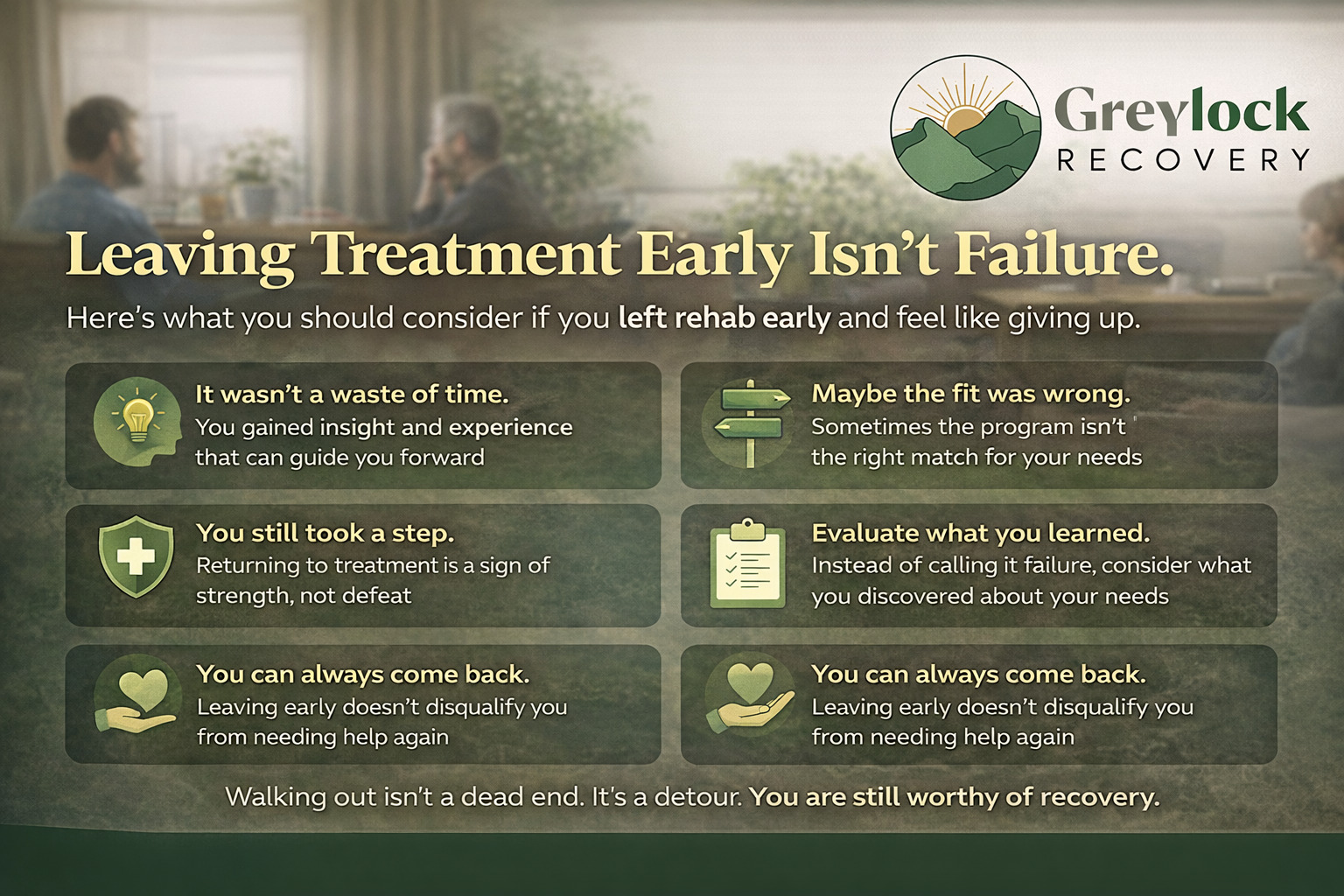
Relapse After Treatment Doesn’t Cancel the Progress
If you used again after leaving, I know how heavy that feels.
It’s easy to think, See? Total waste.
But recovery isn’t erased by relapse.
You still learned things. You heard language you didn’t have before. You met people who were living differently. You experienced—even briefly—what it felt like to wake up without chasing the next dose.
That doesn’t disappear.
I’ve watched people come back months or years later and say, “I didn’t realize it at the time, but something stuck.”
Growth is rarely dramatic. Sometimes it’s just a crack in the old story.
Leaving Early Doesn’t Disqualify You From Coming Back
There’s this quiet fear that once you leave, the door closes.
“They won’t take me seriously.”
“They’ll judge me.”
“I already blew my shot.”
Most reputable programs don’t see it that way.
They’ve seen this before. People step in. Step out. Step back in. Sometimes they need structured daytime support. Sometimes multi-day weekly treatment works better. Sometimes round-the-clock care makes more sense for a season.
The level of care can change. The timeline can shift.
What matters is that you’re still alive—and still thinking about change.
The Skepticism Makes Sense
If you’re reading this with crossed arms, I get it.
You tried. You showed up. You were vulnerable. And it didn’t feel transformative.
It’s hard to risk that again.
But skepticism isn’t the same thing as hopelessness. Skepticism means you care enough to evaluate. You’re not blindly buying in. You want something real.
That’s not a weakness. That’s discernment.
The key question isn’t, “Will treatment magically fix me?”
It’s, “What kind of support might actually meet me where I am now?”
What If It Was Information, Not Failure?
Instead of saying:
“I blew it.”
What if you tried this:
- I learned what doesn’t resonate with me.
- I learned how quickly I want to escape discomfort.
- I learned I can walk into a treatment center—even if I didn’t stay.
That’s information.
And information can guide your next move.
Failure is a dead end.
Information is a map.
You’re Not the Only One Who Left
This part is important.
You are not uniquely broken because you didn’t complete a program.
Many people leave early at least once. Some come back stronger. Some try a different setting. Some need medical stabilization before therapy can really take hold.
There isn’t a straight line here.
If you’re still breathing and still questioning your relationship with opioids, the story isn’t over.
If you’re reconsidering your options, it may help to look again at what comprehensive Opioid Addiction Treatment can look like when the structure, support, and timing align differently.
You don’t have to pretend the first experience was perfect. You also don’t have to let it be the final word.
Frequently Asked Questions
Is leaving treatment early a sign that I’m not serious about recovery?
Not necessarily.
People leave for many reasons—fear, discomfort, outside pressure, family obligations, financial stress, or simply feeling overwhelmed.
Seriousness isn’t measured by perfect completion. It’s measured by whether you’re still willing to look at your life honestly. If you’re questioning what happened, that’s engagement—not apathy.
If I relapsed after treatment, does that mean it failed?
Relapse can feel like proof of failure. But in reality, it often signals that more support, a different structure, or additional tools are needed.
Treatment isn’t a magic shield against future use. It’s a foundation. Some people need to reinforce that foundation more than once.
Relapse doesn’t erase the insight you gained. It shows you where the gaps are.
What if I felt disconnected or misunderstood in my last program?
That matters.
Feeling unseen can shut anyone down. If the environment didn’t feel safe or aligned with your needs, it’s reasonable to reassess.
Different programs vary in structure, intensity, therapeutic focus, and culture. A different setting can create a completely different experience.
How do I know if I’m actually ready this time?
Readiness doesn’t mean you’re fearless. It means you’re willing to tolerate discomfort for the possibility of something better.
You might be more ready if:
- You’re tired of repeating the same cycle.
- You’re more honest with yourself about the consequences.
- You’re open to trying a different approach instead of proving the last one “didn’t work.”
You don’t have to be 100% sure. You just have to be willing to explore.
What if I’m embarrassed to call the same center again?
Embarrassment is common. So is shame.
But treatment providers have seen people leave and return many times. Reaching back out isn’t unusual—it’s human.
You can start with a simple conversation. No grand promises. No dramatic declarations. Just, “I’m thinking about trying again.”
That’s enough.
What if I’m scared it still won’t work?
That fear is honest.
Instead of asking, “Will this fix me forever?” try asking, “What support would make it easier to stay this time?”
Different structure. Medication support. Smaller groups. More one-on-one time. A different pace.
Recovery isn’t about blind faith. It’s about adjusting the variables until something holds.
If part of you is still wondering whether change is possible—even after leaving once—that part deserves attention.
You don’t have to call it failure.
You can call it unfinished.
Call (413) 8486013 or visit our Opioid Addiction Treatment services to learn more about our Opioid Addiction Treatment services in Williamstown, Massachusetts.