

You’ve probably replayed this decision a hundred times.
Maybe you’ve tried cutting back. Maybe you promised yourself “just weekends.” Maybe you’ve had that quiet 2 a.m. moment where you thought, I can’t keep doing this.
Now you’re here. Not in denial. Not pretending it’s fine.
Just scared.
At Greylock Recovery, we meet people in that exact space every day. If you’ve been searching for answers about Alcohol Addiction Treatment, what you likely want isn’t marketing.
You want to know what actually happens.
And whether it can really work for someone like you.
Let’s walk through it—clearly, gently, and honestly.
The First Conversation Is About You—Not Your Worst Moment
When people imagine treatment, they picture interrogation.
That’s not what happens here.
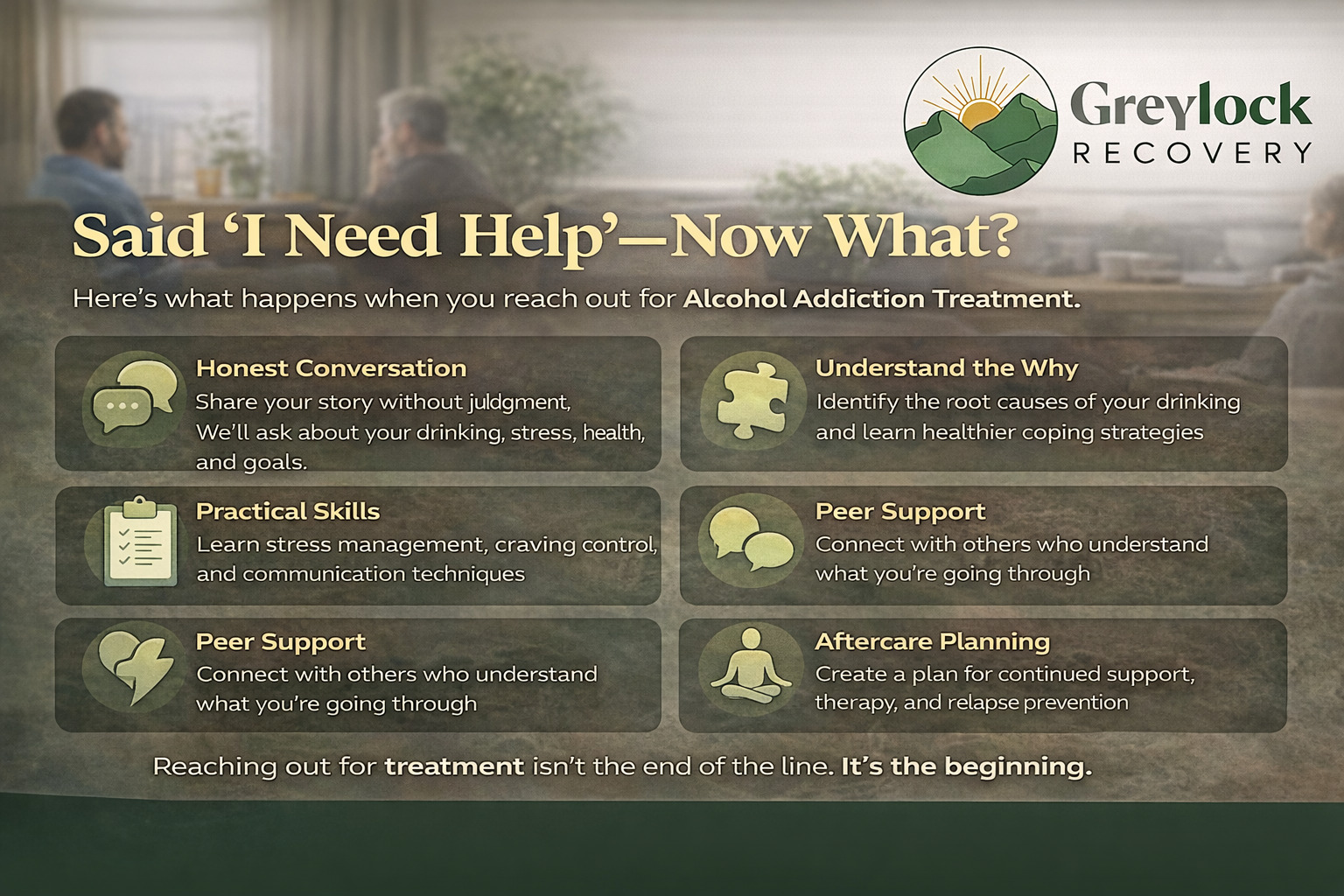
Your first step is a real conversation. We’ll ask about your drinking, yes—but we’ll also ask about your sleep, your stress, your relationships, your work, your anxiety, your losses.
We want context. Because alcohol rarely shows up in a vacuum.
You won’t be reduced to “how much” or “how often.”
You’ll be seen as a whole person whose coping strategy stopped working.
And that shift—from shame to understanding—is where hope begins.
If Your Body Needs Help Stabilizing, We Start There
Many first-time treatment seekers worry about withdrawal.
“Is it going to be awful?”
“What if I can’t handle it?”
“What if I change my mind?”
If your body has developed physical dependence, stopping suddenly can feel overwhelming. That’s why medical support matters. It isn’t dramatic. It isn’t punitive. It’s steady.
The goal is to help your nervous system regulate safely.
Because when your body calms down:
- Your thinking becomes clearer
- Your anxiety reduces
- Your sleep improves
- Your emotional work becomes possible
Trying to heal while your body is in crisis is like rebuilding a house during a storm. We stabilize first—then we build.
We Help You Understand What Alcohol Was Doing For You
This surprises people.
You don’t come here to be told drinking is bad. You already know the consequences.
Instead, we explore something more honest:
What did alcohol solve for you?
Did it:
- Quiet racing thoughts?
- Help you socialize without feeling exposed?
- Numb unresolved grief?
- Create relief from constant pressure?
When mental health and alcohol use intersect, drinking often becomes a coping mechanism—not just a habit.
Understanding that doesn’t excuse the damage.
But it does remove the myth that you’re weak.
When you see the function behind the behavior, you can build healthier replacements.
You Learn Practical Skills—Not Just Insights
Insight is powerful. But insight without tools feels frustrating.
So we practice.
In individual therapy and group sessions, you’ll work on:
Regulating Stress in Real Time
You’ll learn how to calm your nervous system without numbing it—through grounding skills, breathing techniques, and cognitive tools that reduce panic and overwhelm.
Managing Cravings Without Panic
Cravings aren’t moral failures. They’re neurological patterns. We teach you how to ride them out, interrupt them, and reduce their intensity over time.
Communicating Honestly
Many people use alcohol to avoid conflict or vulnerability. Treatment helps you build the language to say what you need—without shutting down or exploding.
Building Structure That Supports Sobriety
Recovery isn’t just about not drinking. It’s about redesigning your daily life so it doesn’t constantly push you back toward it.
It can feel awkward at first. New skills always do.
But think of it like emotional physical therapy. The muscles feel shaky before they get strong.
You Won’t Be the Only One Who Feels This Way
Isolation feeds addiction.
Shame tells you:
- “No one drinks like you.”
- “You’re uniquely broken.”
- “If people knew, they’d leave.”
Then you sit in a room and someone says something that feels pulled straight from your own mind.
And the isolation cracks.
Group therapy isn’t about forced sharing. It’s about realizing your internal world isn’t as rare—or as hopeless—as you thought.
One alumni shared:
“I thought treatment would make me feel exposed. It actually made me feel understood for the first time.”
– Greylock Recovery Client
Connection isn’t a bonus feature. It’s a core ingredient.
Treatment Isn’t One-Size-Fits-All
Not everyone needs the same level of support.
Depending on your situation, that could include:
- Live-in treatment with round-the-clock support if your environment isn’t stable or safe
- Structured daytime care that provides full-day therapeutic support without overnight stays
- Multi-day weekly treatment that allows you to maintain work or family commitments while receiving consistent clinical care
The intensity is tailored to you.
Some people need distance from daily triggers.
Others need strong clinical support while staying connected to home life.
We build a plan around your reality—not someone else’s.
We Prepare You for Life After Treatment—Not Just Life Inside It
A common fear:
“What happens when I leave?”
This is where real recovery planning begins.
You’ll work on:
- Identifying triggers in your real environment
- Creating relapse prevention strategies
- Building accountability systems
- Connecting to ongoing therapy or support groups
- Strengthening family communication
Treatment isn’t meant to isolate you from the world. It’s meant to prepare you to re-enter it differently.
More regulated.
More honest.
More supported.
Why This Actually Works
Here’s the honest answer.
Alcohol use reshapes the brain’s reward system. It changes stress responses. It rewires habits.
You can’t out-shame that.
You can’t out-willpower it forever.
What works is a combination of:
- Medical stabilization
- Evidence-based therapy
- Behavioral skill-building
- Peer support
- Structured accountability
- Ongoing planning
When these elements work together, your brain begins to heal.
And slowly—sometimes quietly—you start recognizing yourself again.
Recovery isn’t about becoming someone new.
It’s about coming back to who you were before alcohol became your solution.
Frequently Asked Questions
How long does treatment usually last?
It depends on your needs. Some people benefit from several weeks of structured care. Others engage in multi-month step-down approaches that gradually reduce intensity while maintaining support. We assess your situation and recommend a timeline that balances effectiveness and sustainability.
What if I’ve tried to quit before and failed?
That’s more common than you think.
Previous attempts don’t mean you can’t recover. They often mean you didn’t have enough support, structure, or clinical insight at the time.
Many people who succeed long-term had earlier attempts that didn’t stick.
Failure isn’t final. It’s data.
Will I have to talk in group?
You’ll never be forced to share before you’re ready.
Participation is encouraged—but safety matters. Many people start by listening. Over time, as trust builds, speaking becomes easier.
There’s no performance requirement.
What if I have anxiety or depression too?
You’re not alone.
Many individuals seeking Alcohol Addiction Treatment also experience underlying mental health concerns. Treating both at the same time is often essential. When anxiety or depression improves, the urge to self-medicate often decreases as well.
Can I work while in treatment?
In some cases, yes.
Structured daytime care or multi-day weekly treatment options may allow flexibility around work schedules. During your assessment, we’ll discuss what’s realistic and safe for you.
What if I’m scared I won’t succeed?
That fear is incredibly common.
You don’t have to believe 100% that this will work. You just have to be willing to try with support.
Courage in recovery doesn’t look loud.
It looks like showing up while scared.
Will people find out?
Your privacy matters. Treatment is confidential. We’ll discuss who, if anyone, you want involved—family, employers, or no one at all.
You remain in control of your information.
What happens if I relapse during or after treatment?
Relapse is not a moral failure.
If it happens, we reassess. We adjust. We strengthen support. Recovery is rarely linear, and we approach setbacks as signals—not punishments.
The door doesn’t close.
You don’t need to have everything figured out before you reach out.
If you’re tired of managing this alone—if you’re exhausted from pretending—you deserve real support.
Call 413-848-6013 or visit our Alcohol Addiction Treatment services to learn more about our Alcohol Addiction Treatment services in Williamstown, Massachusetts.