


You might not drink in the morning.
You might not miss work.
You might not fit the stereotype.
But lately, when you say, “It’s not that bad,” something inside you whispers, Are you sure?
If you’re sober curious—exploring, questioning, not labeling—this isn’t about forcing you into a box. It’s about helping you decide whether getting real support would feel like relief.
If you’ve already browsed our alcohol addiction treatment options, you’re not overreacting. You’re gathering information. That’s thoughtful. That’s brave.
Here’s how to know whether taking the next step makes sense for you.
1. You’ve Tried to Change Your Drinking—But It Doesn’t Stick
You’ve made rules.
Only weekends.
Only two.
Only socially.
Only after 7 p.m.
And sometimes it works… for a while.
Then stress hits. Or celebration. Or boredom. Or loneliness. And you’re back to negotiating with yourself.
The mental energy this takes is enormous. You might look fine on the outside, but inside you’re running spreadsheets: How much did I have? Is this too much? Am I okay?
If moderation feels like a second job, that’s information—not failure.
A lot of people who eventually seek support say the same thing:
“I wasn’t out of control. I was just tired of managing it.”
2. Your Relationship With Alcohol Feels Louder Than It Used To
Maybe your drinking hasn’t dramatically increased. But your thoughts about it have.
You think about when you’ll drink next.
You look forward to it more than you’d like to admit.
You feel slightly irritated when plans don’t include it.
It’s subtle. Quiet. Easy to justify.
But when something becomes the emotional punctuation mark of your day—This will make tonight better—it can slowly crowd out other coping skills.
Support isn’t about punishing that pattern. It’s about understanding it.
3. The Hangovers Are Emotional, Not Just Physical
The headache fades.
The anxiety doesn’t.
You wake up at 3 a.m. replaying conversations.
You check your phone with dread.
You promise yourself you’ll “do better” next time.
Even if nothing catastrophic happened, there’s a heaviness.
For many sober curious adults, it’s not rock bottom that pushes them to consider help. It’s emotional exhaustion.
Alcohol can amplify anxiety and low mood—even in people who don’t consider themselves “depressed.” If you notice that drinking makes your mental health worse, that’s a meaningful pattern.
You deserve mornings that don’t start with regret.
4. You’re Functioning… But White-Knuckling
You’re high-performing. Responsible. Capable.
You meet deadlines.
You show up for your family.
You look composed.
But internally? You feel like you’re holding it together with tension and caffeine.
A lot of people we meet say some version of:
“I’m not falling apart. I’m just constantly bracing.”
Alcohol can become a pressure valve. The fastest way to take the edge off.
If the idea of stopping feels less scary than the idea of continuing exactly like this for five more years, that’s worth exploring.
You don’t need visible chaos to justify support.
5. You’ve Started Hiding Pieces of It
Secrecy is often the quiet tipping point.
You:
- Refill your glass before people notice
- Downplay how much you had
- Toss bottles before anyone sees
- Feel relieved when no one comments
It’s not always dramatic deception. Sometimes it’s just avoidance.
But hiding—even small things—creates distance from the people you care about. And from yourself.
When alcohol moves into the shadows, it usually means part of you already senses misalignment.
That’s not shameful. It’s awareness.
6. You’re Afraid of What Getting Help Would Mean
This one is big.
Maybe you’re not afraid of quitting.
You’re afraid of identity shift.
What happens to:
- Your social life?
- Your confidence at events?
- Your creativity?
- Your way of unwinding?
If alcohol has been woven into how you relax, connect, or celebrate, imagining life without it can feel destabilizing.
We hear this often.
“I thought I’d lose who I was. Instead, I finally met myself.”
– Alumni, 2024
Treatment doesn’t erase your personality. It helps you untangle it from something that may no longer be serving you.
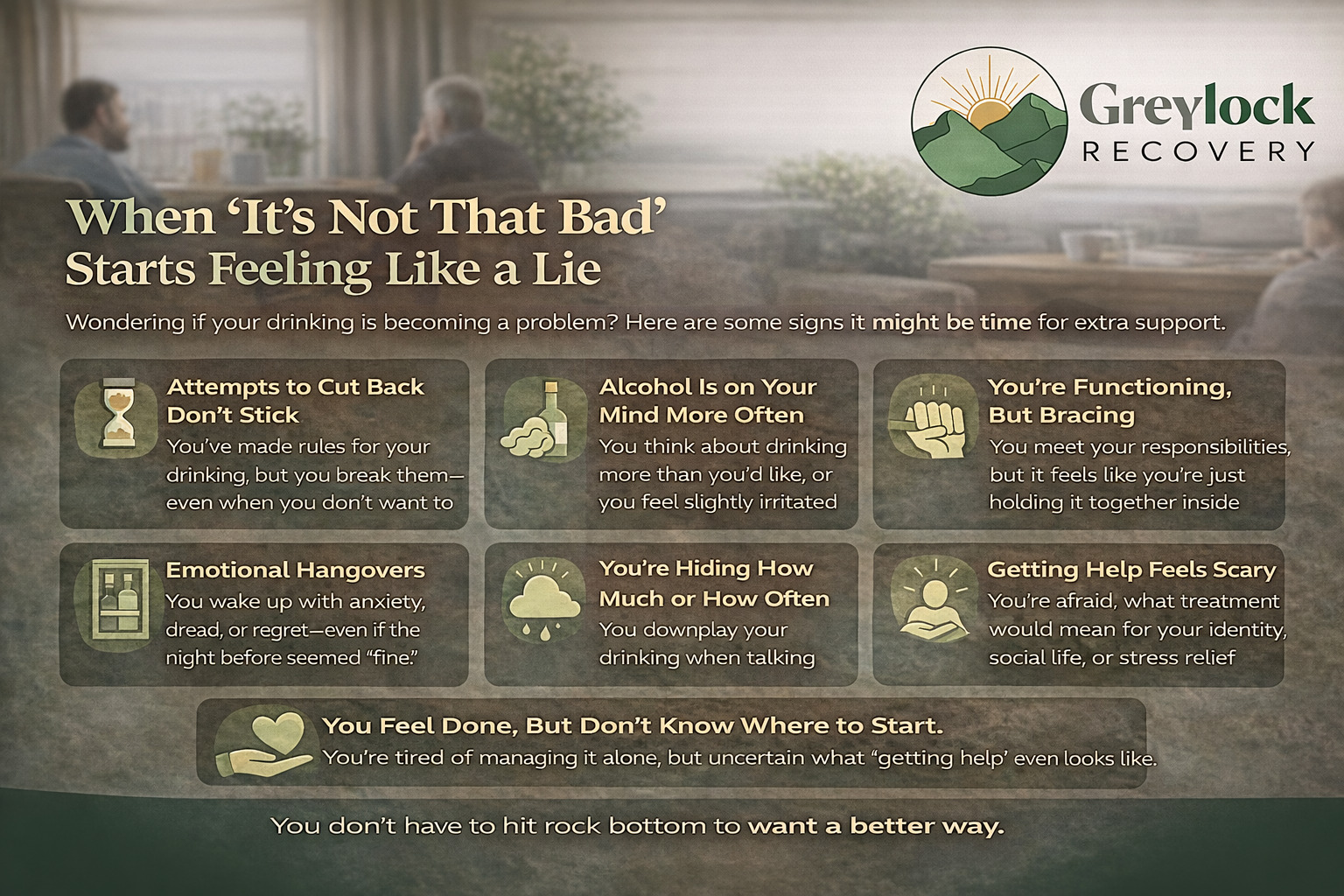
7. You Want Support—Not Just Willpower
You can quit for a week. Maybe two.
But what you really want isn’t a streak. It’s freedom.
Support can look different depending on what you need:
- Structured daytime care if you need more stability
- Multi-day weekly treatment that works around your job
- Individual therapy to address stress, trauma, or anxiety beneath the drinking
- Group connection with others quietly asking the same questions you are
Alcohol addiction treatment isn’t about being “bad enough.” It’s about getting help when something feels off.
Sometimes people come in unsure. They don’t identify as alcoholics. They just know they want change.
That’s enough.
What Success Actually Looks Like
It’s not dramatic.
It’s subtle.
It looks like:
- Sleeping through the night
- Saying yes to plans without needing a drink first
- Laughing and remembering it
- Driving home clear-headed
- Feeling emotionally steady
It’s not perfection. It’s relief.
And relief is powerful.
We’ve worked with parents who wanted to show up more fully for their kids.
Professionals who were tired of being sharp at work and numb at home.
Creatives who feared losing their spark—and instead found clarity.
You don’t need a catastrophe to deserve a course correction.
A Gentle Self-Check
If you’re still unsure, sit with these questions:
- Do I feel more peace when I drink less?
- Have I tried to change my drinking more than once?
- Does alcohol complicate my mental health?
- Am I hiding any part of this?
- Would I feel relieved if someone else helped me sort this out?
If even one question lands hard, you don’t have to carry that alone.
Exploring alcohol addiction treatment doesn’t mean committing to anything forever. It means having a real conversation with professionals who understand nuance—not stereotypes.
Frequently Asked Questions
Do I have to call myself an alcoholic to get help?
No. Labels are not a requirement for support. Many people enter treatment simply because their relationship with alcohol feels unhealthy or unsustainable. The focus is on patterns and impact—not identity.
What if I’m still functioning in my job and relationships?
Functioning doesn’t equal thriving. Many high-achieving adults seek help before external consequences happen. Getting support early can prevent deeper disruption later—and often feels far less overwhelming than waiting for a crisis.
How do I know if I need structured care versus therapy once a week?
It depends on factors like:
- How often you’re drinking
- Whether you experience withdrawal symptoms
- The impact on your mental health
- Your past attempts to cut back
An assessment can clarify the level of support that fits. Sometimes weekly therapy is enough. Sometimes more structure provides faster stabilization. The right approach is personalized.
Will treatment completely disrupt my life?
Not necessarily. Many programs are designed to fit around work, family, and responsibilities. Options range from intensive daytime support to multi-day weekly care. The goal is to help you build a stable foundation—not upend your entire world.
What if I try this and decide it’s not for me?
Exploring help is not a life sentence. It’s a step. Many people begin cautiously, unsure if they “qualify.” The first conversation is about understanding—not locking you into anything.
I’m scared sobriety will make me boring. Is that normal?
Very normal.
Alcohol often feels tied to confidence, humor, or connection. But many people discover those qualities were theirs all along. Sobriety doesn’t erase personality—it removes interference.
What happens in the first call?
The first call is simple. We ask about your current situation, your goals, and what you’ve been experiencing. There’s no pressure, no interrogation, and no obligation. It’s a conversation to see what support might feel right.
What If This Is the Moment You Stop Minimizing?
If you’re reading this carefully—if parts of it made your stomach drop a little—you already know something deserves attention.
You don’t need to wait until it’s worse.
You don’t need to prove that you’ve suffered enough.
You can choose support because you want more from your life.
Call 413-848-6013 or visit our Alcohol Addiction Treatment services to learn more about our Alcohol Addiction Treatment services in Williamstown, Massachusetts.
You’re not dramatic.
You’re not broken.
You’re paying attention.
And that might be the most powerful starting point of all.