

There’s a moment where everything shifts—but not in a dramatic way.
You’ve admitted, at least to yourself, that something isn’t working anymore.
And now you’re staring at a different kind of question:
“What kind of help do I actually need?”
Not if.
Not whether it’s bad enough.
Just… how much support is enough to finally make this stick?
For many people, that’s when options like live-in treatment support start coming up—and with them, a wave of second-guessing.
Because this doesn’t feel like a simple decision.
It feels like choosing between holding onto your life… or stepping away from it.
Let’s walk through this in a way that actually helps.
The Decision Feels Bigger Than It Is (But Also Exactly As Big As It Feels)
Here’s the paradox:
This choice is not about your worth.
It’s not about how “bad” things are.
But it does matter deeply—because the level of support you choose can shape how steady your start feels.
A lot of people freeze here because they think:
- “If I choose too much, I’m overreacting.”
- “If I choose too little, I’ll fail again.”
That pressure can keep you stuck longer than anything else.
So let’s remove one thing right away:
There is no punishment for needing more support.
Only an opportunity to give yourself a better chance.
Staying Home While Getting Help: What It Really Feels Like
On paper, staying home can feel like the easier option.
You keep your routine.
You stay in your environment.
You don’t have to explain as much to others.
And for some people, it works—especially if there’s already stability in place.
But the emotional reality is often more complicated.
Because while you’re trying to change, everything around you is staying the same.
That means:
- The same stressors still show up
- The same habits are within reach
- The same emotional patterns get triggered in real time
So you’re not just doing the work of recovery.
You’re doing it while actively navigating the exact environment that made it hard in the first place.
For some, that builds resilience.
For others, it feels like trying to rebuild while the ground is still shaking.
Stepping Away: Why It Feels So Hard to Say Yes
Let’s name it directly.
The idea of stepping away—even temporarily—can feel overwhelming.
People worry about:
- Work responsibilities
- Family expectations
- Finances
- Being judged or misunderstood
But underneath all of that is something quieter:
“What if I lose control of my life?”
Here’s the reframe we offer often:
You’re not losing control—you’re choosing where to place it.
Because right now, things may already feel out of control internally.
Stepping into a more supported environment doesn’t take your life away.
It gives you a chance to stabilize within it.
The Environment Question Most People Avoid
This is one of the most important—and most uncomfortable—questions:
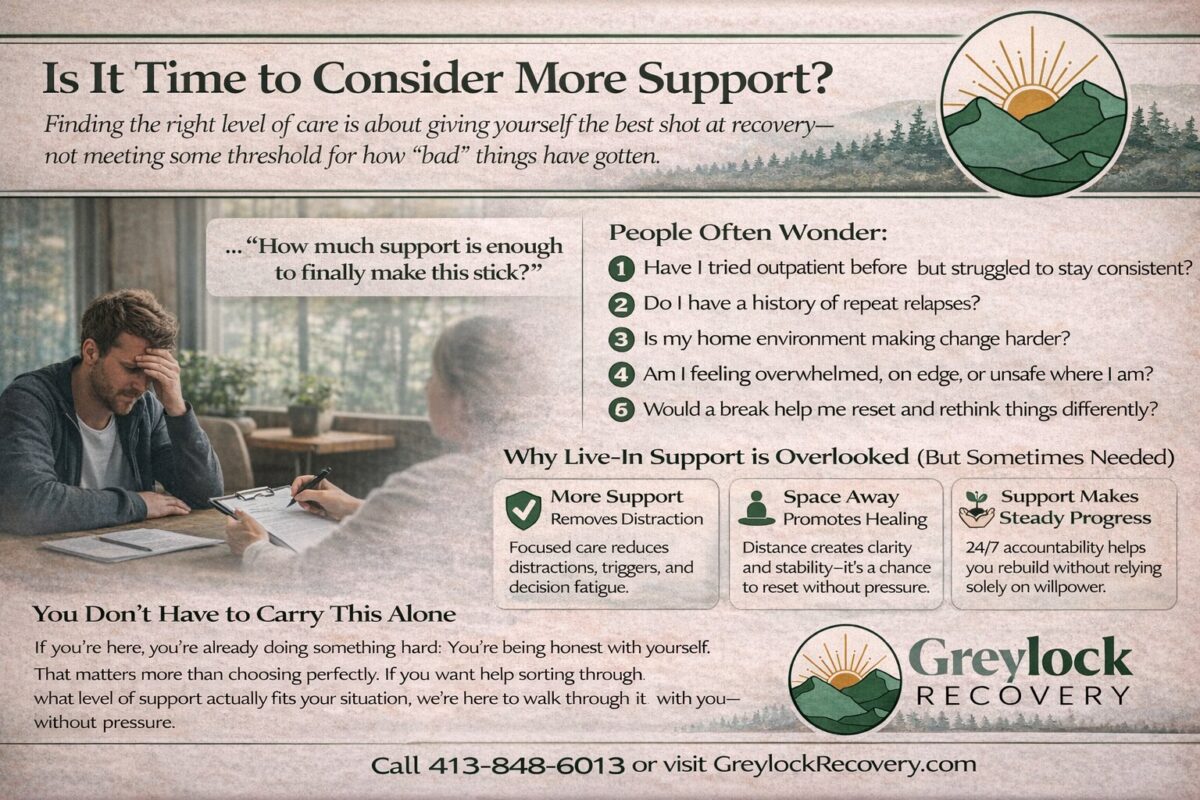
Is your current environment helping you change… or making it harder?
Not in theory. In reality.
Ask yourself:
- Are there people, places, or routines that pull you back into old patterns?
- Do you feel safe enough—physically and emotionally—to focus on getting better?
- Can you realistically build new habits where you are right now?
If the honest answer is no, that matters.
Because recovery doesn’t happen in isolation from your environment.
It happens inside it.
And sometimes, changing your environment—even temporarily—is what allows everything else to shift.
Support Isn’t About Strength — It’s About Fit
This is where a lot of people get stuck in comparison.
They think:
- “Other people handle this without stepping away.”
- “I should be able to manage this on my own.”
But recovery isn’t about proving anything.
It’s about finding the level of support that actually fits your situation.
Some people need:
- More structure
- More distance from triggers
- More consistent accountability
Others can build momentum with less intensive support.
Neither is better.
But one may be more aligned with what you need right now.
If You’ve Tried Before, That Information Matters
A question we gently ask:
“What happened the last time you tried to do this?”
Not to judge.
Just to understand.
If you’ve:
- Tried to cut back on your own
- Tried outpatient support but struggled to stay consistent
- Found yourself repeating the same cycle
That’s not failure.
That’s data.
And often, that data points toward needing a different level of support—not more willpower.
The Myth of “I’ll Figure It Out As I Go”
It’s tempting to choose the path that feels less disruptive.
To think:
“I’ll start small and adjust later if I need to.”
And sometimes, that works.
But sometimes, it delays the level of support that would have helped from the beginning.
There’s no rule that says you have to struggle at one level before “earning” more help.
You’re allowed to choose what gives you the best shot—right now.
A Metaphor That Might Help
Imagine trying to learn how to swim.
One option is practicing in open water—with waves, currents, and uncertainty.
The other is starting in a space where you can stand, breathe, and focus.
Both lead to learning.
But one gives you more stability at the start.
This decision works the same way.
You’re Not Choosing Forever
Another pressure point:
“What if I choose wrong?”
Here’s what matters:
This isn’t a permanent identity. It’s a starting point.
Care can evolve.
Support can shift.
What you choose now is simply what helps you begin.
This Is About Giving Yourself a Real Chance
If there’s one thing to take from this, it’s this:
You don’t need to pick the option that looks easiest.
You need to pick the one that makes it most possible for you to follow through.
Because motivation comes and goes.
But the right level of support stays with you when motivation dips.
FAQ: Honest Questions People Ask at This Stage
How do I know if I need to step away instead of staying home?
If your current environment feels unstable, triggering, or makes it hard to stay consistent, stepping away may give you the space needed to reset and focus fully.
What if I’m not “bad enough” to need that level of care?
There’s no threshold you have to meet. If you’re struggling and previous attempts haven’t worked, more support isn’t an overreaction—it’s a strategy.
Can I still stay connected to my life if I step away?
Yes. While you may pause certain responsibilities, the goal is to return more stable and capable—not disconnected from your life.
What if I try staying home first and it doesn’t work?
That’s okay. Many people adjust their level of care over time. What matters is staying engaged and being honest about what’s working.
Is it normal to feel scared about making the wrong decision?
Completely. This is a big step. Fear doesn’t mean you’re making the wrong choice—it means you care about the outcome.
How quickly do I have to decide?
You don’t need to rush—but staying stuck in indecision can keep things the same. Even exploring options is a meaningful step forward.
You Don’t Have to Carry This Alone
If you’re here, you’re already doing something hard:
You’re being honest with yourself.
That matters more than choosing perfectly.
If you want help sorting through what level of support actually fits your situation, we’re here to walk through it with you—without pressure.
Call 413-848-6013 or visit our addiction recovery programs, residential addiction treatment services to learn more about your options.
You don’t have to have it all figured out.
You just have to take the next step that gives you a real chance to feel better.