

I remember the exact moment I knew I was in trouble.
It wasn’t dramatic. No flashing lights. No crisis.
It was the morning after.
Ninety days sober behind me. A room full of people who had hugged me, clapped for me, told me they were proud of me. And now I was sitting on the edge of my bed, staring at my phone, trying to decide whether to disappear or tell the truth.
Relapse doesn’t just sting. It burns.
And the worst part? I didn’t think I deserved to come back.
Within the first few days of trying to “handle it myself,” I found myself back on the page for alcohol addiction treatment at Greylock Recovery. Not because I didn’t understand what treatment was. I’d already done it.
But because I needed to know if there was still a place for me.
If you’re alumni and you relapsed after 90 days—or 9 months—this is for you.
The Shame Hits Harder the Second Time
The first time I entered treatment, I was scared.
The second time, I was ashamed.
There’s something about getting sober once that changes the emotional stakes. You’ve proven you can do it. You’ve said the words. You’ve posted the milestones. People know.
So when you relapse, it feels public—even if no one technically knows yet.
The thoughts get loud:
- I ruined everything.
- They’re going to think I didn’t take it seriously.
- Maybe I’m just not built for this.
And here’s the thing no one says enough: shame after relapse can be more dangerous than the relapse itself.
Because shame isolates.
The Part No One Sees
My relapse didn’t look chaotic on the outside.
I still went to work.
I still answered emails.
I still showed up to family dinner.
But inside, I felt like I was splitting in half.
There was the version of me that had learned tools, built routines, and believed in recovery.
And there was the part whispering, See? This is who you really are.
Relapse can make you question your entire identity. Was the sober version fake? Was it all temporary?
That internal conflict is exhausting.
And it’s why so many alumni don’t come back right away.
Walking Back In Was the Hardest Step
I wish I could tell you I marched confidently back through the doors.
I didn’t.
I stalled. I minimized. I tried to “reset” on my own. I told myself I’d call after a few clean days so I wouldn’t look like a mess.
Eventually, I realized something simple and uncomfortable:
Waiting to feel less ashamed wasn’t working.
So I walked back in while I still felt ashamed.
And here’s what happened.
No one scolded me.
No one looked disappointed.
Someone looked me in the eye and said, “I’m really glad you came back.”
I didn’t know how much I needed that until I heard it.
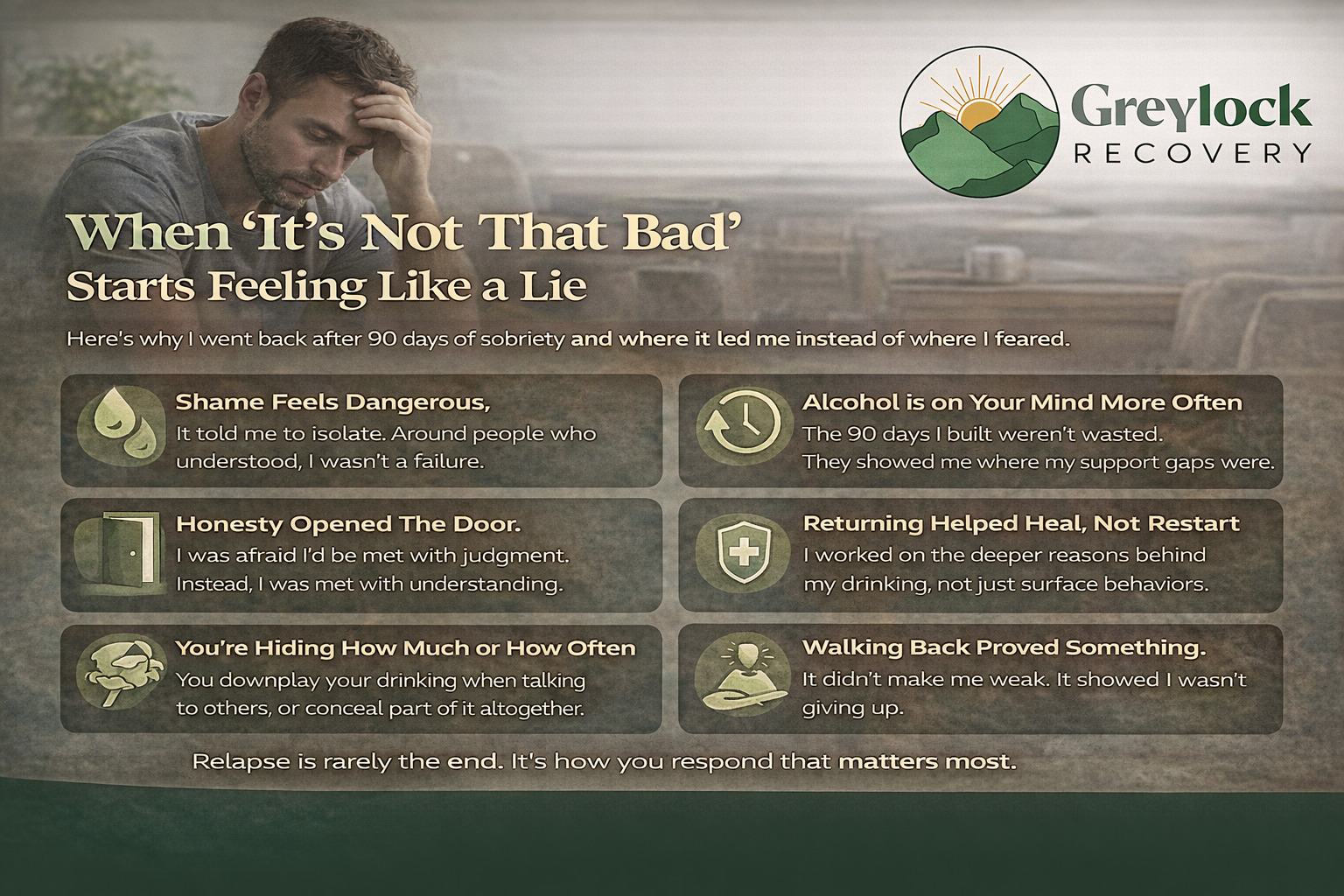
Relapse Didn’t Erase My 90 Days
This took me a while to understand.
Relapse feels like you hit delete on everything.
But you don’t.
You still built 90 days of experience. You still learned your triggers. You still proved you can live sober. You still built connections.
None of that disappears.
What relapse did for me was expose the gaps.
The stress I wasn’t talking about.
The resentment I was stuffing down.
The isolation creeping in quietly.
The first time around, I was focused on stopping drinking.
The second time, I focused on understanding why I wanted to escape in the first place.
That shift changed everything.
The Second Round Was Different (In a Good Way)
I stopped trying to be impressive.
The first time, I wanted to “do recovery right.” I followed the rules. I said the right things. I wanted to be the success story.
The second time, I got honest.
I admitted when I romanticized drinking.
I admitted I felt left out socially.
I admitted I was tired of trying so hard.
That level of honesty felt risky.
But it was also freeing.
When I returned to alcohol addiction treatment, I wasn’t starting from zero. I was starting from experience. And that made the work deeper.
Less performance.
More truth.
If You’re Afraid to Come Back
Maybe you ghosted.
Maybe you stopped answering calls.
Maybe you told yourself you’d figure it out alone.
You’re not the first.
Programs see this all the time. Not because people don’t care—but because shame convinces us we’re disqualified.
You’re not disqualified.
Relapse doesn’t cancel your seat at the table.
It just means something in your support system needs strengthening.
And that’s fixable.
You’re Not Weak for Needing More Support
There’s this quiet belief that if treatment “worked,” you wouldn’t need it again.
That belief kept me stuck for weeks.
But recovery isn’t a one-and-done event. It’s a process. Sometimes that process includes returning to structured support—whether that’s live-in treatment, structured daytime care, or multi-day weekly treatment while you rebuild stability.
Needing help again doesn’t mean it failed.
It means you’re still fighting.
And that matters.
FAQ: Relapse After 90 Days
Is relapse common after 90 days sober?
Yes. The early months of recovery can feel stable on the outside, but internal stressors often build quietly. Ninety days is significant—but it’s still early in the long-term healing process.
Relapse is more common than most people admit. You are not uniquely broken.
Should I feel ashamed for relapsing?
Shame is a common reaction—but it’s not a helpful one.
Relapse is information. It points to areas that need more support, structure, or emotional processing. It’s not a moral failure.
The goal isn’t to ignore it. The goal is to respond to it with honesty instead of hiding.
Do I have to start completely over?
No.
While you may reset your sobriety date, you don’t lose the knowledge, tools, or insight you gained. Many alumni say their second attempt at recovery feels more grounded because they know what to expect.
You’re not starting from scratch. You’re starting from experience.
Will people judge me if I come back?
Most treatment teams understand relapse as part of many recovery journeys. Their priority is safety and stabilization—not judgment.
If you’re imagining disappointed faces, that’s usually shame talking—not reality.
How do I know if I need to return to treatment?
Ask yourself:
- Am I trying to manage this alone and struggling?
- Am I isolating from sober support?
- Has my use escalated quickly?
- Do I feel out of control again?
If the answer is yes to even one of those, reaching out is wise—not dramatic.
Early intervention is easier than waiting for another crisis.
What if I’m embarrassed to call?
You can say exactly that.
“I relapsed and I feel embarrassed.”
That’s enough.
You don’t need a polished explanation. You don’t need a speech. Just honesty.
This Is Not the End of Your Story
Relapse can feel like a verdict.
Like a judge slamming a gavel and saying, “See? Case closed.”
It’s not.
It’s a plot twist.
And sometimes plot twists make the story stronger.
Walking back into alcohol addiction treatment the second time didn’t make me weaker. It made me braver. Because this time, I knew exactly what I was risking—and I chose recovery anyway.
If you’re hovering outside the door right now, unsure if you’re allowed back, hear this:
You are.
No performance required.
No perfection expected.
No shame needed at the door.
Just you.
Call 413-848-6013 or visit our Alcohol Addiction Treatment services to learn more about our Alcohol Addiction Treatment services in Williamstown, Massachusetts.