

A mother once described a phone call she never forgot.
Her son was twenty years old.
For months, she had worried about his drinking. Some weeks seemed better. Some weeks seemed worse. Like many parents, she spent a lot of time wondering whether she was overreacting.
Then he called.
Not because he had been drinking.
Because he had stopped.
His voice sounded shaky. He told her he couldn’t stop sweating. His hands were trembling. His stomach felt awful. He hadn’t slept. His anxiety was through the roof.
His first question wasn’t about treatment.
It wasn’t about recovery.
It was much simpler.
“Is something seriously wrong with me?”
If you’ve found yourself asking a similar question—or watching someone you love ask it—you are not alone.
Many people begin searching for answers after stopping alcohol and feeling surprisingly sick. Some eventually learn that their symptoms may be connected to withdrawal and begin exploring options like medical detox support.
As a clinician, I’ve seen how frightening this experience can be.
I’ve also seen how much hope exists on the other side of it.
#1: Is It Actually Normal to Shake and Sweat After Stopping Alcohol?
It can be.
One of the biggest misconceptions about alcohol is that withdrawal only happens to people whose lives have completely fallen apart.
That’s not what we see in real life.
Many people experiencing withdrawal still have jobs.
They go to school.
They live with family.
They maintain relationships.
From the outside, they may appear functional.
Yet when they stop drinking, their body reacts.
Shaking, sweating, nausea, restlessness, and anxiety can all occur as the body adjusts to the absence of alcohol.
For many people, the symptoms feel unexpected because they assumed stopping alcohol would immediately make them feel better.
Instead, they feel worse.
That can be incredibly confusing.
#2: Why Does It Feel Like I Have the Flu?
This is one of the most common descriptions we hear.
People tell us:
“I feel like I got hit by a truck.”
“It feels like the worst flu I’ve ever had.”
“I thought I was getting sick.”
The reason is simple.
Many withdrawal symptoms overlap with symptoms people associate with illness.
You may experience:
- Sweating
- Chills
- Nausea
- Headaches
- Fatigue
- Body discomfort
- Trouble sleeping
- Increased heart rate
Many people searching for information about alcohol withdrawal shaking symptoms initially assume they have a virus.
What surprises them is learning that the body’s response to alcohol cessation can create a very similar experience.
#3: Why Does the Anxiety Feel So Intense?
Parents often focus on the physical symptoms.
The emotional symptoms can be equally distressing.
Someone who stops drinking may suddenly experience:
- Panic
- Restlessness
- Racing thoughts
- Irritability
- Intense worry
- Difficulty concentrating
Imagine driving a car whose engine suddenly starts revving much faster than normal.
Nothing feels calm.
Nothing feels settled.
That’s often how people describe their nervous system during withdrawal.
Their body feels like it’s stuck in overdrive.
This is one reason withdrawal can feel so overwhelming.
It’s not just physical discomfort.
It’s physical and emotional discomfort happening simultaneously.
#4: Does This Mean My Child Has an Alcohol Problem?
This is often the question hiding underneath every other question.
Parents want certainty.
Unfortunately, recovery rarely provides simple yes-or-no answers.
Experiencing withdrawal symptoms suggests that the body has adapted to alcohol.
That’s important information.
It doesn’t tell us everything about someone’s situation.
But it does tell us that alcohol is affecting the body in a meaningful way.
Think of it like smoke coming from under a car hood.
The smoke isn’t the entire problem.
It’s evidence that something deserves attention.
Ignoring it rarely makes the issue disappear.
#5: Can Symptoms Start After Just One Day Without Drinking?
Yes.
Many people are surprised by how quickly symptoms can appear.
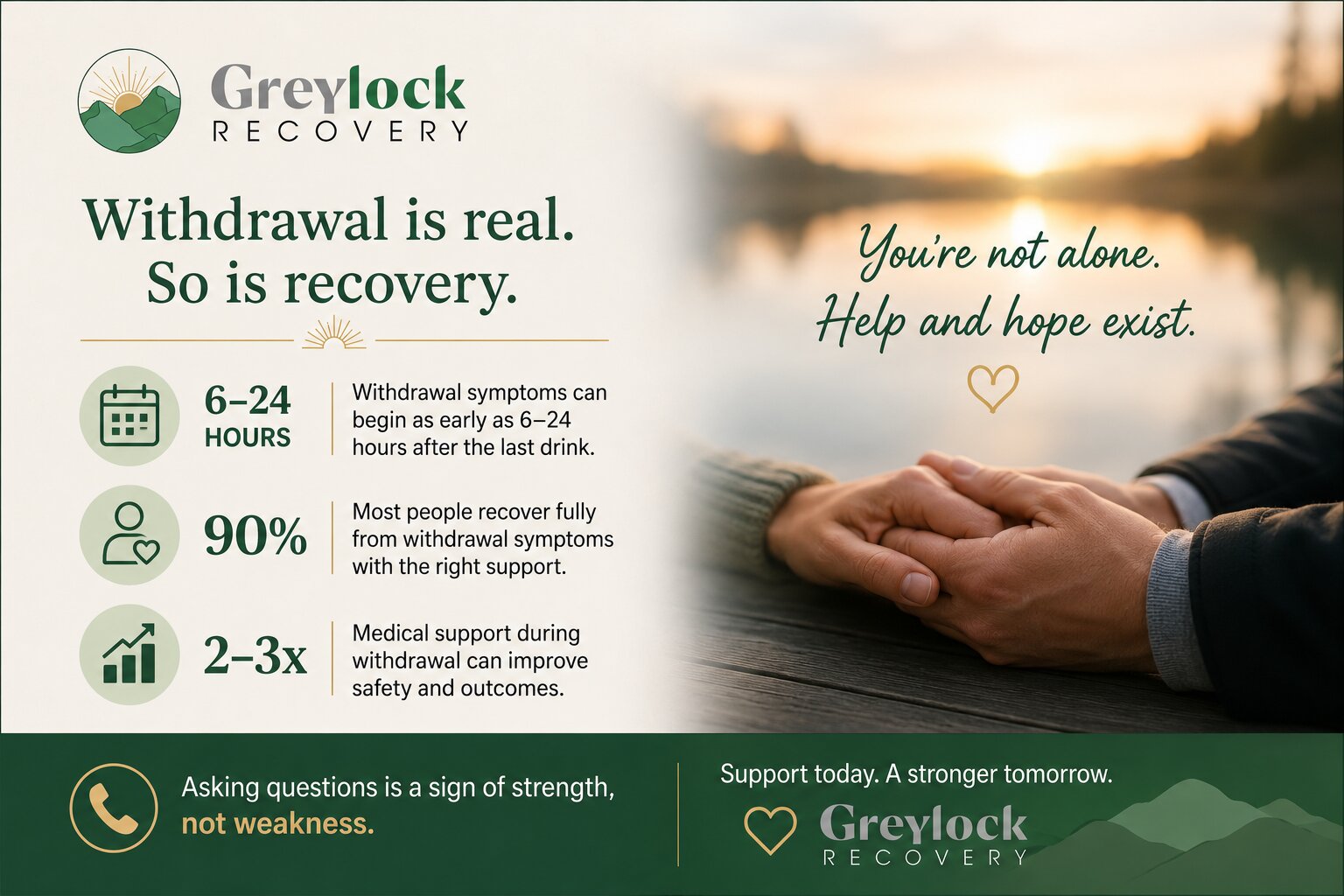
Some begin noticing changes within hours.
Others may experience symptoms later.
Timing varies based on factors such as:
- Drinking history
- Frequency of alcohol use
- Amount consumed
- Individual health factors
- Personal biology
What matters most is recognizing that feeling significantly worse after stopping alcohol deserves attention rather than dismissal.
#6: Why Are Families Often Caught Off Guard?
Because most people aren’t educated about withdrawal.
Families usually know drinking can cause problems.
They understand hangovers.
They understand intoxication.
What they don’t always understand is that stopping alcohol can sometimes create serious discomfort.
That gap in understanding creates fear.
Parents often tell us:
“I thought stopping was supposed to be the healthy part.”
It is.
But the body sometimes needs time and support to make that transition safely.
#7: Should We Just Wait It Out?
This is where many families get stuck.
They don’t want to overreact.
They also don’t want to ignore something important.
The result is often paralysis.
They wait.
Then wait a little longer.
Then spend another night worrying.
While some people experience symptoms that improve, others experience symptoms that become more intense.
That uncertainty is one reason professional guidance can be so valuable.
Knowledge tends to reduce fear.
Guessing usually increases it.
#8: What Makes Parents Feel So Helpless?
The hardest part is often watching.
You can’t experience the symptoms for your child.
You can’t take the discomfort away.
You can’t force recovery.
Many parents describe feeling trapped between wanting to help and not knowing how.
That uncertainty can become exhausting.
You may find yourself monitoring every text message.
Listening for changes in their voice.
Trying to determine whether they’re improving or getting worse.
The emotional weight of that responsibility is enormous.
And yet it rarely gets acknowledged.
#9: Have You Seen Young Adults Recover After Experiences Like This?
Absolutely.
Many times.
In fact, some of the strongest recovery stories begin with moments exactly like this.
Someone becomes frightened by how bad they feel.
A parent becomes concerned enough to ask questions.
A family decides to seek information instead of hiding from the problem.
Those moments often become turning points.
Not because everything changes overnight.
But because someone stops pretending nothing is wrong.
That shift matters.
We’ve seen young adults who couldn’t imagine life without alcohol eventually rebuild relationships, return to school, restart careers, and reconnect with goals they thought were gone forever.
Recovery rarely begins with certainty.
It usually begins with concern.
#10: What If My Child Has Started Drinking Again?
Parents often carry enormous guilt when relapse occurs.
They wonder what they missed.
What they should have done differently.
Whether they somehow caused the setback.
As difficult as relapse can be, it doesn’t erase the possibility of recovery.
Many people who achieve lasting sobriety have experienced setbacks along the way.
What matters most is what happens next.
A return to alcohol does not mean hope has disappeared.
It means support may need to increase.
It means the conversation isn’t over.
And it means healing is still possible.
#11: What Should Families Focus On Right Now?
Compassion.
Not perfection.
Not blame.
Not winning arguments.
Compassion.
Many young adults already feel ashamed of what they’re experiencing.
Shame rarely motivates meaningful change.
Connection often does.
Ask questions.
Listen carefully.
Stay curious.
Avoid assuming you know exactly what they’re feeling.
Sometimes the most powerful thing a parent can say is:
“I’m here.”
#12: What If We’re Not Ready for Big Decisions Yet?
That’s okay.
Many families arrive at this point feeling overwhelmed.
You don’t need to map out the next five years.
You don’t need every answer.
You only need the next step.
Sometimes the next step is gathering information.
Sometimes it’s making a phone call.
Sometimes it’s having an honest conversation.
The important thing is remembering that uncertainty is not the same thing as hopelessness.
There is a difference.
And that difference matters.
A Final Thought for Parents
If someone you love stopped drinking and now feels shaky, sweaty, anxious, nauseated, or physically unwell, take those concerns seriously.
Not because you should panic.
Because you should pay attention.
Many families spend months convincing themselves things aren’t serious enough to address.
Many later wish they had trusted their instincts sooner.
The good news is that help exists.
So does recovery.
So does hope.
Even if things feel confusing today.
Even if you’re exhausted.
Even if you’re scared.
Especially then.
Call 413-848-6013 or visit our detox treatment services to learn more about our addiction recovery programs, detox services in Williamstown, Massachusetts.