

I didn’t expect it to happen like that.
Not after everything I put in.
Not after the days that felt endless, the groups, the honesty, the way I started to recognize myself again. Somewhere along the line, I stopped just surviving and actually started believing:
This worked. I’m okay now.
And for a while, I was.
That’s what made it hit harder.
Because relapse didn’t feel like slipping.
It felt like everything I had built just… disappeared.
The Quiet Thought That Hurts the Most
It wasn’t even the using.
It was the thought that came right after:
Maybe I’m just someone this doesn’t work for.
That’s the part people don’t always say out loud.
Because it doesn’t sound like hope.
It sounds like resignation.
And if you’re here, you might recognize that feeling—the one where you’re not even panicking anymore. Just… tired.
I Thought Recovery Meant I Was Fixed
I didn’t realize how much I believed this until it fell apart.
Somewhere in my head, recovery had an endpoint.
You go through treatment.
You learn the tools.
You change your habits.
And then you’re done.
But that version of recovery is clean, simple… and not real.
Because what actually happens is messier.
You change—but your life doesn’t pause to match your progress.
Stress comes back.
People come back.
Old patterns wait.
And if your foundation isn’t fully built yet, those things don’t just test you—they expose you.
Why It Felt So Strong All Over Again
This part confused me the most.
I had time. I had clarity. I had distance.
So why did it feel like I was right back where I started?
Because I underestimated how quickly the old wiring comes back online.
Not because nothing changed—
but because some parts of me were still waiting for relief the only way they knew how.
Recovery gave me awareness.
But awareness alone doesn’t always hold up under pressure.
That takes repetition. Structure. Support that doesn’t disappear when things get hard.
The Part No One Prepares You For
Here’s what I wish someone had told me:
Early recovery is protected.
There’s structure.
Accountability.
People around you who understand exactly what you’re doing.
Then you leave… and suddenly you’re back in real life.
And real life doesn’t adjust for your progress.
It expects you to handle stress, boredom, loneliness, and triggers—all at once.
And if your system isn’t ready yet, it’s not a matter of if you struggle.
It’s when.
Relapse Didn’t Erase Me—It Revealed What Was Still Fragile
It took me a while to see this.
At first, relapse felt like proof that I hadn’t learned anything.
But when I slowed down and really looked at it, something else became clear:
I didn’t lose everything.
I just found the edges of what wasn’t solid yet.
- The moments I still avoided instead of facing
- The emotions I didn’t know how to sit with
- The parts of my life that were still built around escape
That’s not failure.
That’s information.
And painful as it was, it was honest.
Going Back Felt Like Defeat—Until It Didn’t
I didn’t want to go back.
That word alone—back—felt heavy.
Like I was undoing everything.
Like people would look at me and think, See? It didn’t stick.
But something shifted when I actually stepped into support again.
It didn’t feel like starting over.
It felt like continuing—but with more awareness, more honesty, and a clearer understanding of what I needed.
This time, I wasn’t trying to prove I was okay.
I was trying to actually be okay.
What Was Different the Second Time
The biggest difference wasn’t the program.
It was me.
I stopped performing recovery.
I stopped trying to say the right things or rush the process.
Instead, I paid attention to what actually destabilized me:
- The moments I isolated
- The thoughts I didn’t challenge
- The ways I minimized what I was feeling
And I allowed myself to need more support than I thought I should.
That’s where things began to change.
Sometimes You Don’t Need More Willpower—You Need More Structure
There’s this belief that if you relapse, you just need to try harder.
That wasn’t true for me.
Trying harder kept me stuck.
What helped was changing the environment.
More structure.
More time.
More distance from the patterns I couldn’t break on my own.
That’s where something like residential addiction treatment programs can matter—not because it “fixes” you, but because it holds you steady long enough to actually build something sustainable.
And if you’ve found yourself searching for inpatient alcohol rehab Massachusetts, it might not just be curiosity.
It might be that part of you recognizing you need something different this time.
You’re Not the Only One Who Thought It Would Stick the First Time
This part matters more than people admit.
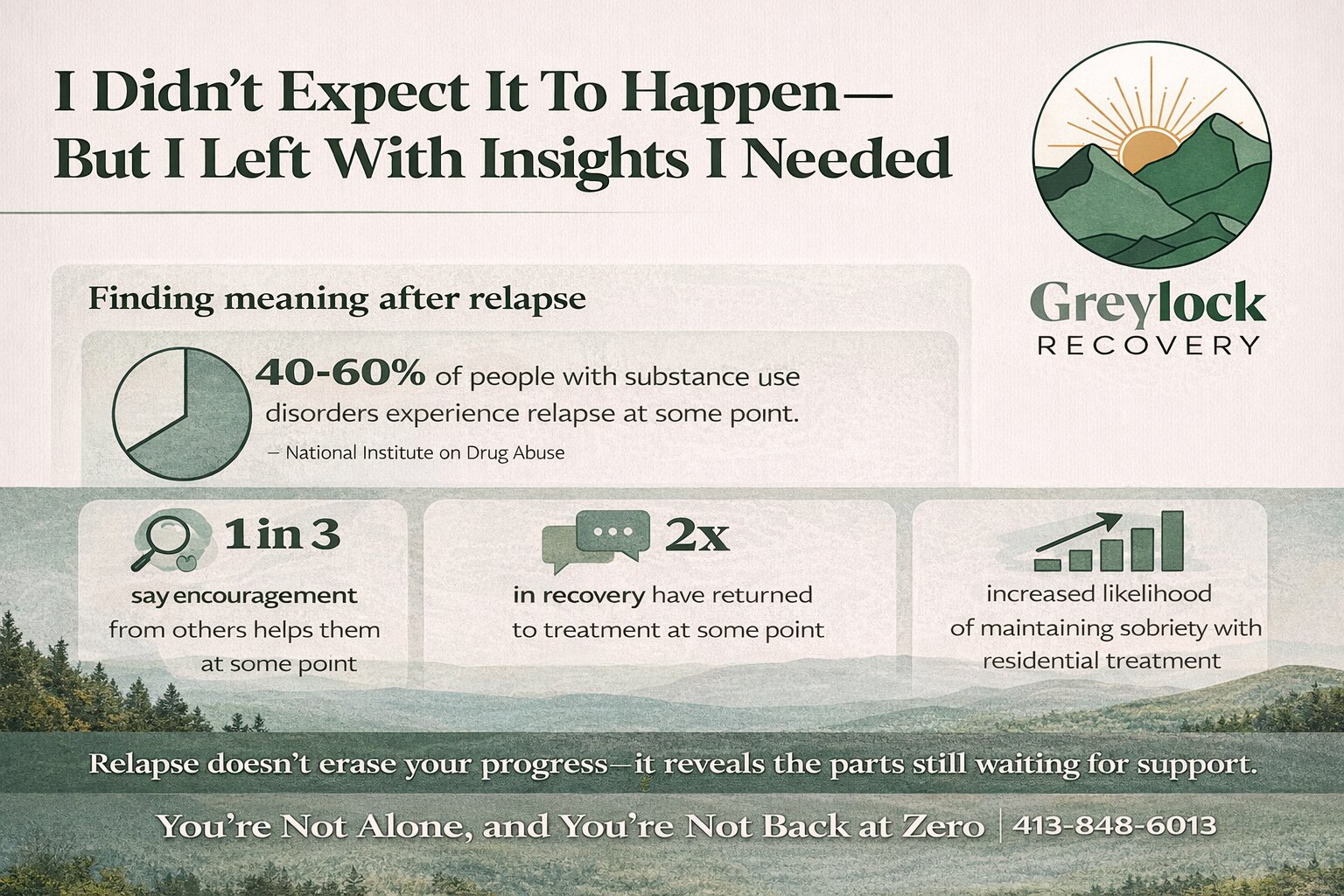
A lot of people who are stable now have a relapse story.
Not because they didn’t care.
Not because they didn’t try.
But because recovery is layered.
What works at one stage might not be enough for the next.
And going back isn’t regression.
It’s adjustment.
You’re Not Back at Zero—You’re Starting With Insight
It might feel like everything reset.
But it didn’t.
You’re not the same person who first walked into treatment.
You’ve:
- Experienced clarity
- Seen what life can feel like without substances
- Identified where things break down
That’s not starting over.
That’s starting with awareness most people don’t have.
And that matters.
FAQ: The Questions That Sit Heavy After a Relapse
Did I ruin my recovery by using again?
No. You interrupted it—but you didn’t erase it. The work you did is still there, even if it doesn’t feel like it right now.
Why did it feel like everything came back so fast?
Because your brain remembers relief. When stress returns and support isn’t strong enough, those pathways react quickly. That’s not failure—it’s how the brain works.
Does going back to treatment mean the first time didn’t work?
No. It means you’ve reached a point where you need a different level of support. Recovery often evolves in stages.
What if I feel ashamed to go back?
That’s normal. But you won’t be the only one there who’s coming back. And you won’t be judged the way you’re judging yourself.
How do I know if I need more structure this time?
If you’re trying to manage everything on your own and it’s not holding, that’s a sign. More structure can create stability where willpower alone can’t.
Is it even worth trying again?
Yes. Not because it will be perfect—but because now you know more. And that changes how you move forward.
You Didn’t Fail—You Hit a Layer You Couldn’t See Before
That’s the truth most people don’t say clearly enough.
You didn’t break your recovery.
You reached the part that requires something deeper.
And yeah—that’s frustrating. Humbling. Sometimes painful.
But it’s also where real, lasting change starts.
Call 413-848-6013 or visit our residential addiction treatment services to learn more about our addiction recovery programs, residential addiction treatment services in Williamstown, Massachusetts.
You’re still in this.
Not at the beginning.
Just at a place where the next step actually matters more.