
Admitting you need help is not the end—it’s the beginning. But if we’re honest, that first admission doesn’t always feel like relief. For many, it’s followed by a wave of fear. What now? What does treatment really look like? Will I be judged, watched, forced to share everything? Will I even make it through the first night?
These fears are common. But they’re also survivable.
At Greylock Recovery’s Residential Addiction Treatment program, we’ve supported countless people who felt like you do right now: scared, unsure, but ready to try. If you’re reading this, that’s more than enough. You don’t have to be sure. You don’t have to be “ready forever.” You just have to be open—and we’ll help with the rest.
You’re Not Walking Into Judgment—You’re Stepping Into Support
Let’s clear this up right away: residential addiction treatment is not boot camp. You won’t be yelled at, shamed, or made to confess every mistake before you’re allowed to belong. At Greylock, the moment you walk through the door, you are met with warmth, not interrogation.
There will be an intake process—but it’s a conversation, not a test. We’ll ask questions to understand your needs, your substance use history, your medical conditions, and what kind of support you’ll need in the early days. Our goal isn’t to catch you in a lie. It’s to meet you where you are and make sure you’re safe.
You’ll be shown your room, introduced to key staff, and given time to settle in. We expect nerves. We expect hesitation. That’s okay.
Detox Isn’t Punishment—It’s Protection
If your body is physically dependent on alcohol, opioids, or other substances, you may need medical detox. This can sound terrifying—but it’s not like the horror stories you might have seen on TV.
At Greylock, detox is monitored 24/7 by medical professionals trained in addiction medicine. You’ll have access to comfort medications if appropriate, and staff who check on you regularly—not just physically, but emotionally. This phase is often described as the hardest part of treatment, but here’s something most people don’t expect: detox is also where many feel their first flicker of hope.
You don’t have to white-knuckle your way through it. You’ll be cared for the whole time.
Your Daily Life Will Have Structure—But Not Surveillance
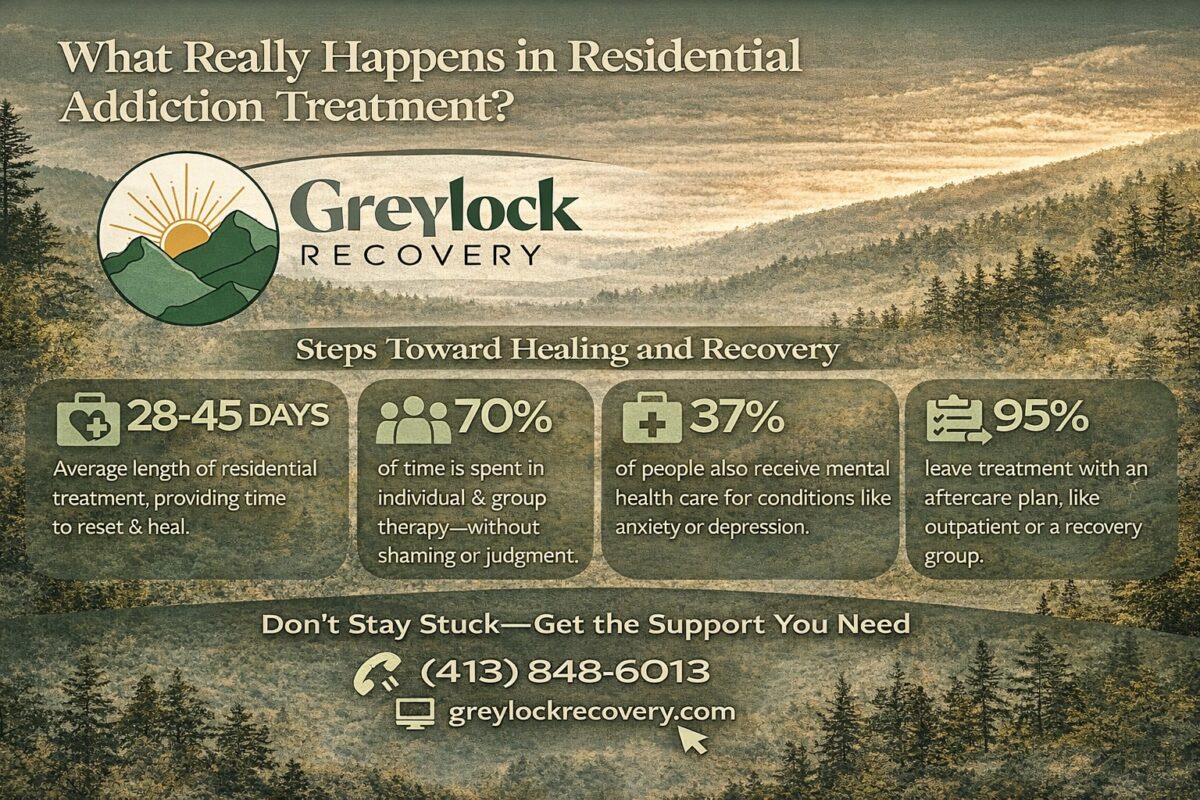
After detox (if needed), your days in residential addiction treatment begin to take shape. There’s a schedule—because when your mind is overwhelmed, structure helps. But this isn’t military precision. It’s a rhythm that supports healing:
- Morning check-ins to ground yourself
- Group therapy to explore themes like shame, resilience, and relapse prevention
- Individual therapy to unpack your story and begin rewriting it
- Time for rest, reflection, journaling, or fresh air
- Recreational activities that help reconnect you with joy, movement, or creativity
- Three nourishing meals a day—no need to figure out when or what to eat
Think of it like scaffolding while you’re rebuilding. It holds you up until you can stand.
You Don’t Have to “Bare Your Soul” Right Away
Therapy doesn’t mean sitting in a circle and being forced to reveal your deepest secrets on day one. In fact, you don’t have to talk at all until you’re ready.
In group therapy, you’ll hear other people’s stories—some that sound a lot like yours. That alone can crack something open. You might think, “I thought I was the only one who felt that.” You’re not.
In one-on-one sessions, you’ll build trust with your therapist. These aren’t lectures or diagnoses—they’re conversations. Sessions are shaped around what you need, not what someone else thinks you should say.
One of the most common reactions we hear after a few days is: “I thought this would be worse. It actually feels… good to be heard.”
Meals, Mornings, and Moments of Quiet Matter
A lot of healing in residential addiction treatment happens in therapy. But just as much happens in the quiet in-between moments.
- Passing the salt at dinner and realizing you’re not alone
- Saying “good morning” and meaning it for the first time in a while
- Taking a walk and remembering that you like being outside
- Sitting in silence and realizing that silence doesn’t feel like punishment anymore
Recovery isn’t one big breakthrough. It’s a thousand tiny ones. And residential treatment gives you the space to notice them.
Relationships Start Healing—Including the One With Yourself
You may come in carrying guilt, fear, or self-hate. That doesn’t magically disappear. But you’ll begin to hear a different story: one where you are not broken, but burdened. Not selfish, but surviving.
You’ll meet others who have loved and lost, who’ve lied and come clean, who’ve relapsed and returned. And somewhere in those stories, you’ll begin to feel the fog lift. You’ll remember that you’re more than what you’ve used or done.
Leaving Doesn’t Mean It’s Over—It Means You’re Ready for What’s Next
Discharge doesn’t mean you’re “cured.” It means you have enough footing to continue your recovery in a new way. At Greylock, we help you build a plan—whether that’s transitioning into our intensive outpatient program, finding a sober living environment, or connecting with therapy and support groups.
You’ll leave with next steps, not guesswork.
FAQ: Residential Addiction Treatment
What should I bring to treatment?
Bring comfortable clothes, basic toiletries, any prescribed medications, and something grounding—a photo, a book, a journal. We’ll provide a packing list, and you can ask questions anytime.
How long will I stay in residential treatment?
Lengths of stay vary, but most programs are between 28–45 days. Your needs and progress will help determine your exact timeline.
Will I be able to contact my family?
Yes, but usually after the first few days. This allows you to settle in and focus on your adjustment. After that, we support healthy contact with loved ones.
What if I have a co-occurring mental health condition?
You’re not alone. Many people struggle with both substance use and mental health. Our team is trained to support dual diagnosis care with compassion and skill.
Is it normal to feel terrified before coming?
Completely. Fear is a sign that something important is happening. You’re not weak for being scared. You’re brave for considering the next step anyway.
You Deserve More Than Survival—You Deserve Support
If you’ve made it this far into the blog, take a breath. You’re doing something brave just by reading this. You don’t have to know exactly what comes next. You just have to know that you want something different—and we’re here to help you find it.
Call (413) 848-6013 or visit to learn more about our Residential Addiction Treatment services in Massachusetts. We’re not here to fix you. We’re here to walk with you—every uncertain, hopeful, complicated step of the way.