


Prescription opioid pain medications have helped many people recover from surgery, injuries, and serious medical conditions. But if you’ve been prescribed one—or someone you love has—you may wonder how these medications compare and whether one is safer than the other.
If you’ve searched oxycodone vs hydrocodone, you’re likely looking for a straightforward answer. Understanding how these medications differ is important, but it’s equally important to recognize what they have in common. Both medications can be effective when used as prescribed, yet both also carry significant risks for dependence and addiction. If you’re concerned about ongoing opioid use, learning more about opioid addiction treatment can help you understand your options. Greylock Recovery also provides comprehensive addiction treatment in western Massachusetts for individuals and families seeking support.
What Is Oxycodone?
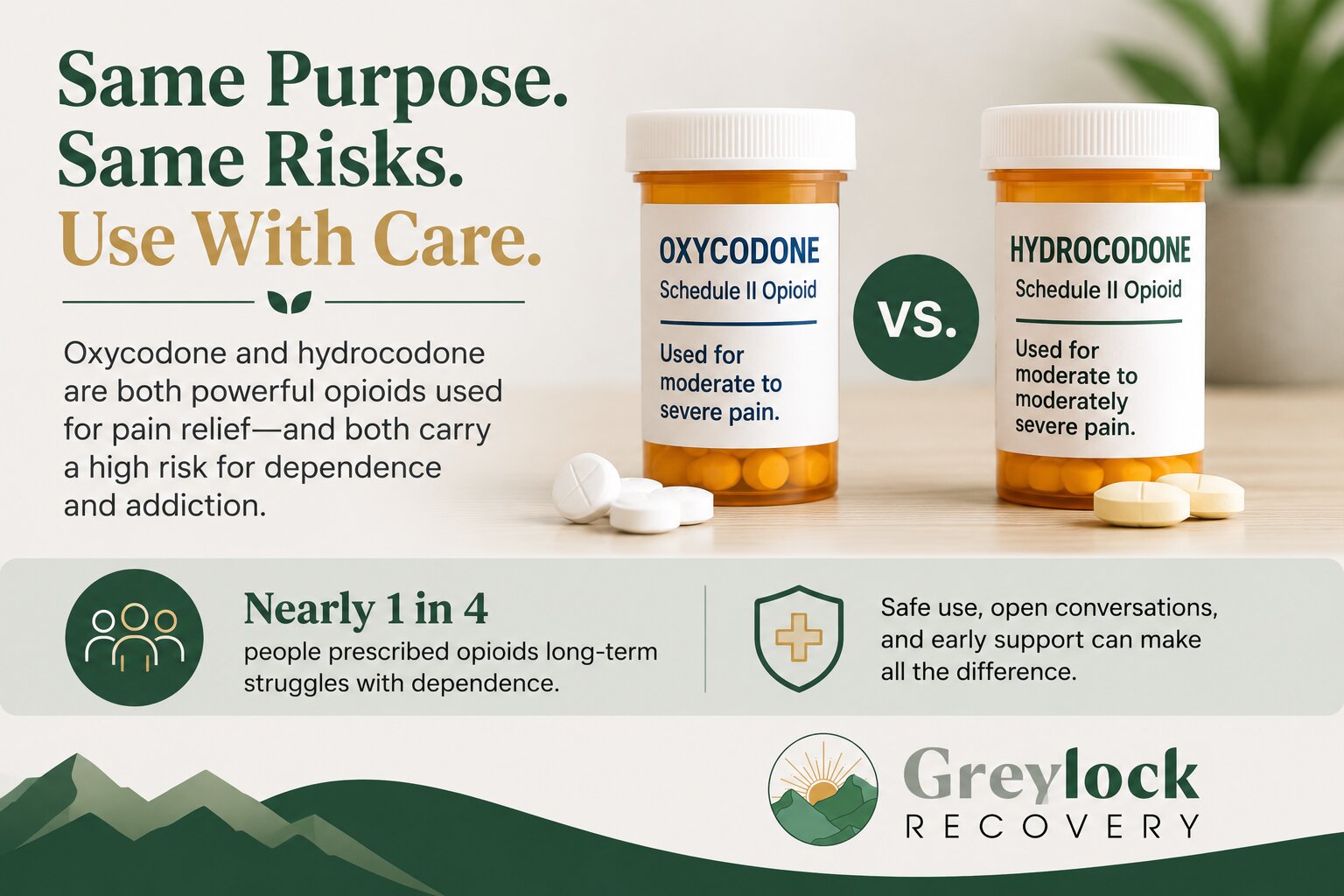
Oxycodone is a Schedule II prescription opioid used to treat moderate to severe pain. It works by attaching to opioid receptors in the brain and spinal cord, changing the way pain signals are perceived.
Depending on the medical need, oxycodone is available in both immediate-release and extended-release formulations.
Common brand names include:
- OxyContin® (extended-release oxycodone)
- Percocet® (oxycodone combined with acetaminophen)
- Roxicodone®
- Generic oxycodone tablets and capsules
Because oxycodone can produce feelings of pain relief as well as euphoria, it has a high potential for misuse. For this reason, it is classified as a controlled substance and should only be taken exactly as prescribed.
What Is Hydrocodone?
Hydrocodone is also a Schedule II prescription opioid used to manage moderate to moderately severe pain. Like oxycodone, it works by activating opioid receptors to reduce pain perception.
Historically, hydrocodone was most commonly prescribed in combination with acetaminophen, although extended-release formulations containing only hydrocodone are also available.
Common brand names include:
- Vicodin®
- Norco®
- Lortab®
- Hysingla ER® (extended-release hydrocodone)
Hydrocodone is one of the most frequently prescribed opioid medications in the United States and, like oxycodone, carries significant risks for misuse, dependence, and addiction.
Key Differences Between Oxycodone and Hydrocodone
Although these medications belong to the same drug class, several differences distinguish them.
Potency
One of the most frequently discussed differences is strength.
In general, oxycodone is considered somewhat more potent than hydrocodone on a milligram-for-milligram basis. However, this does not mean every oxycodone prescription is “stronger” than every hydrocodone prescription.
The total effect depends on:
- The prescribed dose
- Whether the medication is immediate- or extended-release
- Individual metabolism
- Opioid tolerance
- Other medical conditions
Because these factors vary from person to person, direct comparisons are not always straightforward.
Available Formulations
Oxycodone is available in both immediate-release and long-acting formulations and is commonly prescribed alone or combined with acetaminophen.
Hydrocodone has traditionally been prescribed in combination products, although long-acting hydrocodone formulations are also available for certain patients with chronic pain.
Medical Uses
Both medications are approved for pain management.
Healthcare providers choose between them based on several factors, including:
- Type and severity of pain
- Previous response to opioids
- Medical history
- Risk factors for adverse effects
- Other medications being taken
Which Medication Is Stronger?
The honest answer is that it depends.
When comparing equal milligram doses, oxycodone generally produces a stronger opioid effect than hydrocodone. However, strength alone does not determine how well a medication controls pain or how someone experiences it.
Some patients respond better to hydrocodone, while others achieve better pain control with oxycodone. Genetics, metabolism, body chemistry, and opioid tolerance all influence how an individual responds.
More importantly, a medication being “stronger” does not automatically make it better—or safer.
Healthcare providers prescribe opioid medications based on a person’s unique medical situation rather than potency alone.
What Oxycodone and Hydrocodone Have in Common
Despite their differences, these medications share far more similarities than many people realize.
Both medications:
- Are full opioid agonists
- Are classified as Schedule II controlled substances
- Can effectively treat moderate to severe pain
- May cause drowsiness, constipation, nausea, and slowed breathing
- Can lead to physical dependence with continued use
- Carry a high potential for misuse and addiction
Because they act on the same opioid receptors in the brain, many of their risks are nearly identical.
Understanding Dependence and Addiction
People often use the terms dependence and addiction interchangeably, but they are not the same.
Physical Dependence
Physical dependence occurs when the body adapts to the medication after regular use.
If the medication is stopped suddenly, withdrawal symptoms may occur, including:
- Muscle aches
- Anxiety
- Sweating
- Nausea
- Restlessness
- Insomnia
Physical dependence can develop even when someone takes medication exactly as prescribed.
Opioid Addiction
Addiction involves much more than physical dependence.
It is characterized by behaviors such as:
- Craving the medication
- Taking larger doses than intended
- Difficulty controlling use
- Continuing despite negative consequences
- Spending significant time obtaining or using opioids
Not everyone who becomes physically dependent develops addiction, but ongoing opioid use increases that risk.
Why Addiction Risk Is Serious for Both Medications
Some people assume hydrocodone is safer because it has historically been prescribed more frequently.
Others believe oxycodone is automatically more dangerous because it is somewhat stronger.
In reality, both medications carry serious addiction risks.
Risk increases with:
- Higher doses
- Long-term use
- Personal or family history of substance use disorder
- Co-occurring mental health conditions
- Combining opioids with alcohol or sedatives
Neither medication should be considered “safe” simply because it was prescribed.
The good news is that opioid use disorder is a treatable medical condition. Early intervention often leads to better outcomes, especially when treatment includes medical care, counseling, and ongoing recovery support.
If you’re exploring methadone treatment near Pittsfield MA as part of medication-assisted recovery, your care team can help determine whether it’s an appropriate option based on your individual needs.
Knowing the Difference Can Help You Make Informed Decisions
Understanding oxycodone vs hydrocodone isn’t about deciding which medication is “good” or “bad.”
Both medications have legitimate medical uses when prescribed appropriately.
The more important takeaway is recognizing that either medication has the potential to cause dependence and addiction. If you find yourself needing higher doses, taking medication differently than prescribed, or feeling unable to stop despite negative consequences, reaching out for help is a sign of strength—not failure.
The earlier opioid use disorder is addressed, the more treatment options are typically available.
Final Thoughts
Questions about prescription opioids are common, especially if you or someone you love has been taking them for pain. Understanding how oxycodone and hydrocodone compare can help you make informed decisions while recognizing that both medications deserve careful medical supervision.
If oxycodone, hydrocodone, or another opioid has become something you can’t stop on your own, our opioid addiction treatment in Berkshire County team is ready to help you find a way forward. Call (413) 269-8387 learn more about treatment to take the next step toward lasting recovery.
Frequently Asked Questions
Is oxycodone stronger than hydrocodone?
Generally, oxycodone is considered somewhat more potent on a milligram-for-milligram basis. However, the overall effect depends on the prescribed dose, formulation, and individual response.
Can you become addicted to hydrocodone if you take it as prescribed?
Yes. Physical dependence can develop with long-term prescribed use, and some people may also develop opioid use disorder. Taking medication exactly as directed lowers risk but does not eliminate it entirely.
What should I do if I think I’m becoming dependent on prescription opioids?
Talk with your healthcare provider as soon as possible. Do not stop taking opioid medications abruptly without medical guidance. If opioid use has become difficult to control, professional treatment can help you safely begin recovery.