
It doesn’t always look like survival.
Sometimes it looks like answering texts. Showing up to work. Laughing at the right moments. Holding eye contact just long enough that no one asks if you’re okay.
From the outside, it can look like a life.
From the inside, it can feel like maintenance.
And if you’ve found yourself searching for something like a medication-assisted recovery program, there’s usually a reason that goes deeper than just wanting to stop.
It’s not just about the substance.
It’s about how much of you has been built around getting through.
Survival Mode Is Quietly Shaping More Than You Think
Most people don’t notice when survival becomes identity.
It doesn’t announce itself.
It just starts making decisions for you.
What you say yes to.
What you avoid.
How you manage emotions.
How you get through uncomfortable moments.
At some point, it stops feeling like coping.
It starts feeling like this is just who I am.
But if we slow that down for a second—
Were you always like this?
Or did you learn to be this way because something in your life required it?
There’s a difference.
And that difference matters, because anything learned for survival can be unlearned—or reshaped—with support.
The Fear Isn’t Irrational—It’s Protective
Let’s not minimize this:
The fear of changing your relationship with substances isn’t just about withdrawal.
It’s about losing access to something that has worked for you.
Maybe it helped you:
- Feel less anxious in your own skin
- Open up in conversations
- Quiet intrusive thoughts
- Stay functional when everything felt overwhelming
So of course part of you is thinking:
Why would I give this up if it’s the only thing that helps me feel like myself?
That thought isn’t weakness.
It’s your brain trying to protect a system that, at one point, kept you going.
But What Helped You Survive Might Be Limiting You Now
Here’s the shift most people don’t see until they’re deep in it:
The thing that once gave relief… slowly starts taking up more space.
It asks for more time.
More energy.
More of your attention.
Until eventually, it’s not just helping you cope—it’s organizing your life.
And when that happens, something subtle but important gets lost:
Flexibility.
You’re no longer choosing how to feel.
You’re managing how not to feel.
That’s exhausting.
You’re Not “Starting Over”—You’re Separating What’s Yours From What Isn’t
The idea of rebuilding your life can feel overwhelming.
Like you have to erase everything and become someone completely different.
That’s not what real recovery looks like.
You’re not deleting yourself.
You’re separating:
What’s actually you
vs.
What you had to build just to survive
And that process doesn’t happen all at once.
It happens in layers.
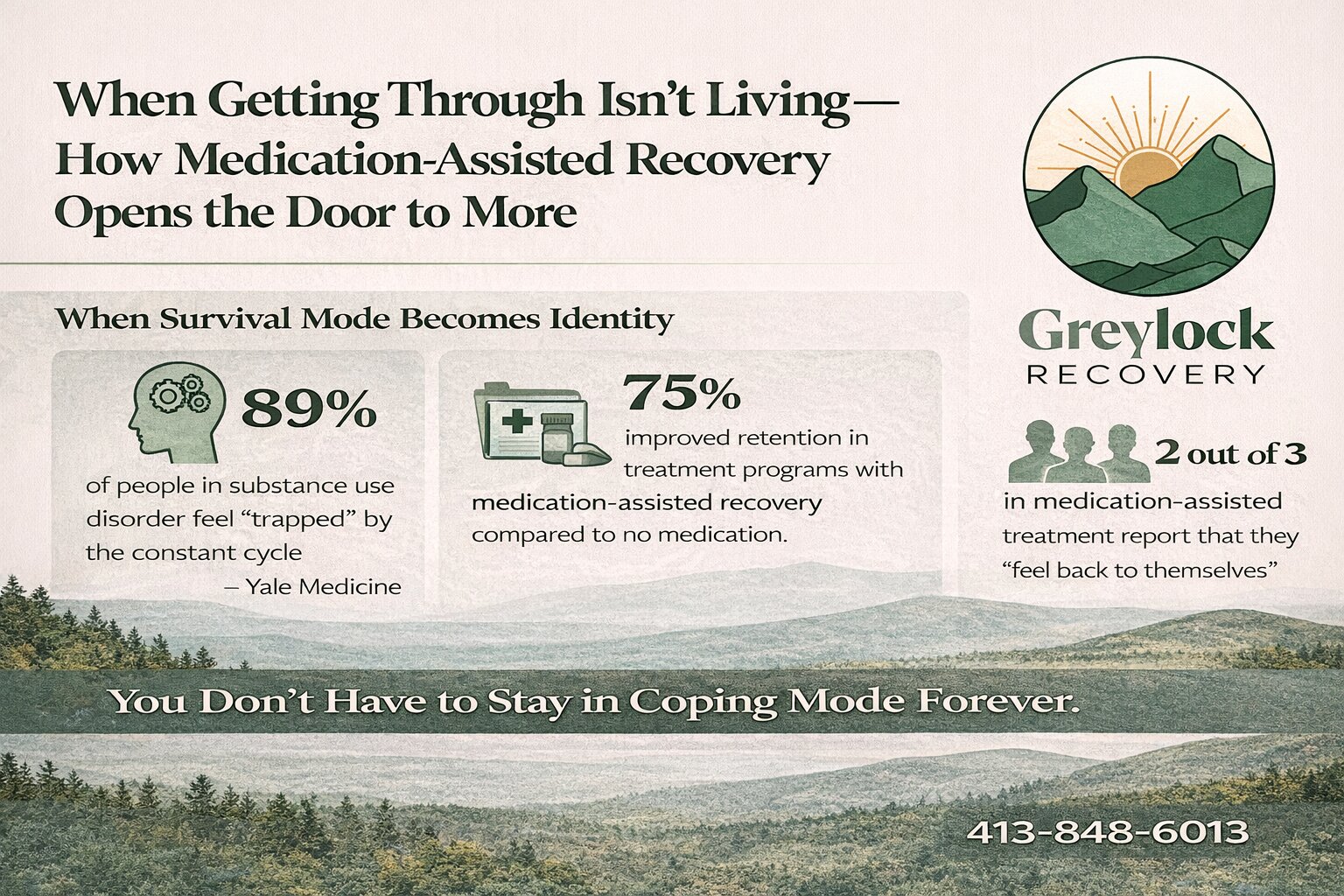
At Greylock Recovery, we see this every day—especially when someone finally gets the kind of support that addresses both the physical and emotional sides of dependence.
The Physical Piece Matters More Than People Admit
One of the biggest barriers people face isn’t motivation.
It’s their body.
If you’ve ever tried to stop and felt sick, restless, or like your entire system was working against you—you already understand this.
It’s not about “trying harder.”
It’s about your body needing support.
That’s often when people start searching for a Suboxone doctor near me—not because they want to rely on something new, but because they’re tired of fighting something they can’t control on their own.
And when that physical intensity is reduced, something important happens:
You get space.
Not just physical relief—but mental room to think, feel, and choose again.
Stability Doesn’t Flatten You—It Gives You Range
There’s a myth that stability equals boredom.
That if things aren’t intense, they must be empty.
But intensity isn’t the same as depth.
What medication-supported care can offer—when done thoughtfully—is consistency.
And consistency creates something most people haven’t had in a long time:
Range.
You can feel things without being overwhelmed.
You can have energy without burning out.
You can connect without forcing it.
It’s not about becoming less.
It’s about becoming less restricted.
There’s an Identity Beyond Survival—But You Don’t Have to Rush Toward It
You don’t have to figure out who you are right away.
You don’t have to suddenly become confident, healed, or completely different.
In fact, trying to do that too fast can feel just as overwhelming as staying stuck.
Instead, think smaller.
Think:
- What feels a little more stable today?
- What feels slightly less heavy?
- Where do I notice even a small shift?
That’s how identity rebuilds itself.
Not through pressure.
Through experience.
The Version of You That Emerges Isn’t Empty—It’s Sustainable
This part is hard to believe until you feel it.
But what comes after survival mode isn’t a blank space.
It’s a steadier version of you.
Not numb.
Not flat.
Just not constantly overwhelmed.
You might laugh differently.
You might feel things more clearly.
You might notice you’re not chasing the same extremes.
And yes—it can feel unfamiliar at first.
But unfamiliar doesn’t mean wrong.
It often means you’re finally not running on emergency mode.
FAQ: The Questions People Ask Right Before They Reach Out
Will I still feel like myself if I get this kind of support?
Yes—but often in a more stable way. Most people don’t lose who they are. They lose the constant pressure and chaos that made it hard to feel like themselves in the first place.
What if I’m only considering this because I’m tired—not because I’m “ready”?
That’s valid. Exhaustion is often what brings people to this point. You don’t need perfect clarity to take a step forward.
Is medication just replacing one thing with another?
Not in the way people fear. When used correctly, it’s a tool to stabilize your body so you’re not constantly pulled back into the same cycle.
What if I’ve tried before and it didn’t work?
That doesn’t mean this won’t. Different levels of support create different outcomes. Sometimes the missing piece is the right kind of care—not more effort.
How do I know if I actually need this?
If you’ve tried to stop and couldn’t, or if stopping feels overwhelming physically or mentally, that’s worth paying attention to. You don’t have to wait for things to get worse.
What if I’m scared I’ll lose something important about myself?
That fear matters. And it’s something we take seriously. The goal isn’t to take anything meaningful away from you—it’s to help you keep it without the cost.
You Don’t Have to Keep Living in Survival Mode
If you’ve made it this far, something in you is already questioning the way things have been.
Not in a loud, dramatic way.
Just enough to wonder:
Is there another way to do this?
There is.
And you don’t have to figure it out alone.
Call 413-848-6013 or visit our medication-assisted treatment services to learn more about our treatment services, medication assisted services in Williamstown, Massachusetts.
You built your identity to survive.
That wasn’t a mistake.
But it doesn’t have to be the version of you that carries you forward.