


I didn’t tell anyone at first.
Not when I slipped.
Not when it happened again.
Not even when I knew, deep down, I was back in something I couldn’t manage on my own.
Because once you’ve had time—real time—there’s this unspoken expectation:
You’re supposed to be okay now.
I had over 90 days. I had routines. I had people who believed in me.
And then I lost it.
Or at least… that’s how it felt.
The Part No One Talks About After You Relapse
Relapse doesn’t usually come in like a wrecking ball.
It’s quieter than that.
It starts with small negotiations:
- “Just this once.”
- “I can handle it now.”
- “I won’t let it go too far.”
And at first, it doesn’t look like disaster.
That’s what makes it so dangerous.
Because by the time you realize you’re slipping, you’re already in it.
For me, it wasn’t one big moment.
It was a series of small decisions I stopped questioning.
And then one day, I looked up and realized:
I don’t feel like myself anymore.
The Shame Didn’t Just Hurt — It Paralyzed Me
I wish I could say I reached out right away.
I didn’t.
Because the voice in my head got loud fast:
- “You already had your chance.”
- “People are going to be disappointed.”
- “You should be able to fix this yourself.”
That voice didn’t motivate me.
It kept me stuck.
Because asking for help again felt worse than staying where I was.
That’s the part that’s hard to explain to people who haven’t been there:
Shame doesn’t push you forward. It holds you in place.
I Tried to Rebuild Quietly (And It Didn’t Work)
Before I even considered going back, I tried to clean it up on my own.
I went back to the things that had helped before:
- Meetings
- Routines
- Promises to myself
And for a few days, maybe even a week, it looked like it was working.
But something felt off.
I wasn’t steady.
I was holding everything together tightly.
And underneath that, I could feel it:
This isn’t going to last.
Because I wasn’t building from a stable place.
I was patching something that needed more than a quick fix.
The Moment Everything Got Honest
There was no big crash.
No dramatic event.
Just a quiet moment where I realized something I couldn’t ignore anymore:
I don’t trust myself right now.
That sentence changed everything.
Because before that, I was still trying to convince myself I had control.
After that, I couldn’t pretend anymore.
And oddly enough… that honesty felt like relief.
Not because it solved anything.
But because I finally stopped fighting reality.
Going Back Felt Like Admitting Defeat
Making the decision to go back—into something like live-in treatment support—was the hardest part.
Not the logistics.
Not the time away.
The meaning I attached to it.
I thought it meant:
- I failed
- I wasted my progress
- I was starting over from nothing
Walking back into that level of support felt like walking backward in my life.
Like I was undoing everything I had worked for.
And I almost didn’t go—because I didn’t want that to be true.
What Actually Happened When I Walked Back In
I expected judgment.
I expected people to look at me differently.
I expected to feel like the “relapse case.”
None of that happened.
What I walked into instead was:
- People who understood without needing an explanation
- A space where I didn’t have to pretend I was okay
- Conversations that felt real, not loaded with disappointment
It wasn’t dramatic.
It was calm.
And that calm felt unfamiliar at first—but it was exactly what I needed.
The Second Time Wasn’t the Same as the First
The first time I went into treatment, I was trying to prove something.
That I could do it.
That I wasn’t “that bad.”
That I could get through it quickly and move on.
The second time, I wasn’t trying to prove anything.
I was there because I needed help.
And that shift changed everything.
I stopped:
- Arguing internally with the process
- Rushing through it
- Pretending I understood things I didn’t
I started:
- Listening more
- Being honest sooner
- Letting things actually land
And slowly, something steadier started to build.
I Realized I Didn’t Lose What I Had
This part took time to accept.
At first, it felt like everything I had done before didn’t count.
But that wasn’t true.
I still had:
- Awareness I didn’t have before
- Language for what I was experiencing
- Insight into my own patterns
The relapse didn’t erase that.
It added to it.
I wasn’t starting over.
I was starting from a more honest place.
The Line That Changed How I Saw Everything
Someone said something to me early on that stuck:
“You didn’t fail. You found the point where you need more support.”
That reframed everything.
Because instead of seeing relapse as the end…
I started to see it as information.
And information can be used.
What’s Different Now (And Why It Matters)
I won’t pretend everything is perfect.
But what’s different now is this:
I don’t rely on pretending I’m okay.
I catch things earlier.
I speak up sooner.
I don’t wait until things fall apart to ask for help.
And maybe most importantly:
I don’t see going back as failure anymore.
I see it as a decision.
A hard one.
But a life-saving one.
If You’re Sitting Where I Was
If you’re reading this and thinking:
“I don’t know if I can go back.”
I understand that.
Because going back means facing something you didn’t want to be true.
But staying where you are—when you know it’s not working—that has a cost too.
And you don’t have to keep paying it.
FAQ: What Relapsed Alumni Usually Wonder
Does going back mean I failed?
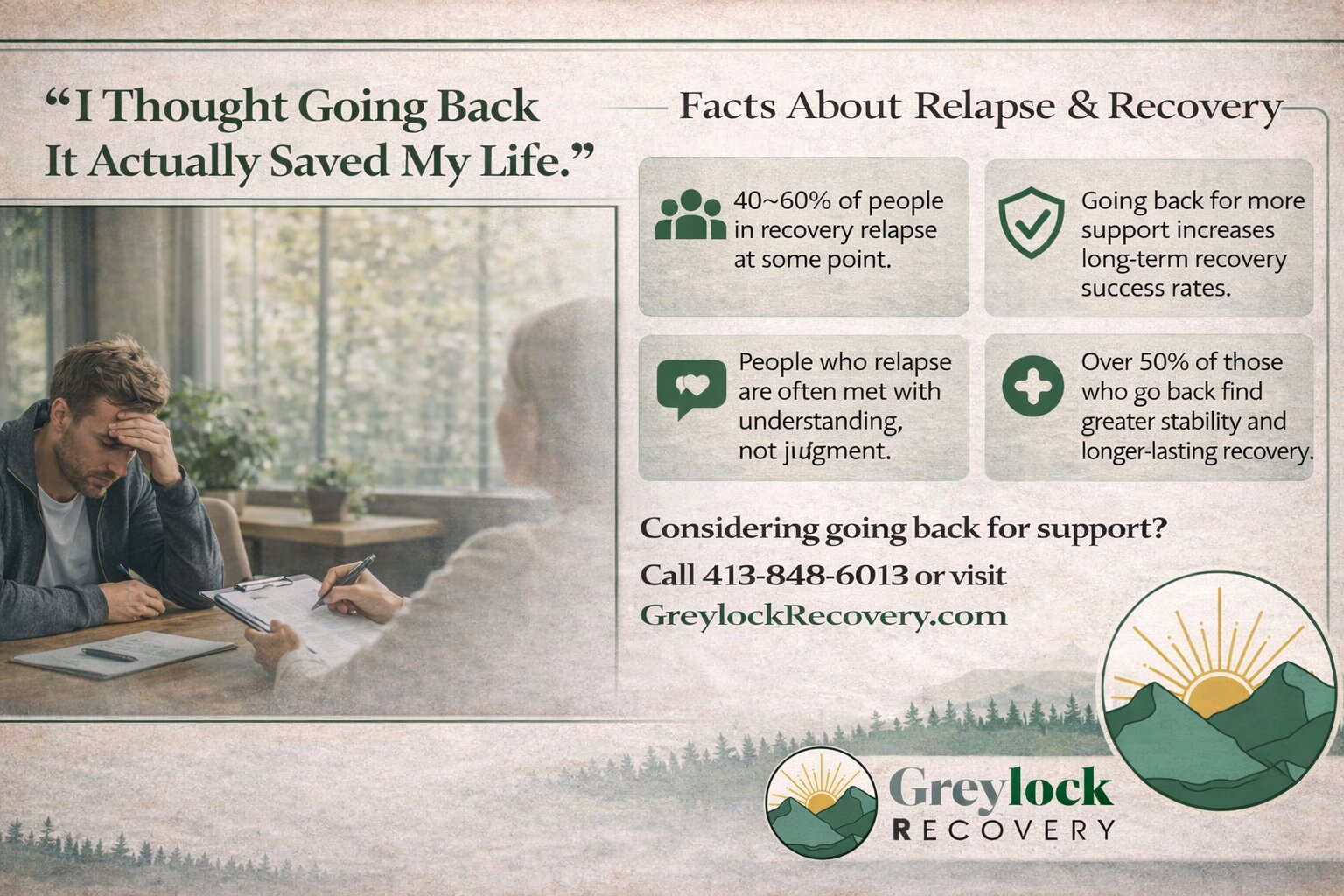
No. It means you’re still choosing yourself. Relapse is something many people experience—it doesn’t erase the progress you made.
Will people judge me for coming back?
Most people in recovery understand relapse deeply. You’re far more likely to be met with understanding than judgment.
Am I starting over from zero?
No. You’re bringing everything you’ve learned with you. That experience matters—and it often makes the next step more grounded.
What if I relapse again?
That fear is real. But more support now often reduces the likelihood of repeating the same pattern. And even if things get hard again, you’ll have more tools to respond differently.
Why does it feel harder the second time?
Because you’re more aware. You know what’s at stake. But that awareness can also become one of your greatest strengths.
How do I know I need more support again?
If you feel unstable, unsure, or like you’re holding things together instead of actually being steady—that’s worth paying attention to.
You’re Still Allowed to Come Back
If part of you feels like you messed it all up…
You didn’t.
You’re still here.
You’re still thinking about this.
You’re still willing to consider doing something different.
That matters more than a perfect track record.
If you’re considering stepping back into something more supportive—like addiction recovery programs, residential addiction treatment—you don’t have to figure it out alone.
Call 413-848-6013 or visit our addiction recovery programs, residential addiction treatment services to learn more about your options.
You didn’t lose everything.
You just found the place where you need more support.
And choosing to return?
That might be the strongest move you make.