
It’s one of the hardest things a parent can experience: watching your child relapse after treatment. Whether it’s been three weeks or three years, the grief is sharp. You might feel angry, terrified, helpless—or all three at once. You may also be wondering: Does treatment even work? Should we try again?
The answer isn’t just about trying again. It’s about trying differently.
Residential addiction treatment offers young adults the structured environment, peer support, and therapeutic depth they often need to recover—especially after a setback. This isn’t about starting from scratch. It’s about reentering care with greater clarity, stronger support, and renewed focus.
Let’s break down how and why residential treatment helps stabilize young adults after relapse—and what it can mean for your family.
Why Relapse Happens—Even After “Successful” Treatment
Relapse doesn’t always mean treatment failed. Often, it means that something deeper wasn’t fully addressed—or that life outside treatment was too overwhelming, too fast, or too triggering.
Common reasons young adults relapse include:
- Emotional overwhelm. Unprocessed trauma, anxiety, or depression can resurface quickly.
- Social pressure. Friends, environments, or even social media can become relapse triggers.
- Lack of readiness. Some people leave treatment before fully integrating the tools they need.
- False confidence. “I feel better now” can lead to risky situations too soon.
And for young adults in particular, the brain is still developing. Emotional regulation, impulse control, and risk awareness are still maturing. That’s not an excuse—it’s biology. And it helps explain why residential addiction treatment is often the best next step after relapse.
What Residential Addiction Treatment Offers That Other Levels Can’t
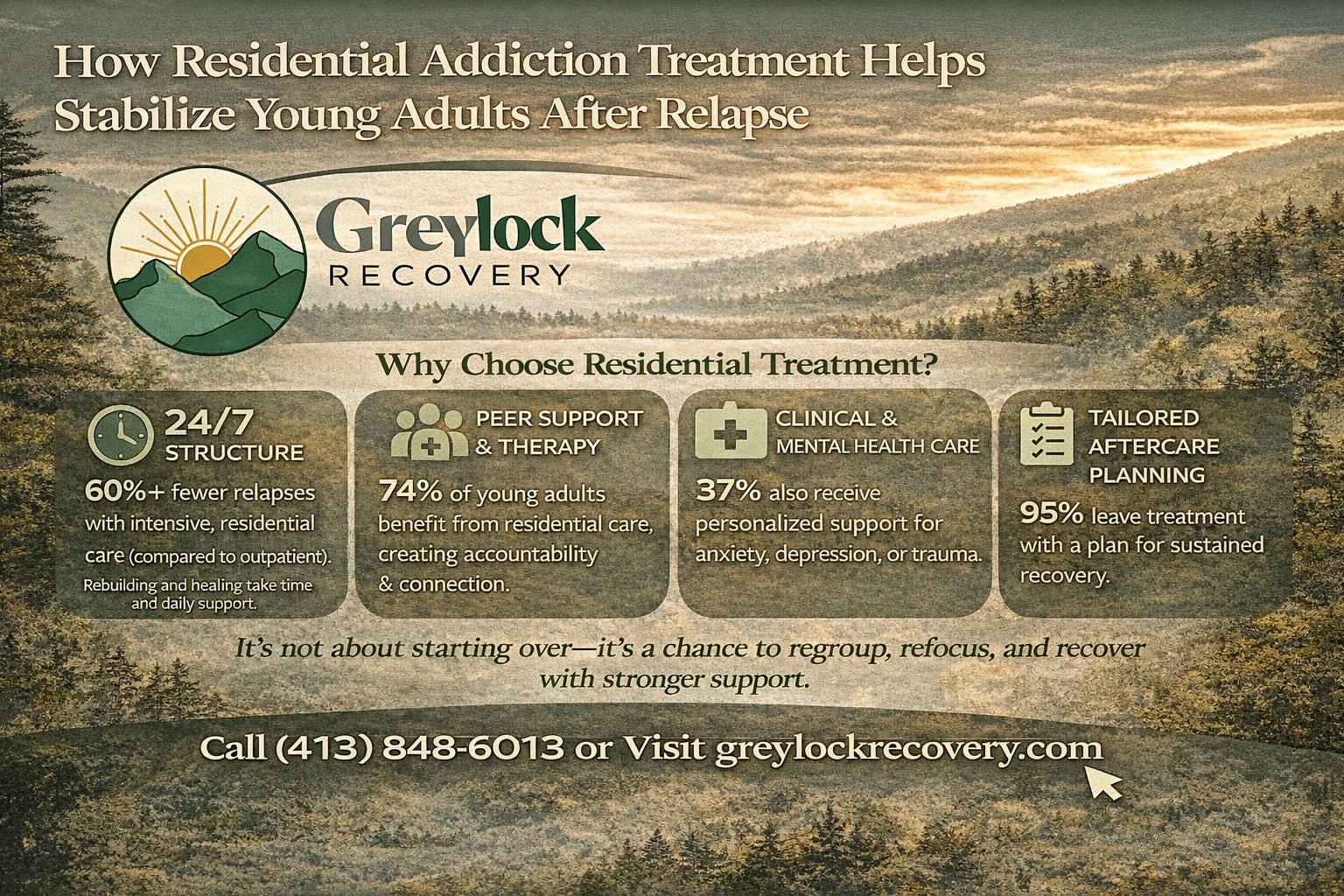
Unlike outpatient programs or therapy alone, residential care provides full immersion. It removes distractions and gives space to truly stabilize—physically, emotionally, and psychologically.
Here’s what that looks like at Greylock Recovery and similar programs:
1. 24/7 Structured Environment
Your loved one isn’t navigating triggers alone. Every hour has intention—whether it’s group therapy, clinical support, rest, or self-reflection. This structure helps reset chaotic rhythms and creates emotional safety.
2. Integrated Clinical Care
Residential programs often include individual therapy, trauma work, psychiatric support, and skill-building. The team is watching for patterns—what’s underneath the substance use—and tailoring care in real time.
3. Community Support
Relapse can be isolating. Residential treatment surrounds young adults with others who understand what they’re going through. They’re not “the one who messed up”—they’re part of a healing community.
4. Time Away From Triggers
Whether it’s an ex, a city scene, or even your own home environment—sometimes healing requires distance. Residential treatment offers that reset in a safe, supportive space.
Emotional Stabilization: The Often Overlooked Need
We talk a lot about medical stabilization in recovery. But for young adults, emotional stabilization is just as important—if not more.
Relapse often leaves them:
- Ashamed of “failing”
- Afraid they’ll never get better
- Grieving the trust they’ve lost
Residential care allows them to slow down, reconnect with themselves, and learn how to manage emotions without turning to substances. This is where true resilience begins.
A Message to Parents: This Is Not Your Fault
If you’re reading this as a parent, please know:
💔 You did not cause this.
💗 Your love still matters.
🧭 And there are options—real, hopeful ones—that can help.
You’ve likely done more than most parents ever have to—rides to therapy, hard boundaries, long nights, and sleepless worry. Maybe you’re emotionally tapped out. Maybe your home is tense or broken with fear.
That doesn’t mean you’ve failed. It means you’re human.
Residential treatment offers you a breath too. A moment to exhale, to rest, to let trained professionals carry the weight for a while.
Real-Life Shift: What Stabilization Can Look Like
“I didn’t think he’d make it through another program. But this time, something clicked. He called us after two weeks just to say thank you. No pressure—just, ‘Thank you.’ It was the first time in months I heard hope in his voice.”
– Parent of a 21-year-old, Greylock Recovery
This isn’t a miracle story. It’s a story of what happens when care meets someone at their lowest and says, “You’re not broken. You’re just tired. And we can work with that.”
The Timing Window After Relapse
Relapse sometimes opens a small window—where pain creates willingness.
Your son or daughter might say, “I need help,” “I can’t do this,” or even, “I don’t care anymore.” Those moments of surrender can be painful to witness. But they can also be powerful starting points.
Residential addiction treatment provides a structured place to land in that window—before shame or chaos takes over again.
How to Know If Residential Treatment Is the Right Next Step
Here are a few signs it might be time to consider residential care:
- Multiple relapses after outpatient or therapy
- Mental health concerns alongside substance use
- Escalating risky behavior or withdrawal from life
- Family safety or wellbeing is at risk
- They’ve expressed a desire to “get away” or “start over”
If you’re seeing these, it’s worth having a conversation with an admissions specialist or treatment provider.
FAQ: Residential Addiction Treatment for Young Adults
What’s the average length of stay in residential treatment?
Programs typically range from 30 to 90 days, depending on individual needs. At Greylock Recovery, we assess progress regularly to ensure each client gets the time they need—no more, no less.
Can my child attend college or work while in treatment?
Residential treatment is immersive, so school and work are typically paused. However, academic planning and vocational support are often included as part of long-term stabilization.
Is residential care only for people who’ve hit “rock bottom”?
Not at all. Many young adults enter residential treatment before things spiral further. It’s often most effective when used early, after warning signs or a relapse—not only in crisis.
What’s the role of the family during residential treatment?
Families are often invited to participate through therapy, education, and check-ins. At Greylock Recovery, we view parents as vital allies—not obstacles—in the healing process.
What happens after residential treatment ends?
A good program will help plan next steps, including outpatient care, sober living, or return-to-life strategies. The goal isn’t just to stabilize—but to prepare for long-term recovery.
You Don’t Have to Fix This Alone
Watching your child struggle again is devastating—but it’s not the end of the story. Greylock Recovery’s residential addiction treatment offers a space where young adults can pause, regroup, and build the emotional and clinical tools they need to move forward.
📞 Call (413) 848-6013 or visit our Residential Addiction Treatment page to learn more about our Residential Addiction Treatment services in Massachusetts.