


You didn’t ignore it.
You noticed the pattern.
You tried to adjust.
You told yourself, “I don’t need to stop—I just need to get better at this.”
And for a little while, that felt true.
Until it didn’t.
If you’ve been stuck in that cycle—doing better, then slipping, then promising yourself you’ll do better again—you’re not failing.
You’re running into a limit that a lot of people hit quietly.
And if you’ve found yourself looking into options like live-in treatment support and thinking, “That feels like too much… but maybe I need more than this,” you’re in a very real, very human place.
Let’s walk through what actually helps from here.
Step 1: Stop Framing This as a Discipline Issue
This is where most people start—and where they stay stuck the longest.
You think:
- “I just need to be stricter.”
- “I need more self-control.”
- “Other people can manage this—why can’t I?”
But if you’ve already tried to cut back multiple times, you’ve already proven something important:
You do have discipline. It just isn’t enough on its own.
Because discipline has limits.
It weakens when you’re:
- Stressed
- Tired
- Emotional
- Overwhelmed
And those are exactly the moments where the urge tends to show up strongest.
So instead of blaming yourself, try shifting the lens:
What if this isn’t about being stronger—
but about needing more support than willpower can provide?
Step 2: Get Honest About the Pattern (Not Just the Outcome)
It’s easy to focus on the moment things “went wrong.”
But what actually matters is what happens before that moment.
Think about the last few times you slipped.
Was it after:
- A long day where you felt drained?
- A social situation where it felt easier to just go along?
- Feeling restless, anxious, or disconnected?
- Telling yourself “just one” would be fine?
These aren’t random.
They’re patterns.
And here’s the key insight:
If the setup doesn’t change, the outcome usually won’t either.
You can intend to do things differently—but if you’re in the same environment, with the same triggers, under the same stress…
You’re fighting uphill every time.
Step 3: Understand Why Moderation Feels So Exhausting
There’s a reason cutting back feels like a constant mental tug-of-war.
Because it is.
Moderation requires you to:
- Make repeated decisions all day long
- Negotiate with yourself in real time
- Stay hyper-aware of limits
- Recover quickly if you go past them
It sounds manageable.
But it’s actually a full-time mental job.
And over time, your brain gets tired.
That’s when the rules soften.
The lines blur.
The “just this once” voice gets louder.
Not because you don’t care—but because you’re worn down.
More structured support removes that constant negotiation.
Not forever.
Just long enough for your system to reset.
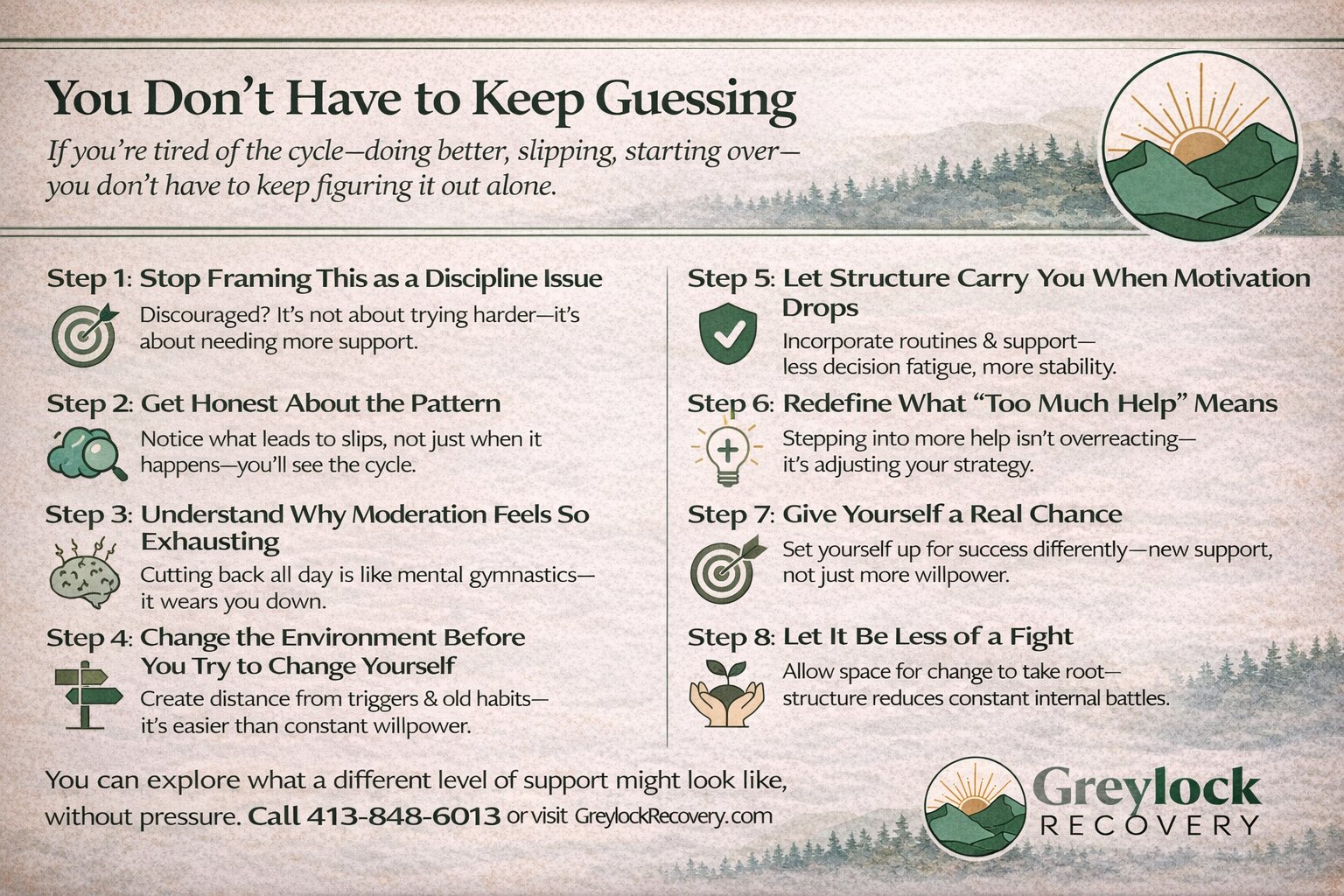
Step 4: Change the Environment Before You Try to Change Yourself
This is where things start to shift.
Because most people try to change their behavior while staying in the exact same environment that shaped it.
Same routines.
Same access.
Same emotional triggers.
That’s incredibly hard.
Creating distance—even temporarily—does something powerful:
- It reduces exposure to triggers
- It interrupts automatic habits
- It gives your brain space to recalibrate
This is where residential addiction treatment options become relevant—not as a last resort, but as a way to step out of the cycle long enough to actually reset it.
Think of it like stepping off a moving treadmill.
You can’t change your pace while it’s still pulling you forward.
Step 5: Let Structure Carry You When Motivation Drops
Right now, everything depends on you.
Your decisions.
Your energy.
Your ability to follow through.
And that’s a lot.
Structure changes the equation.
Instead of:
- Constant decision-making
- Internal debates
- Trying to “stay strong” all day
You have:
- A predictable rhythm
- Support built into your day
- Fewer moments where you have to rely on willpower alone
And something subtle but important happens:
You stop thinking about it all the time.
You get mental quiet.
And in that quiet, real change starts to take root.
Step 6: Redefine What “Too Much Help” Means
A lot of sober curious people hesitate here.
Because stepping into more support can feel like:
- Admitting things are worse than you wanted to believe
- Overcorrecting
- Doing something “extreme”
But here’s the reframe:
It’s not about how it looks.
It’s about how well it works.
If cutting back hasn’t been consistent…
Then choosing more support isn’t overreacting.
It’s adjusting your strategy.
Step 7: Give Yourself a Real Chance (Not Just Another Attempt)
There’s a difference between:
Trying again…
and setting yourself up differently.
Trying again sounds like:
- “This time I’ll stick to it”
- “I’ll be more careful”
- “I’ll do better”
Setting yourself up differently looks like:
- Changing your environment
- Increasing your support
- Removing constant friction
One relies on effort.
The other creates conditions where effort actually works.
Step 8: Let It Be Less of a Fight
A lot of people assume change has to feel like constant resistance.
Like you’re always pushing against something.
But what if it didn’t?
What if, instead of fighting yourself every day, you had:
- Space to think clearly
- Support when things felt heavy
- A structure that helped you follow through
That’s what the right environment can offer.
Not ease in a simplistic way.
But relief from constant internal conflict.
You’re Not “Bad at Cutting Back” — You’re Outgrowing It
If this approach isn’t working anymore, that doesn’t mean nothing will.
It means you’ve reached the edge of what this method can do for you.
And recognizing that?
That’s not failure.
That’s awareness.
FAQ: What Sober Curious People Usually Wonder Next
Does this mean I have to quit completely?
Not necessarily—but if moderation hasn’t been consistent, it’s worth exploring why. Sometimes stepping away fully, even temporarily, helps reset your relationship with it.
What if I’m not “bad enough” for this level of support?
There’s no threshold you have to hit. If something is impacting your life and your attempts to manage it aren’t working, that’s enough reason to explore more support.
Will I lose control over my life if I step into a more structured environment?
The goal is actually the opposite—to help you regain control internally so your life feels more stable when you return to it.
What if I try this and it’s not right for me?
You’re allowed to adjust. Exploring a higher level of support doesn’t lock you in—it gives you information about what works for you.
Why does cutting back work sometimes but not consistently?
Because it depends on variables like stress, environment, and emotional state. Without changing those, consistency becomes very hard to maintain.
Is it normal to feel both curious and resistant at the same time?
Completely. That tension usually means part of you wants change—and another part is unsure how it will affect your life. Both deserve to be heard.
You Don’t Have to Keep Guessing
If you’re tired of the cycle—doing better, slipping, starting over—you don’t have to keep figuring it out alone.
You can explore what a different level of support might look like, without pressure.
Call 413-848-6013 or visit our addiction recovery programs, residential addiction treatment services to learn more about what could actually help you feel steady.
You’re not stuck.
You’re just at the point where the old way isn’t working anymore.
And that’s usually where something better begins.