


When you’re starting medication-assisted treatment (MAT), it’s natural to have questions about the medication you’re taking. One of the most common is how long methadone stays in the body and what that means for daily life, drug tests, and treatment.
If you’re considering or receiving methadone treatment, understanding how the medication works can help you feel more confident in the recovery process. Rather than focusing on how quickly methadone leaves the body, it’s more helpful to understand why it was designed to last longer than many other opioids and how that supports recovery. If you’re looking for comprehensive addiction treatment in western Massachusetts, learning the basics of MAT is an important first step.
What Is Methadone?
Methadone is a Schedule II prescription medication that has been used safely for decades to treat opioid use disorder and, in some cases, chronic pain.
Unlike short-acting opioids that produce rapid highs and lows, methadone is a long-acting full opioid agonist. When prescribed and monitored appropriately, it helps stabilize brain chemistry, reduce cravings, and prevent withdrawal symptoms without the repeated cycle of intoxication and withdrawal that often fuels addiction.
Because of its long duration of action, methadone plays an important role in medication-assisted treatment (MAT), allowing many people to regain stability while participating in counseling and other recovery services.
How Long Does Methadone Stay in Your System?
The answer depends on several individual factors, but methadone generally remains in the body much longer than many other opioids.
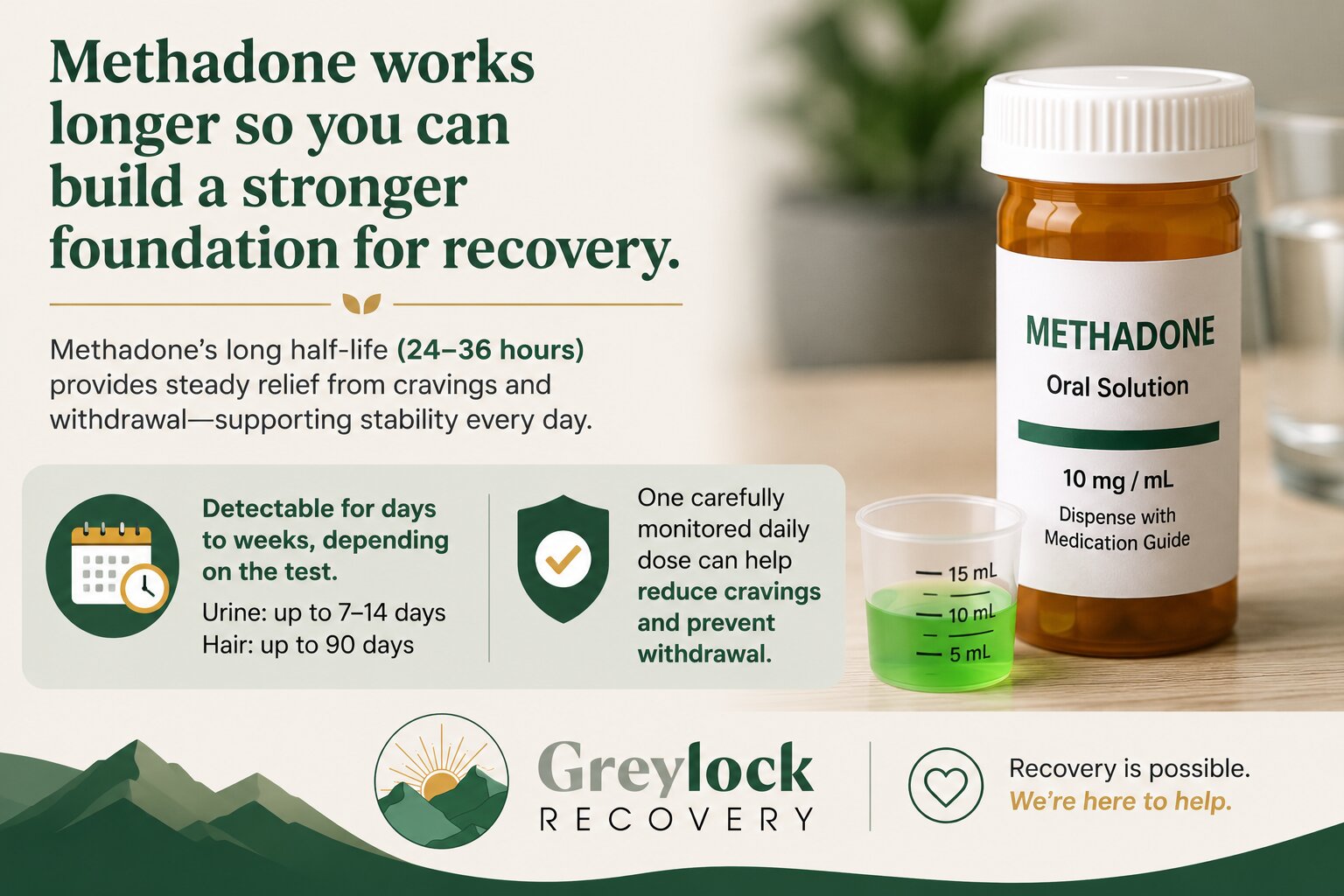
Its average half-life is approximately 24 to 36 hours, although some people metabolize it much more slowly. In certain situations, the half-life may extend beyond 50 hours, particularly during the early stages of treatment or in people with slower metabolism.
A medication’s half-life refers to the amount of time it takes for half of the drug to be eliminated from the bloodstream.
Because several half-lives are required before a medication is mostly cleared, methadone may remain detectable for several days after the last dose.
This unusually long half-life is intentional. It helps provide consistent symptom relief between doses, reduces withdrawal symptoms, and supports long-term recovery.
Detection Windows for Methadone
Many people beginning MAT ask about drug testing for employment, medical care, or legal requirements.
Detection windows are estimates rather than guarantees because every person’s body processes medications differently.
Urine
Urine testing is the most common method used to detect methadone.
For many people, methadone can be detected for approximately 7 to 14 days after the last dose, particularly after long-term use.
Blood
Blood tests generally detect methadone for a shorter period, often 24 to 55 hours, although this varies depending on metabolism and dosage.
Saliva
Methadone may remain detectable in saliva for roughly 24 to 48 hours, though detection times can vary.
Hair
Hair testing has the longest detection window.
Methadone may be detectable in hair for up to 90 days, reflecting past exposure rather than current impairment.
It’s important to remember that a positive drug test does not indicate someone is intoxicated or misusing medication. For individuals participating in MAT, methadone may be an expected and medically appropriate finding when prescribed.
What Affects How Quickly Methadone Leaves the Body?
There is no single timeline that applies to everyone.
Several factors influence how quickly methadone is metabolized and eliminated.
Dose
Higher doses generally take longer for the body to process than lower doses.
Length of Treatment
Someone who has taken methadone consistently for months or years may retain the medication longer than someone receiving only a few doses because methadone can accumulate in body tissues over time.
Individual Metabolism
Methadone is primarily metabolized by liver enzymes, including CYP3A4. Genetics, liver function, and interactions with other medications can significantly affect how quickly it is broken down.
Urine pH
The acidity or alkalinity of urine can influence how efficiently methadone is eliminated. More acidic urine generally increases elimination, while more alkaline urine may slow it.
Age and Overall Health
Older adults and people with certain medical conditions may process methadone more slowly than younger, healthier individuals.
Why the Long Half-Life Matters During MAT
Methadone’s extended half-life is one of the reasons it has been an effective treatment for opioid use disorder for decades.
Instead of requiring frequent dosing throughout the day, many patients receive one carefully monitored daily dose that provides consistent medication levels.
However, this same characteristic also requires careful medical supervision.
Medication Can Accumulate
Because methadone remains in the body for an extended period, repeated doses may accumulate before the body has fully eliminated previous doses.
This is one reason healthcare providers increase doses gradually rather than making large adjustments too quickly.
Drug Interactions Matter
Certain medications can change how methadone is metabolized.
Examples include:
- Some antibiotics
- Certain antifungal medications
- Some antidepressants
- Anti-seizure medications
- Other sedatives, including benzodiazepines
- Alcohol
These interactions may increase side effects or reduce methadone’s effectiveness, making it important to inform your healthcare provider about every medication, supplement, or over-the-counter product you take.
Missing or Changing Doses Can Be Risky
Because methadone works differently from short-acting opioids, it should never be stopped abruptly or adjusted without medical guidance.
If you have concerns about your dose or side effects, speak with your treatment provider before making changes on your own.
Does Staying in Your System Longer Mean Methadone Is More Dangerous?
Not necessarily.
The fact that methadone remains in the body longer does not automatically make it unsafe.
When prescribed appropriately and monitored by qualified healthcare professionals, methadone has been shown to reduce opioid misuse, lower overdose risk, improve treatment retention, and support long-term recovery for many individuals.
The medication simply requires individualized dosing and ongoing monitoring because of its unique pharmacology.
For people participating in MAT, the longer duration is often one of methadone’s greatest therapeutic strengths.
If you are exploring opioid addiction treatment near Pittsfield MA, your treatment team can explain whether methadone or another medication may be the best fit for your needs.
Why Understanding Methadone Helps Reduce Anxiety
Many people search how long does methadone stay in your system because they are worried about what the medication means for their future.
The encouraging reality is that methadone’s long half-life is not a flaw—it’s one of the features that allows it to provide stable symptom control throughout the day.
Knowing why methadone works the way it does can make treatment feel less intimidating. Instead of viewing the medication as something to fear, many patients come to understand it as one evidence-based tool that supports recovery while they rebuild their health, relationships, and daily routines.
Final Thoughts
Starting medication-assisted treatment often comes with questions, and that’s completely normal. Understanding how methadone is processed, why it lasts longer than many opioids, and what that means for dosing can help you feel more prepared and informed as you move forward.
If you have questions about methadone as part of your recovery, or you’re looking for methadone treatment in Berkshire County, our team can walk you through your options and what to expect. Call (413) 269-8387 learn more about treatment to take the next step toward lasting recovery.
Frequently Asked Questions
Can methadone build up in the body?
Yes. Because methadone has a long half-life, it can accumulate during the first several days of treatment before reaching a stable level. This is why healthcare providers increase doses carefully and monitor patients closely.
Does methadone always show up on a standard drug test?
Not always. Many routine opioid screening panels do not automatically detect methadone. Specific testing is often required when healthcare providers or employers need to identify methadone use. If you’re taking methadone as prescribed, it’s important to disclose this when appropriate and provide documentation if requested.
Is it safe to stop taking methadone on my own?
No. Methadone should never be discontinued abruptly without medical guidance. Stopping suddenly can lead to withdrawal symptoms and increase the risk of relapse. If you’re considering changing your treatment plan, speak with your healthcare provider so your medication can be adjusted safely.