


When parents first begin considering a live-in recovery environment for their child, the feeling is rarely relief.
More often, it’s a quiet storm of emotions—fear, guilt, confusion, and heartbreak all tangled together.
Many families begin searching for answers when they realize the situation has moved beyond difficult conversations or promises to stop drinking. It’s often after months—or years—of trying to help at home that parents start exploring options like live-in addiction support for young adults.
At that moment, most parents are not thinking about programs or logistics. They’re thinking about one thing:
“How did we get here?”
And right behind that question is another one that hurts even more:
“Am I about to make the right decision for my child?”
The Moment Parents Realize the Situation Is Bigger Than Them
Almost every parent reaches a moment where something shifts.
It might be subtle. A conversation that feels painfully familiar. Another promise to change that fades within days. Another night where your phone stays beside your pillow just in case it rings.
Parents often describe the feeling like standing in a fog.
You’re trying everything you know how to do. Encouraging. Advising. Supporting. Sometimes pleading. But nothing seems to change the deeper pattern.
A mother once told me:
“I kept thinking if I just said the right thing, it would click for him.”
But addiction rarely responds to perfect words.
Eventually many parents reach a painful realization: the problem has grown larger than what the family can solve alone.
That moment doesn’t mean you’ve failed your child.
It means you’re beginning to see the situation clearly.
Why the Idea of Sending Them Away Feels So Wrong
Few parenting decisions feel as emotionally complicated as asking your child to step away from home for help.
Parents worry about what their child will think.
Will they feel rejected?
Will they feel punished?
Will they believe their parents have given up on them?
These fears are incredibly common.
But what many families later discover is that addiction thrives inside familiar routines. The same places, people, and patterns that surround someone every day can quietly reinforce the cycle.
Changing the environment—even temporarily—can interrupt that pattern.
Imagine trying to learn how to swim while standing in a stormy ocean. It’s almost impossible.
Sometimes recovery begins by stepping out of the storm long enough to relearn how to float.
The Emotional Tug-of-War Parents Experience
Parents of young adults struggling with addiction often feel trapped between two instincts.
The instinct to protect.
And the instinct to intervene.
Protection says:
Keep them close. Keep them safe. Don’t let them feel abandoned.
Intervention says:
Something has to change.
That internal conflict can keep families stuck for months or years.
But there is a difference between protecting your child and protecting the addiction that is hurting them.
Parents who eventually pursue deeper support often describe the decision not as giving up—but as finally choosing a different path forward.
What Many Parents Don’t Realize About Addiction
From the outside, addiction can look like stubbornness or poor decision-making.
Parents might think:
Why can’t they just stop?
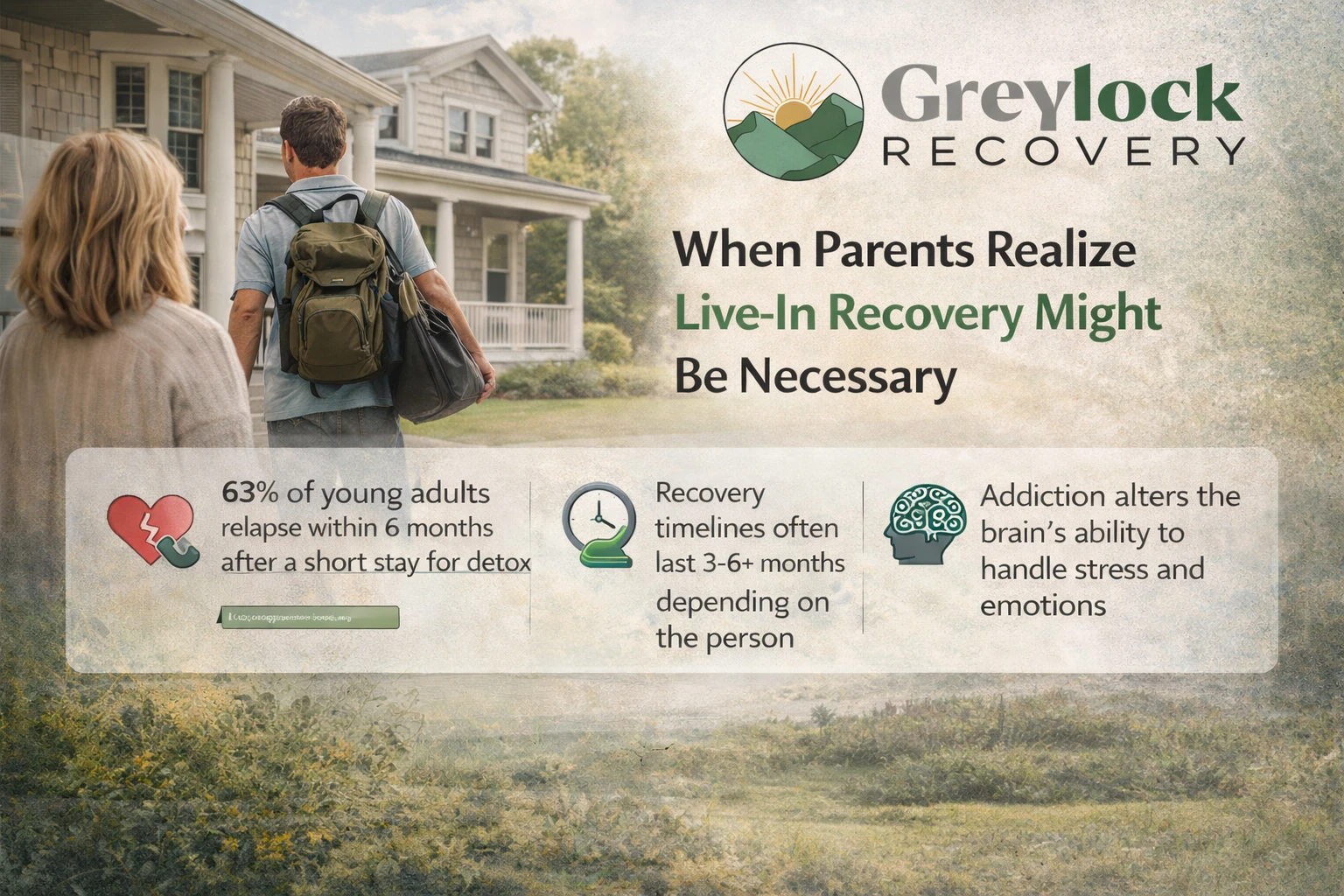
But addiction changes how the brain processes stress, reward, and emotional relief.
Over time, substances become the brain’s fastest escape route when life feels overwhelming.
For young adults, this pattern can become even stronger because the brain is still developing. The areas responsible for impulse control, emotional regulation, and long-term planning are still maturing well into the mid-twenties.
That means addiction often grabs hold during a stage of life when identity and coping skills are still forming.
What looks like irresponsibility may actually be a brain caught in a powerful feedback loop.
And breaking that loop usually requires more than willpower.
Why Environment Matters More Than Most Families Expect
Parents sometimes believe their child needs motivation first before entering a structured recovery environment.
But motivation often grows after the environment changes.
When someone steps into a setting built around recovery, several important things happen at once:
The daily chaos slows down.
Access to substances becomes harder.
Support becomes consistent rather than occasional.
Most importantly, the brain finally gets a break from the constant push and pull of addiction.
One young man once described his experience this way:
“It was the first place where my brain stopped screaming at me.”
That quiet space allows people to begin learning new coping tools, rebuilding emotional awareness, and rediscovering parts of themselves that addiction had buried.
The Part of Recovery Families Don’t Expect
Parents usually focus entirely on their child when considering recovery support.
But something surprising often happens along the way.
Families begin to heal too.
For months or years, addiction often pulls parents into exhausting roles:
Investigator.
Crisis manager.
Financial safety net.
Emotional shock absorber.
When a young adult enters a recovery-focused environment, that constant emergency state can finally pause.
Parents often rediscover something they lost along the way—peace.
They start sleeping through the night again. Thinking clearly again. Reconnecting with the parts of their own lives that were overshadowed by worry.
This doesn’t mean parents stop caring.
It means they can start supporting their child from a healthier place.
The Courage It Takes to Change the Family Pattern
Sometimes the bravest thing a parent can do is step out of the familiar cycle.
Addiction often creates a family pattern that looks like this:
The child struggles.
The parent rescues.
Temporary calm follows.
Then the pattern repeats.
Breaking that cycle can feel terrifying.
But many families discover that real change begins when the environment changes.
When expectations become clearer.
When responsibility returns to the person struggling.
When support becomes structured rather than reactive.
Parents who make this shift are not abandoning their child.
They are creating the conditions where recovery has a real chance to grow.
Stories That Help Parents Hold On to Hope
Every parent entering this process carries a quiet fear.
What if this doesn’t work?
Recovery is rarely instant. But many families do see meaningful change.
One father shared that he nearly canceled the plan for his son to enter care the night before it happened.
“I felt like the worst parent in the world. I kept thinking he’d hate me forever.”
Six months later, his son told him something unexpected.
“You were the only one who stopped pretending everything was okay.”
Another mother described the moment she realized her daughter was beginning to change.
“For the first time in years, she was talking about the future again.”
These moments don’t erase the hard parts of recovery.
But they remind families that change—real, lasting change—is possible.
When Parents Feel Completely Out of Options
Many parents reach this stage feeling emotionally exhausted.
You’ve had the conversations.
You’ve offered help.
You’ve tried patience, boundaries, and encouragement.
And still, the drinking or substance use continues.
That kind of helplessness can feel unbearable.
But families are not powerless.
Sometimes the next step is simply learning more about the kinds of support that exist. Many parents begin exploring addiction recovery programs and residential addiction treatment when they reach this point because these environments provide stability, structure, and professional guidance during a very difficult season.
Recovery doesn’t begin with certainty.
It begins with a willingness to try something different.
Frequently Asked Questions
How do parents know when outside help might be necessary?
Many families consider deeper support when substance use continues despite repeated conversations, consequences, or attempts at change. If drinking or drug use is affecting school, work, relationships, or emotional stability, additional support may be worth exploring.
Will my child feel abandoned if they enter a live-in recovery environment?
This fear is very common. But many young adults later describe the experience differently. Instead of abandonment, they often recognize that their family cared enough to take the situation seriously.
What if my child refuses help?
Resistance is common. Addiction often creates fear around change, especially when substances have become a coping mechanism. Families sometimes benefit from guidance on how to have these conversations and set boundaries that encourage healthier choices.
Can recovery really happen for someone in their early twenties?
Yes. Many young adults successfully rebuild their lives after receiving the right support. Early intervention often improves long-term outcomes because habits and coping strategies are still developing during this stage of life.
How long does recovery usually take?
Recovery timelines vary from person to person. Some individuals begin stabilizing quickly, while others need more time to rebuild emotional resilience and healthy routines. The goal is lasting change rather than quick fixes.
How can parents take care of themselves during this process?
Parents often neglect their own well-being while trying to help their child. Support groups, counseling, and conversations with experienced professionals can help families navigate the emotional stress that addiction creates.
If your family is struggling and you’re unsure what the next step should be, compassionate guidance is available. Call (413) 8486013 or explore our live-in addiction support services to learn more about our addiction recovery programs, residential addiction treatment.