

You did it.
You stopped using. You survived the worst of it. You rebuilt relationships. Maybe you repaired your body. Maybe you repaired your name.
And now, years later, you wake up some mornings and think:
Why do I still feel off?
Not craving. Not spiraling.
Just… stuck.
If that thought has crossed your mind, you’re not ungrateful. You’re not broken. And you’re definitely not alone.
Early on, many of us relied on serious structure — therapy, accountability, community, sometimes formal opioid addiction treatment to stabilize our lives when everything felt like it was burning down.
But long-term sobriety asks different questions than early recovery ever did.
And no one really prepares you for that shift.
The Middle Years No One Warned You About
The first year is loud. It’s raw. It’s intense.
Five years in? Ten?
It’s quieter.
You’re functioning. You show up. You pay bills. You might even mentor others. From the outside, it looks solid.
But internally, it can feel flat.
You might notice:
- You’re less excited about life than you expected
- Meetings feel repetitive
- You don’t relate to newcomers anymore — but you also don’t fully relate to “normal” life
- You feel restless, but not in a crisis way
This is the phase where people whisper, “Is this all there is?”
That question isn’t about relapse.
It’s about meaning.
Sobriety removes chaos. It doesn’t automatically create purpose.
When Survival Ends, Identity Begins
Early recovery is survival mode. Stay clean. Stay alive. Stay accountable.
Years later, the real work shifts to identity.
Who are you without the chaos?
Without the story of being the “one who struggled”?
Without the intensity?
Addiction gave many of us a strange kind of identity. It shaped how we related to people. It dictated our routines. It gave us drama, even when it hurt.
Take that away, and you’re left with space.
And space can feel terrifying.
Some of that “stuck” feeling isn’t boredom. It’s growing pains.
You’re not missing the substance.
You might be missing the version of yourself that felt extreme, emotional, or alive.
But intensity and aliveness aren’t the same thing.
The Emotional Work You Didn’t Have Capacity for Before
Here’s something that doesn’t get talked about enough.
When you first got sober, you didn’t have the emotional bandwidth to unpack everything. You were focused on staying stable.
Years later, stability is there.
And suddenly:
- Old trauma surfaces
- Grief you pushed down starts tapping on your shoulder
- Depression creeps in quietly
- Anxiety shows up in subtler ways
It can feel unfair.
I did the work. Why is there more?
Because early sobriety is about stopping harm.
Long-term recovery is about healing deeply.
Some alumni reach a point where they realize they need support again — not because they’re failing, but because they’re ready for a deeper layer.
That might look like therapy focused on trauma.
It might look like mental health support that wasn’t accessible early on.
For some, it may even mean revisiting structured care models similar to what helped them stabilize — including comprehensive Opioid Addiction Treatment that addresses both the history of use and the emotional architecture underneath it.
That’s not going backward.
That’s leveling up.
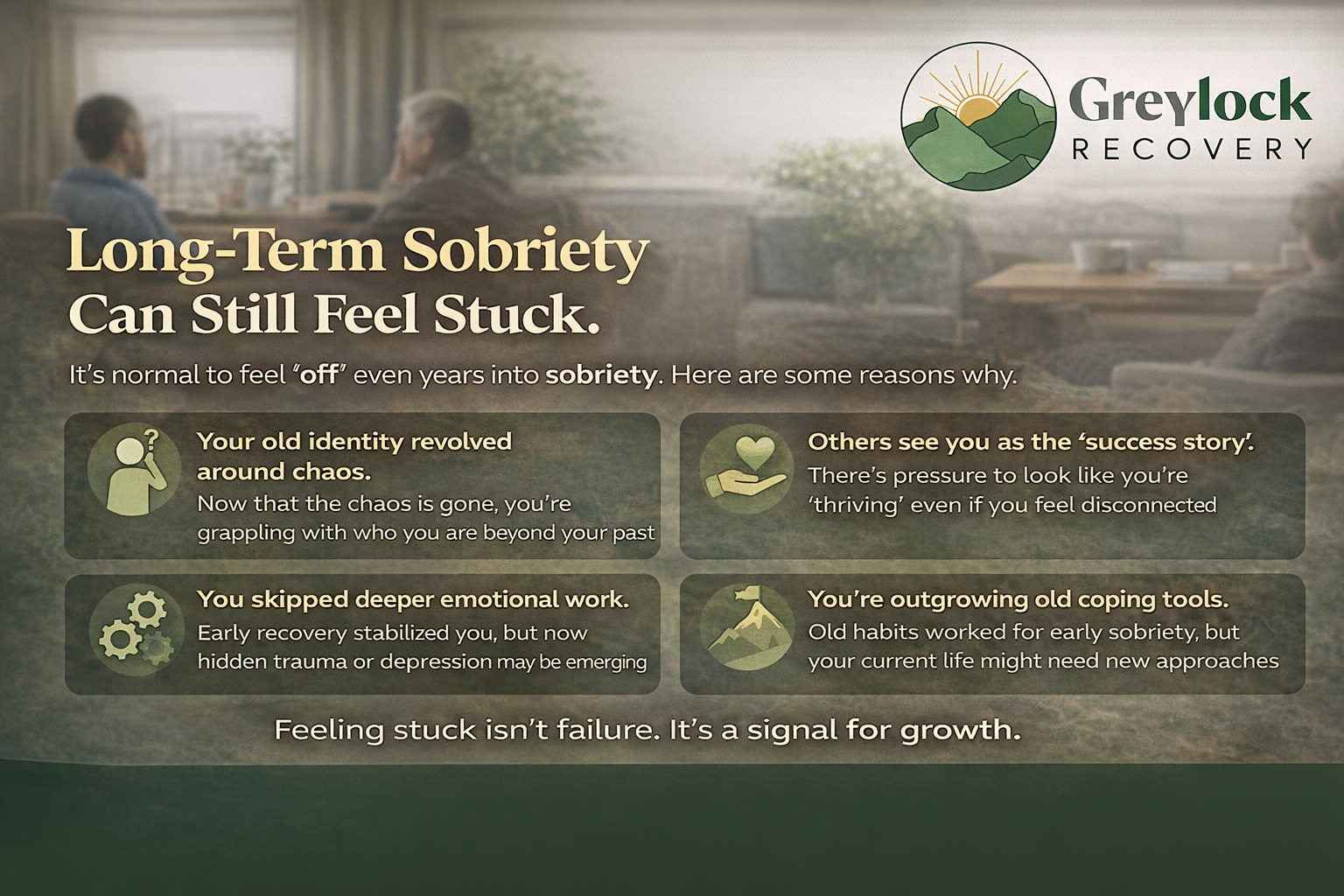
The Pressure to Be the “Success Story”
This one is heavy.
When you’ve been sober for years, people start looking at you like proof that recovery works.
You become:
- The example
- The mentor
- The stable one
And that can make it harder to admit you’re struggling internally.
There’s a quiet pressure to stay inspiring.
But inspiration is exhausting when it’s your identity.
You’re allowed to be human again. Not a symbol. Not a spokesperson. Just a person.
If you feel disconnected, it might be because you’ve been performing “doing well” for too long.
Gratitude Isn’t the Same as Fulfillment
You can be grateful and still feel empty.
You can appreciate sobriety and still want more.
Telling yourself to “just be thankful” when you feel flat is like putting a bandage over a deeper wound.
Recovery isn’t meant to be emotional beige.
You’re allowed to want:
- Joy
- Passion
- Creativity
- Deeper relationships
- Spiritual connection
If your life feels muted, that’s information — not betrayal.
When Stuck Is Actually a Signal
Here’s something I had to learn the hard way:
Feeling stuck is often a sign that something is trying to evolve.
Maybe:
- Your coping strategies need updating
- Your community no longer fits who you are now
- You’ve outgrown certain narratives
- You’re craving growth instead of maintenance
Long-term sobriety isn’t about holding still. It’s about continued expansion.
And expansion can feel uncomfortable before it feels empowering.
Sometimes the bravest thing a long-term alum can say is, “I think I need more support.”
Greylock Recovery understands that recovery doesn’t freeze at year one. Growth continues. Healing deepens. Needs change.
And reaching back out isn’t regression — it’s wisdom.
FAQ: Long-Term Sobriety and Feeling Stuck
Is it normal to feel depressed years into sobriety?
Yes. Emotional waves don’t disappear just because substances do.
In early recovery, adrenaline and urgency can mask deeper mental health patterns. Years later, when life stabilizes, underlying depression or unresolved trauma may become more visible. That doesn’t mean sobriety failed. It means you’re ready to look at deeper layers.
Does feeling stuck mean I’m at risk of relapse?
Not automatically.
Feeling stuck is a warning sign to pay attention — but it’s not the same as craving. It’s often a sign of emotional stagnation, burnout, or unmet needs. The key is not ignoring it.
Disconnection grows in silence. Curiosity shrinks it.
Why do I miss the intensity of my old life?
Because intensity can feel like aliveness.
Addiction floods the brain with extremes — highs and lows. Long-term sobriety is steadier. For some people, that steadiness feels dull at first.
The goal isn’t to recreate chaos. It’s to build meaningful intensity — creativity, passion, connection — without self-destruction.
Should I go back to treatment if I’m not using?
“Back” might not be the right word.
Some alumni choose to re-engage in therapeutic work years later — not for detox or crisis stabilization, but for deeper growth. If you find yourself emotionally flat, spiritually disconnected, or weighed down by unresolved trauma, structured support can provide focus and clarity.
This isn’t about starting over. It’s about continuing forward.
What if I feel guilty for not being happier?
Guilt thrives in comparison.
You might think:
- “Other people are still struggling.”
- “I should be proud.”
- “At least I’m not using.”
All true — and still incomplete.
You’re allowed to experience complex emotions. Long-term recovery isn’t a gratitude competition. It’s an ongoing relationship with yourself.
You’re Not Broken — You’re Evolving
Here’s the truth no one says loudly:
Long-term sobriety isn’t the finish line. It’s the starting point for a deeper life.
If you feel stuck, it might mean:
- You’re outgrowing old versions of yourself
- You’re ready to process what you couldn’t before
- You want more than survival
That’s not weakness. That’s maturity.
Greylock Recovery has worked with individuals at every stage — from early stabilization to long-term alumni seeking renewed clarity and purpose. Recovery isn’t static, and neither are you.
If you’re feeling disconnected, it may be time to revisit the kind of support that once helped you build your foundation — not because you’re falling apart, but because you’re ready to grow again.
Call 413-848-6013 or visit our Opioid Addiction Treatment services in to learn more about what the next chapter of recovery can look like.
You didn’t fight this hard just to live halfway.
There’s still depth ahead of you.