
You might still remember the day they finished treatment.
The relief. The cautious hope. The feeling that maybe—finally—you could exhale.
And now here you are again. Watching old behaviors resurface. Seeing signs you prayed you’d never have to recognize twice. Asking yourself the same questions, only heavier this time.
As a clinician, I want you to hear this first: your child’s return to use is not proof that treatment failed—and it is not proof that you did.
If you’re wondering whether a medical detox program could still help after your child has already been through treatment, the answer is yes. Not because detox “fixes everything,” but because it restores safety, clarity, and choice when things feel chaotic again.
At Greylock Recovery, we often support families at this exact crossroads. And while no two situations are the same, the questions parents ask tend to echo one another—raw, honest, and deeply human.
Let’s walk through them together.
Why would someone need a medical detox program again after treatment?
From a medical standpoint, relapse changes the body quickly.
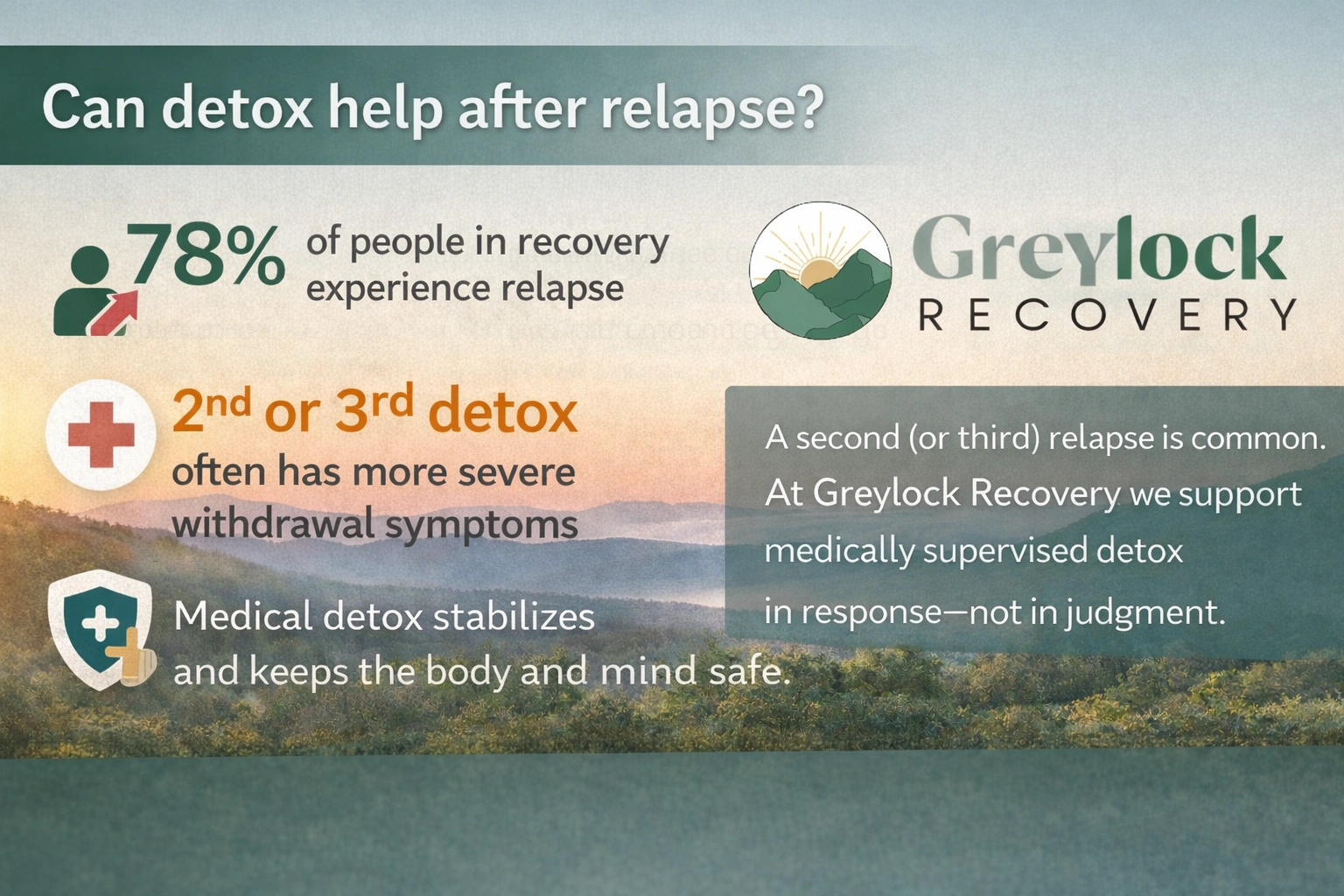
Tolerance drops during periods of abstinence. When use resumes, the brain and nervous system are often less equipped to handle it. That’s why withdrawal symptoms can actually be more dangerous the second or third time, even if your child detoxed safely before.
A medical detox program provides monitored, evidence-based care during this vulnerable window. It stabilizes vital signs, manages withdrawal symptoms, and reduces medical risk—especially when substances are used inconsistently or in higher amounts than before.
But there’s also an emotional reason detox matters again.
Relapse often comes with shame. That shame can keep a young adult stuck—using just enough to avoid withdrawal, but not enough to feel okay. Detox interrupts that cycle. It creates a pause. A moment where the nervous system can settle and the brain can think again.
This isn’t repetition for repetition’s sake. It’s responding to what’s happening now.
Does going back to detox mean the first treatment didn’t work?
This is one of the most painful fears parents carry.
You may be wondering if all the effort, money, and hope poured into the first round of treatment was wasted. Clinically speaking, that’s not how recovery works.
Treatment is not a single event—it’s a process. Skills learned in treatment don’t disappear because someone relapses. Insight doesn’t vanish. What often happens is that stress, pressure, or emotional pain outpaces coping capacity.
Think of treatment like learning to swim.
Someone can take lessons, understand the technique, and still struggle if they’re thrown into rough water before they’re ready. That doesn’t mean the lessons were useless. It means conditions changed.
A medical detox program isn’t an admission of failure. It’s a recognition that your child needs stabilization before they can use what they’ve learned—or learn something new.
What if my child says, “I’m not doing rehab again”?
That sentence alone can stop a parent’s heart.
It can feel like a door slamming shut. But clinically, resistance doesn’t always mean refusal—it often means fear.
Many young adults resist returning to treatment because they remember what was hard:
-
-
-
- Loss of independence
- Emotional vulnerability
- Shame about “ending up back here”
-
-
A medical detox program is different from long-term treatment. Detox focuses on physical safety and short-term stabilization. It doesn’t require your child to make promises about the future.
Sometimes detox is the only step a person is willing to take—and that’s often enough to change the conversation.
Once withdrawal eases, sleep improves, and anxiety quiets, many people become more open to support. Not because they were forced—but because their brain is no longer in survival mode.
From a clinician’s perspective, detox restores choice, not compliance.
Can detox help even if they don’t commit to more care?
Yes—and this is important.
Parents are often told, implicitly or explicitly, that detox “doesn’t count” unless it leads directly into another level of care. That’s not clinically accurate, and it puts unnecessary pressure on families.
Medical detox serves a specific purpose:
-
-
-
- It reduces medical risk
- It stabilizes the nervous system
- It creates a window for reflection
-
-
For some young adults, that window is enough to say yes to further treatment. For others, it’s a chance to regain footing and avoid deeper harm.
Neither outcome is meaningless.
At Greylock Recovery, we view detox as care—not leverage. We don’t use it as a bargaining chip. We use it as a foundation.
What does a medical detox program actually look like day to day?
Parents often imagine detox as cold, clinical, or chaotic—especially if their only reference point is a hospital emergency room.
Our detox program in Williamstown is intentionally different.
Here’s what your child can expect:
-
-
-
- 24/7 medical monitoring by licensed professionals
- Medications when appropriate to reduce discomfort and risk
- A calm, structured environment designed to lower stimulation
- Regular check-ins that address both physical and emotional needs
- Clear communication about what’s happening and why
-
-
There is no punishment. No shaming language. No pressure to “perform recovery.”
From a clinical standpoint, healing starts with safety—and safety is something we take seriously.
You can learn more about how this works through our medical detox program at Greylock Recovery, which is designed to support both individuals and families during these moments.
Am I enabling them by helping them go to detox again?
This question carries so much weight.
Parents often confuse support with permission, especially when they’ve already said yes once before. But medically and ethically, detox is healthcare—not rescue.
Enabling removes consequences. Detox addresses danger.
There is a difference.
When a young adult is using again, the risk isn’t abstract. Withdrawal, overdose, and emotional instability are real clinical concerns. Offering a medical detox program doesn’t excuse behavior—it protects life.
You are not responsible for making recovery happen.
But offering safety when someone is vulnerable is not weakness. It’s appropriate care.
What makes a second (or third) detox different clinically?
From a clinician’s perspective, repeat detox admissions often provide more information, not less.
We learn:
-
-
-
- What substances are involved now
- How withdrawal presents for this individual
- What stressors preceded relapse
- What support structures helped—or didn’t—last time
-
-
This allows care to be more precise. More responsive. Less generic.
At Greylock Recovery, we do not treat returning clients as problems to solve. We treat them as people whose needs have evolved.
And we recognize that parents, too, need clarity—not blame.
How does Greylock support parents during this process?
As clinicians, we don’t just treat individuals—we work with systems. Families are part of that system, whether they want to be or not.
We support parents by:
-
-
-
- Offering clear, honest communication
- Avoiding alarmist language
- Helping you understand what is—and isn’t—within your control
- Normalizing the emotional toll this takes
-
-
You may feel numb one moment and panicked the next. You may feel anger alongside love. None of that disqualifies you from being a good parent.
It means you’re human in an impossible situation.
What if I’m exhausted and don’t know how many times I can do this?
This may be the hardest truth to sit with.
From a clinical lens, relapse is common—but that doesn’t make it easy. Each recurrence compounds grief and fear. Parents often feel like they’re living in a constant state of vigilance.
It’s okay to acknowledge that this is wearing you down.
Seeking a medical detox program isn’t about committing to endless cycles. It’s about addressing what’s happening now, with the information you have today.
You are allowed to hope again—even cautiously.
And you are allowed to rest, even while caring.
If you’re located in western Massachusetts, Greylock Recovery provides medically supervised detox services in Williamstown for individuals and families navigating relapse with care and professionalism.
Call (413) 848-6013 to learn more about our medical detox program services in Williamstown, Massachusetts.
You don’t have to decide everything today. You just have to take the next safe step—and we’re here to help you do that.