
Sometimes the most loving thing a parent can do is to try again.
If your young adult child has relapsed—or never fully stopped using—you might be wondering what went wrong. You helped them get into treatment. You did everything the books, therapists, and support groups said to do. But here you are again—worried, hurt, and not sure where to turn.
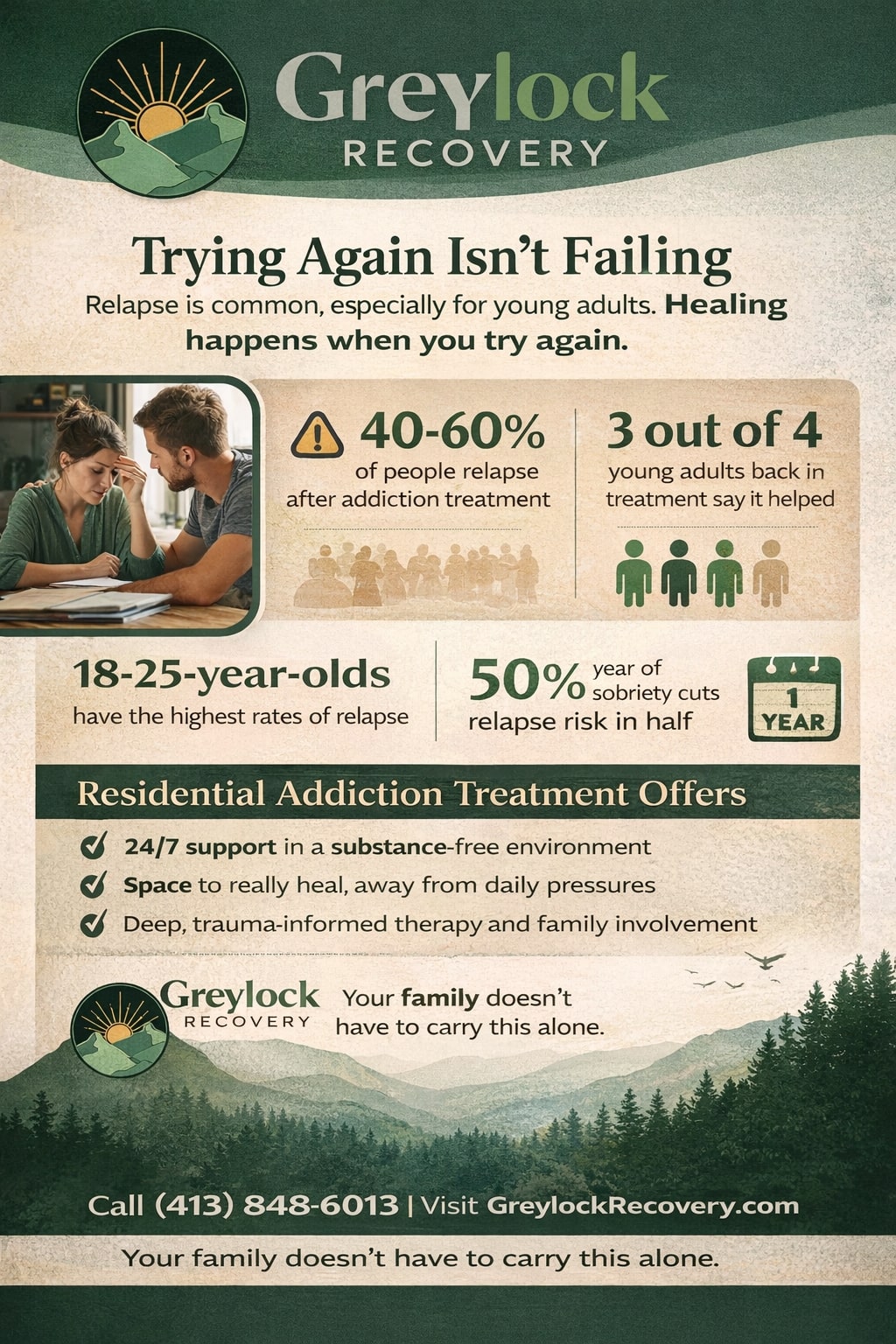
At Greylock Recovery’s residential addiction treatment program in Williamstown, Massachusetts, we work with families just like yours every day. We want to say this clearly: relapse doesn’t mean failure. It means something still needs support. And residential treatment can help provide it—again, or for the first time, in a deeper way.
Relapse Isn’t the End. It’s a New Signal.
When a child you love returns to using, it can feel like the floor drops out from under you. The hurt, confusion, and guilt can be overwhelming.
But relapse is not a moral failure. It’s a sign that something didn’t hold. Maybe the treatment model wasn’t the right fit. Maybe they weren’t ready. Maybe life hit them hard the second they left the safety of structured support.
It’s not that they didn’t learn anything the first time—it’s that real life is hard. And without the right scaffolding, even the best intentions can crumble.
Relapse gives us information. It’s data about what didn’t work—and more importantly, where we can adjust.
What Makes Residential Addiction Treatment Different?
Residential care is more than a place to stay. It’s a place to stabilize, reflect, and build back a stronger foundation.
Here’s what sets it apart:
- 24/7 support means they’re never alone in a moment of craving or panic.
- Therapeutic immersion allows them to engage deeply in group, individual, and family therapy.
- Structure and rhythm restore routine, which is often lost in relapse.
- Distance from triggers gives them space to focus on healing without distractions or pressures.
- Time for reflection helps them understand why they relapsed—and what needs to change.
At Greylock, we’ve seen young adults return to treatment with shame in their eyes—only to leave weeks later with clarity, confidence, and a plan they believe in.
Why Trying Again Matters—Especially for Young Adults
The adolescent and young adult brain is still developing well into the mid-20s. That means decision-making, impulse control, and emotional regulation are still under construction.
This developmental reality makes young people both more vulnerable to relapse and more capable of recovery when supported well.
Returning to residential addiction treatment can feel like “starting over.” But for many young adults, it’s not a redo—it’s a restart from a wiser place. They know what didn’t work last time. They can engage more intentionally this time. And with the right support, they can build something more sustainable.
Parents Carry a Lot—Let Treatment Carry Some of It
If you’re reading this, chances are your nervous system has been in overdrive for months, maybe years. You’re checking phones, tracking moods, covering shifts, rearranging everything to keep them safe.
That level of vigilance takes a toll.
Residential treatment isn’t just about helping your child. It’s also about giving you space to step back, breathe, and let someone else carry the therapeutic load for a while.
We stay in touch with families. We involve you in treatment, but not in a way that exhausts you. And we work with you, not against you, to make sure when your child returns home, they’re not coming back to the exact same stress patterns that pushed them toward use.
When Treatment “Didn’t Work” the First Time
We often hear this: “We already tried treatment. It didn’t help.”
That’s valid—and painful.
But it’s also important to ask: What kind of treatment was it? Was it the right level of care? Were mental health issues fully addressed? Were there aftercare supports in place? Were they ready—or just going because they felt pressured?
Sometimes treatment doesn’t work because the timing isn’t right. Sometimes it’s because the environment didn’t match the person’s needs. And sometimes, the person wasn’t emotionally ready to engage.
None of that means it was a waste. It means now, we can try something different—more personalized, more structured, or more supportive.
Our Approach to Second (and Third) Chances
At Greylock, we don’t believe in “one and done.” Recovery is often nonlinear—and we plan for that.
When a young adult comes back into care after a relapse, we don’t start over. We build on what they learned before, even if it feels buried.
We ask what’s changed. We explore what’s hurting. We address the guilt, the fear, and the part of them that says, “Maybe I can’t do this.”
And then—we help them try again. From where they are. With what they have.
Because what they have is still enough.
What Parents Can Expect During Residential Treatment
Here’s what family involvement looks like at Greylock:
- Weekly family updates to keep you informed (without overwhelming you)
- Family therapy sessions to rebuild communication and trust
- Clear discharge planning so you’re not left guessing what comes next
- Guidance for your own healing, including referrals to parent support groups and tools for healthy boundaries
We know how hard it is to send your child to treatment—again. But we also know how healing it can be when the pressure to fix it all yourself finally lifts.
How to Talk to Your Child About Returning to Treatment
If you’re thinking about recommending treatment again, tread gently. Shame is often loud after relapse.
Here are a few grounding phrases:
- “You don’t have to be fixed to be worth helping.”
- “This doesn’t mean you failed. It means something still hurts.”
- “I love you. And I can’t carry this alone anymore.”
You don’t need to convince them. Just open the door—and let us help from there.
FAQs About Residential Addiction Treatment After Relapse
Is it normal for young adults to relapse after treatment?
Yes. Especially for young people, relapse is common. It doesn’t mean they didn’t learn anything—it means something about their recovery environment or coping strategies needs support.
How is this different from the last treatment program they tried?
Every treatment center is different. At Greylock, our residential addiction treatment in Williamstown offers trauma-informed care, deep family involvement, and a peaceful setting designed to support young adult development.
What if my child refuses to go back?
We can help guide that conversation. Sometimes, a clinician-led family session or gentle third-party encouragement can make all the difference.
How long is residential treatment?
Lengths of stay vary. Some clients benefit from short stabilization (30 days), while others engage in longer-term care. We assess and adjust based on clinical need—not a one-size-fits-all timeline.
Will I get updates during their stay?
Yes. Our team maintains regular communication with families, and we include you in care planning so you’re never left in the dark.
When to Consider Returning to Residential Treatment
Here are some signs that it may be time to return to care:
- Your child is actively using and struggling to stop.
- Their mental health has worsened significantly.
- You feel unsafe or constantly on edge in your own home.
- Outpatient treatment hasn’t been enough.
- You’re watching them withdraw again—socially, emotionally, physically.
Even if they “don’t look that bad,” trust your gut. The earlier we intervene, the more support we can offer before things spiral further.
Healing Happens Here—in the Berkshires
Located in the calm beauty of Williamstown, Massachusetts, our residential addiction treatment program is rooted in compassion, clinical excellence, and a deep belief that healing is always possible—even after relapse.
Whether your child is returning to treatment or starting for the first time, we meet them where they are—with clarity, not judgment.
You don’t have to carry this alone anymore. And your child doesn’t have to keep trying to fix themselves without support.
Call (413) 848-6013 or visit Greylock Recovery’s Residential Addiction Treatment page to learn how we can help your family restart recovery—with dignity, care, and the belief that trying again is never a failure.